MetLife Stadium looked less like a football venue and more like a high-budget reality TV set on July 19, 2026.
Spain walked away with their second World Cup trophy after Ferran Torres netted a dramatic extra-time winner in the 106th minute against Argentina. Yet, half the world wasn't just talking about football when the final whistle blew. They were talking about Donald Trump getting loudly booed by 82,000 fans as he lingered on the podium during Spain's medal presentation. They were talking about Justin Bieber and Shakira sharing a staged halftime pop concert while Lionel Scaloni tried to deliver tactical instructions in a cramped locker room.
Soccer changed forever on New Jersey turf. FIFA officially traded 96 years of traditional, austere tournament culture for American entertainment excess. If you spent the last month watching the 2026 World Cup, you realized early on that this tournament wasn't built purely for traditional supporters. It was designed for broadcast rights holders, celebrity skyboxes, and multi-platform pop culture feeds.
When Football Met Super Bowl Halftime Culture
For nearly a century, the FIFA World Cup final observed an unshakeable ritual during the interval. Fifteen minutes off the pitch. Quick tactical tweaks. Pundits arguing in television studios. Players returning refreshed for the second half.
That rhythm died at MetLife Stadium.
FIFA President Gianni Infantino partnered with Global Citizen CEO Hugh Evans and Coldplay lead singer Chris Martin to curate the first official halftime show in World Cup final history. For 20 minutes, the turf was covered in stage rigging, light rigs, and backing dancers. Shakira brought out her classic stadium anthems, Justin Bieber performed to an audience of billions, while Madonna and BTS joined to turn a tight, high-stakes football match into a global concert festival.
Purists hated it. Broadcast networks loved it.
I've sat through dozens of major tournament finals across Europe and South America, and the mood inside MetLife Stadium was unlike anything before. The hardcore Spanish and Argentine fan blocks behind each goal spent halftime looking utterly bewildered. They didn't travel thousands of miles to watch pop choreography. They wanted to chant, sweat, and worry about whether their back four could hold off counter-attacks. Meanwhile, corporate guests in the luxury suites were thrilled, filming TikTok clips while Beyoncé, Jay-Z, and Tom Cruise watched from the VIP tiers.
This wasn't an accident. FIFA tested this exact format at the 2025 Club World Cup final using J Balvin and Doja Cat as a trial run. The commercial incentive is simply too massive for governing bodies to ignore. When Super Bowl broadcasts generate hundreds of millions of dollars in mid-game ad inventory, FIFA wants that same revenue model for global soccer.
The Political Side Show That Stole the Trophy Ceremony
The halftime musical extravaganza was only half the spectacle. The post-match trophy presentation provided a level of political awkwardness rarely seen on a sporting stage.
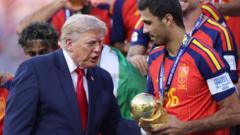
US President Donald Trump walked onto the pitch alongside Infantino to hand over the iconic golden trophy. The moment his image hit the giant stadium screens, a thunderous wave of boos echoed through the stands. It was deafening. Thousands of international supporters voiced their opinions live on global television, forcing host broadcasters to quickly adjust audio feeds.
What made the moment truly bizarre was what happened next. Instead of handing the trophy to Spanish captain Álvaro Morata and stepping back into the background, Trump stayed right in the center of the stage. He hovered beside 19-year-old phenom Lamine Yamal and the rest of Spain's squad as golden confetti rained down.
Broadcasters were visibly baffled. On-air commentators tried to figure out why a politician was refusing to yield the spotlight to the actual champions. It felt symbolic of the entire tournament. 2026 wasn't just hosted by North America; it was swallowed whole by American political and pop-cultural theater.
Ferran Torres and the Tactical Battle Behind the Circus
Lost underneath the pop stars and political awkwardness was a brutally intense, high-level football match. Spain and Argentina put on a masterclass in tactical tension.
For 90 minutes, both sides traded blows without finding a breakthrough. Spain dominated possession through their midfield rotators, while Argentina relied on physical defending and sharp counter-attacking transitions. Lionel Scaloni's side resorted to aggressive foul tactics to disrupt Spain's rhythm, resulting in a flurry of yellow cards throughout the second half.
The match swung decisively in stoppage time before the extra period. Argentine midfielder Enzo Fernández picked up a second yellow card in the 93rd minute for an aggressive late challenge, leaving the defending champions down to 10 men.
Playing an extra 30 minutes with ten men against Spain's ball-retention machine is a nightmare scenario. The relentless pressure paid off in the 106th minute.
- The Build-up: Lamine Yamal dragged two Argentine defenders toward the right touchline.
- The Pass: Yamal slipped a sharp, disguised ball through the channel.
- The Finish: Ferran Torres timed his run perfectly, hitting a low, decisive shot past the keeper into the bottom corner.
Argentina threw everything forward in the final minutes, but Spain held firm to claim their second World Cup title, adding to their 2010 triumph. Lamine Yamal ended the night as the tournament's standout player, completing an extraordinary rise to the summit of world football at just 19 years old.
The Commercial Blueprint for Future World Cups
If you think the 2026 tournament was a one-off experiment, think again. FIFA has established a permanent blueprint for how major international tournaments will operate going forward.
The expansion to 48 teams created a massive 104-game slate across three countries. It stretched squad depth, tested traveling fans' wallets, and generated billions in ticket sales and corporate sponsorships. Adding mid-game entertainment shows is the logical next step in monetizing broadcast time slots.
What Modern Spectacle Means for Traditional Supporters
- Longer Match Windows: Halftime shows extend the traditional 15-minute break into 25-to-30-minute spectacles, breaking the physical flow for players and extending total broadcast times.
- Skyrocketing Ticket Costs: The inclusion of top-tier musical acts and Hollywood packaging drives secondary ticket market prices into four figures, priced out for traditional fan bases.
- Neutralized Stadium Atmospheres: Corporate ticketholders and casual fans replace die-hard supporters in prime lower-bowl seating, changing the auditory environment of big games.
Opposing views suggest this evolution is necessary. Proponents argue that bringing mainstream entertainment into soccer attracts younger audiences who don't watch full 90-minute matches anymore. They point out that commercial growth Funds grassroots development in smaller soccer federations across Africa, Asia, and North America.
There's truth on both sides. Money fuels the global game, but hyper-commercialization strips away the tribal raw energy that made the World Cup special in the first place.
How Fans Can Prepare for the New Era of Major Tournaments
The transformation of the World Cup into an entertainment spectacle is complete. With the 2030 tournament spanning South America, Africa, and Europe before heading to Saudi Arabia in 2034, fans need to adapt their approach to attending and watching these events.
Start planning your tournament travel early. Ticket allocation systems heavily favor corporate packages and local host market draws, meaning official fan club allocations will continue to shrink. Secure memberships with your national federation at least two years prior to major tournaments to qualify for direct supporters' section ballots.
Expect longer stadium entry procedures. The inclusion of high-profile political figures and global pop stars requires NFL-level security perimeters. Show up to venues at least three hours before kickoff if you want to avoid missing the match start due to security bottlenecks.
Understand that the 90-minute game you grew up with is now part of an all-day festival. Whether you love the glitter or hate the distraction, soccer has entered its Hollywood era, and there's no turning back.