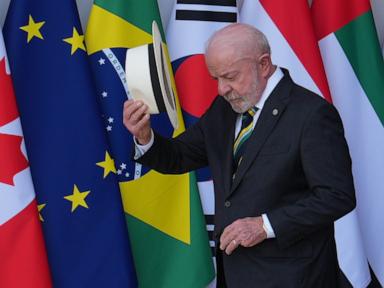
Brazilian politics loves a high-stakes brawl, but the latest explosion out of Brasília is different. It isn't just about domestic policy or campaign posturing anymore. It's about how a foreign superpower's trade agenda is being dragged directly into the upcoming October vote. The recent news that Brazil's top presidential candidates Lula and Flávio Bolsonaro clash over US tariff proposal reveals a deeply fractured political climate where trade policy doubles as raw political warfare.
At the center of this firestorm is a massive 25% tariff proposal from Washington targeting key Brazilian exports. Instead of putting up a united national front against a major economic threat, Brazil’s leading political heavyweights are tearing each other apart. Current leftist President Luiz Inácio Lula da Silva is furious, while his right-wing challenger, Senator Flávio Bolsonaro, is playing a dangerous game of diplomatic damage control.
This entire situation escalated drastically after a formal document landed on the desk of the United States Trade Representative. The fallout was immediate, ugly, and exposed the fragile state of Latin America’s largest economy as it heads toward a definitive election.
Understanding why Brazil's top presidential candidates Lula and Flávio Bolsonaro clash over US tariff proposal right now
To see why this conflict turned toxic so quickly, you have to look at the timeline. On July 1, 2026, Flávio Bolsonaro submitted an official request to the US trade office. His suggestion sounded practical on the surface but carried massive political implications. He asked the American administration to postpone implementing the 25% tariffs until after Brazil’s October presidential election.
Flávio argued that pushing the decision back would prevent the tariff from looking like an explicit attempt by Washington to swing the election results. He claimed he wanted to protect local businesses from an immediate shock while keeping foreign influence out of the democratic process.
Lula didn't buy that explanation for a second. The president went on a scorched-earth campaign across social media and official public appearances. He weaponized the situation instantly, branding the economic threat as TariFlávio to tie the financial pain directly to his opponent. Lula's team flooded networks with messages framing the young Bolsonaro as a clear danger to the country's financial independence.
The rhetoric came to a boiling point during a speech in Rio Grande do Norte. Lula openly labeled Flávio a coward and an outright traitor to the nation. He even dragged historical ghosts into the argument, comparing the senator to Joaquim Silvério dos Reis, the infamous historical figure who betrayed the Brazilian independence martyr Tiradentes. Lula argued that going to a foreign power to manage tariff timing is a betrayal of the highest order, suggesting that Flávio secretly wants the tariffs to cripple the economy just to make the current administration look bad.
The Washington connection and the July 15 deadline
The actual power to pull the trigger on these trade penalties rests entirely with US President Donald Trump. His administration set a hard deadline of July 15, 2026, to decide whether to codify the 25% import taxes. This gives businesses and politicians a tiny window to navigate an absolute minefield.
Flávio Bolsonaro and his father, former president Jair Bolsonaro, have spent years building close, friendly ties with conservative leaders in the United States. Flávio even traveled to Washington for high-level meetings, trying to position himself as the only leader capable of keeping the peace with America. He asserts that his intervention was aimed at convincing US trade officials to spare Brazilian industries entirely.
Lula’s administration views these American excursions with deep suspicion. The left claims that the Bolsonaro family is actively lobbying foreign allies to punish Brazil's current government through punitive economic measures. This dynamic turns an already tense international trade dispute into a domestic proxy war. The White House now holds an accidental veto over the economic stability of a critical global trade partner, right at the peak of a tight election cycle.
Real economic stakes behind the political theater
Away from the shouting matches and historical comparisons, the numbers are genuinely terrifying for Brazilian industry. A broad 25% tariff would hit the nation’s core economic engines hard.
Brazil relies heavily on exporting raw materials and semi-manufactured goods to North American markets. The industrial manufacturing hubs in the southeast, particularly steel and machinery producers, operate on incredibly thin margins. Adding a massive tariff would make Brazilian steel uncompetitive overnight compared to local American producers or alternative exporters in Asia.
Agriculture would face immediate secondary impacts too. While commodities like soy often head to other destinations, the broader economic disruption would devalue the Brazilian Real, driving domestic inflation through the roof. This is exactly what Lula fears. Rising prices and factory layoffs in August and September could easily destroy his reelection narrative of economic recovery and stability.
Flávio Bolsonaro knows this economic vulnerability exists. By asking for a delay, he tried to shield himself from accusations that his political allies in the US are actively ruining local jobs. Yet, by putting that request in writing to a foreign trade entity, he handed Lula the perfect nationalist cudgel.
Navigating the incoming trade disruption
If you operate a business relying on trade between North and South America, you can't afford to sit back and watch this play out as mere entertainment. The political uncertainty alone is enough to cause currency fluctuations and supply chain hesitations.
First, closely audit your exposure to the specific sectors mentioned in the initial trade memos. Steel, heavy manufacturing, and specific agricultural derivatives are directly in the crosshairs. If your supply chain relies on these goods, look into short-term hedging strategies to protect against a sudden currency drop following the July 15 announcement.
Second, diversify your logistics and sourcing options immediately. Relying entirely on frictionless trade between the US and Brazil during a chaotic election season is a massive gamble. Explore backup suppliers in trade blocs that aren't currently caught in a political shouting match with Washington.
Finally, ignore the daily political noise on social media and focus purely on the regulatory outputs from the USTR. The political hyperbole from both campaign camps will only intensify as October approaches, but the actual policy dictates will come from official trade channels by mid-July. Keep your business strategies flexible, protect your capital, and prepare for a volatile second half of the year.
Lula calls Flávio Bolsonaro's stance on US “tariff hike” a “betrayal” this video provides direct broadcast coverage of President Lula's intense public address regarding the tariff controversy and his explicit criticism of his political rival.