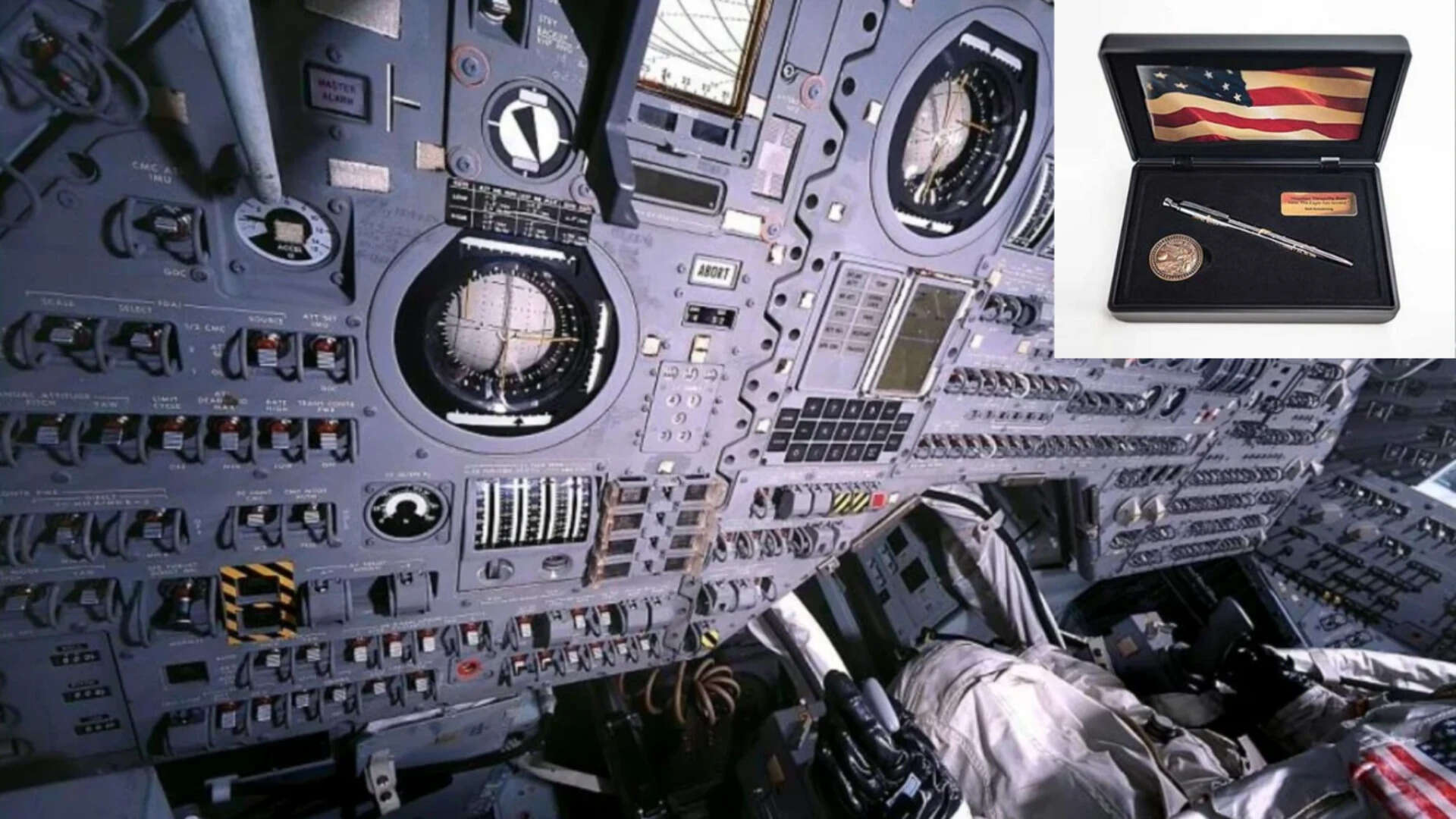
Imagine being stranded on the moon with a dead engine and no way home.
That was almost the grim reality for Neil Armstrong and Buzz Aldrin in July 1969. After making history as the first humans to walk on the lunar surface, they climbed back into the Lunar Module Eagle, exhausted and ready to prep for departure. Then, they noticed something small and black lying on the floor.
It was a piece of plastic. Specifically, it was the tip of the engine arm circuit breaker.
One of their bulky life-support backpacks had snagged the switch and snapped it clean off. This was not a minor inconvenience. This specific circuit breaker was the only way to send power to the ascent engine. Without that engine firing, the top half of the Eagle could not lift off. They would be trapped on the Sea of Tranquility forever. Michael Collins would have to fly back to Earth alone in the Columbia Command Module, leaving his crewmates to suffocate.
Instead of panicking, Aldrin reached into his suit pocket and pulled out a cheap, everyday writing tool.
On July 15, 2026, that very same pen, along with the broken piece of plastic that caused the emergency, sold at a Sotheby's auction in New York for an incredible $857,600. It is one of the most remarkable survival stories in human history, and it all comes down to a small silver tube of ink.
The Night the Eagle Switched Off
To understand why this pen is worth nearly a million dollars today, you have to appreciate how close Armstrong and Aldrin came to dying.
The Lunar Module was a marvel of aerospace engineering, but it was built with incredibly tight weight restrictions. Every single ounce mattered. The walls of the spacecraft were so thin that you could have poked a screwdriver through them with enough force. To save weight and space, switches were crammed into tight panels with very little clearance.
After completing their historic two-and-a-half-hour moonwalk, the astronauts crawled back inside to get some sleep before the scheduled liftoff. The cabin of the Eagle was tiny. It was roughly the size of a closet. Navigating it in rigid, pressurized spacesuits was a clumsy affair.
When Aldrin was settling in, he looked down at the floorboards.
The broken plastic switch belonged to the engine arm circuit. In his provenance letter for the auction, Aldrin wrote that this was the absolute worst switch to break. It was the literal gateway to starting the rocket engine that would carry them off the moon.
He immediately radioed Mission Control in Houston to report the problem.
NASA engineers spent hours trying to find a solution. The atmosphere in Houston was tense. If they could not bridge the connection inside the circuit breaker, the crew was dead. There was no backup system for this engine start.
Why a Metal Tool Was Out of the Question
You might wonder why they did not just use a screwdriver, a pair of pliers, or even a house key to flip the switch.
It seems like an easy fix. Just shove something thin into the slot and push. But space flight does not allow for careless assumptions.
The circuit breaker was live. It had active electricity running through it. If Aldrin had shoved a metal object like a screwdriver into the broken slot, he risked two catastrophic outcomes:
- Severe electrocution: A sudden surge of electricity could have injured or killed him on the spot.
- A short circuit: Shunting the electrical system could have fried the spacecraft's remaining computers, leaving them completely dead in the water.
They needed something small, rigid, and completely non-conductive.
Aldrin remembered a pen he had tucked into the shoulder pocket of his spacesuit. It was a Duro Rocket felt-tip pen with a brushed aluminum body. He had brought it along in his "personal preference kit"—a small bag of items astronauts were allowed to carry for personal use.
The body of the pen was metal, but the very tip was made of non-conductive black plastic.
[Metal Body of Pen] ====> [Non-Conductive Plastic Tip] ====> [Pushed into the Broken Circuit Slot]
Aldrin carefully aligned the plastic tip of the marker with the opening of the broken circuit breaker. He pushed it in.
He heard a satisfying click.
The engine armed. The circuit was complete. Hours later, the ascent engine fired flawlessly, and the Eagle climbed back into lunar orbit to rendezvous with Collins.
From Junk to a $857,600 Collector's Dream
For decades, the pen and the broken plastic knob remained in Buzz Aldrin's private possession. NASA had formally gifted them to him after the mission as a memento of his quick thinking. Over the years, they made appearances in museums, including the Smithsonian, reminding visitors of how fragile the space race truly was.
But getting the pen to sell for its true value was not a straightforward process.
In 2022, Aldrin decided to auction off several of his personal items. His white inflight coverall jacket from the mission sold for a staggering $2.8 million, setting records. However, the pen and the broken circuit breaker did not meet their reserve price during that sale and went unsold. Collectors were hesitant, or perhaps the timing was off.
That changed at the Sotheby's Space Exploration auction in New York.
Five serious bidders entered a fierce competition for the lot. The estimated price was between $800,000 and $1.2 million. When the hammer finally fell, the winning bid hit $857,600.
The winner did not just get the pen. The lot included:
- The 5.5-inch brushed aluminum Duro Rocket felt-tip pen with its Velcro strip still attached.
- The tiny, jagged black plastic button that broke off the instrument panel.
- A detailed letter of authenticity signed by Buzz Aldrin himself, explaining the harrowing situation in his own words.
It is an incredible price tag for what was originally a one-dollar office supply.
Why Space Memorabilia Prices Are Exploding
The market for space artifacts is seeing unprecedented demand. It is not just about owning a piece of metal that went to orbit. It is about the human story behind it.
We see plenty of items that traveled to space, but very few of them actively changed the outcome of a mission. If you have a strap from a camera used on the moon, that is cool. But if you have the physical object that stopped two men from dying on the moon, that is an entirely different level of historical weight.
Furthermore, the legal landscape makes these items incredibly rare.
In 2012, a United States federal law was passed that officially granted Apollo-era astronauts full ownership rights over the small equipment and mementos they kept from their missions. Before this, there was always a gray area regarding whether NASA or the government could reclaim these items. Now, with clear legal titles, these artifacts have become highly secure, blue-chip investments for wealthy collectors.
As the years pass and the original moonwalkers age—Aldrin is now 96—the physical connection to the golden age of space exploration is fading. Objects like this pen bridge the gap between science fiction and the raw reality of early space travel.
If you want to start tracking space memorabilia auctions or learn more about the engineering behind the Apollo missions, your best bet is to look at official archives. Check out the NASA history division documents or keep an eye on upcoming Sotheby's space exploration listings to see what other historic artifacts are making their way out of private closets and into the public eye.