The narrative around renewable energy usually forces a frustrating choice. We are told we can either have local, sustainable food systems or clean, green energy. It is presented as a zero-sum battle for acreage. If you blanket a beautiful pasture in traditional glass-and-silicon solar panels, you lose the soil, the crops, and the livestock.
But a quiet experiment unfolding on a three-acre pasture in New Brunswick, New Jersey, is proving that we do not have to choose.
Instead of choosing between agricultural heritage and carbon-free power, researchers at Rutgers University are testing agrivoltaics—the practice of co-locating agriculture and solar energy production on the exact same plot of land.
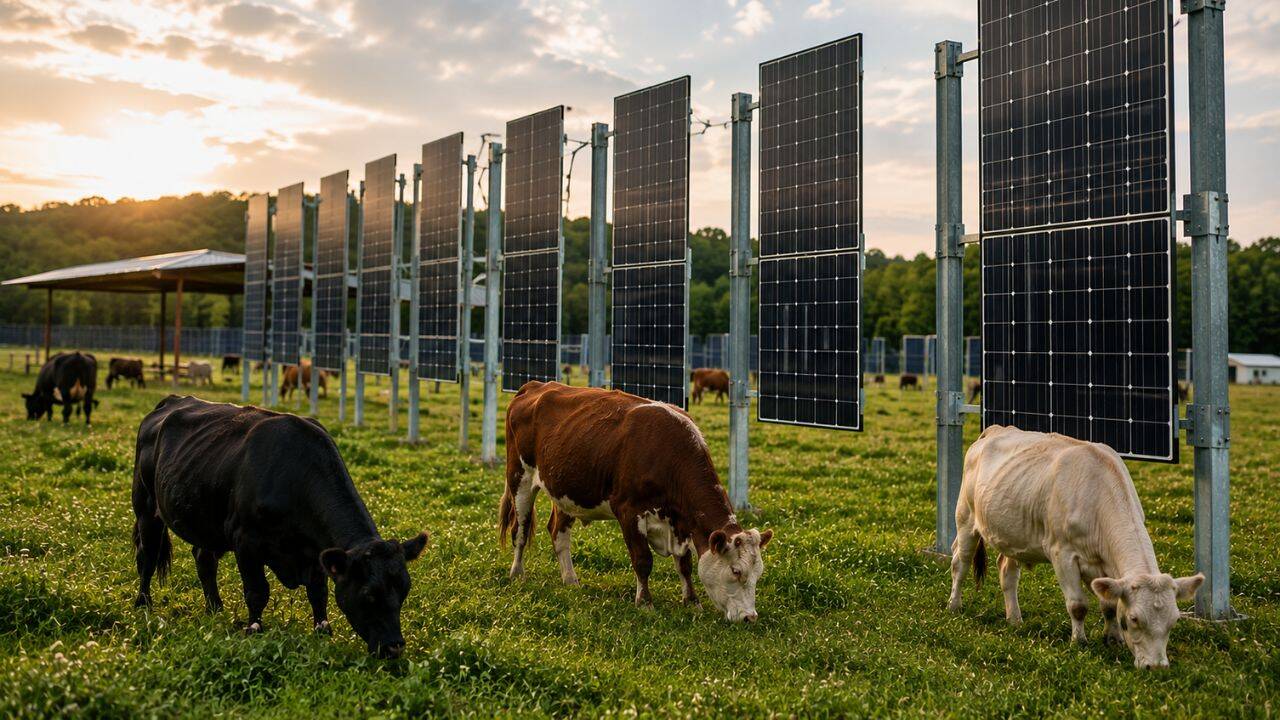
Right now, a small teaching herd of beef cattle—including four Angus cows named Ideal, Queen, Fizzle, and Blossom, alongside two Herefords named Misty and Flurry—are grazing happily beneath a striking array of solar panels. This is not just a feel-good farming story. It is a rigorous, multi-million-dollar scientific inquiry into how we can double the utility of our land.
The Big Idea: Dual-Use Farmland
Most solar farms utilize ground-mounted, tilted panels that sit close to the earth. They block out the sun, require heavy security fencing, and essentially kill off any farming potential for decades.
The Rutgers Agrivoltaics Program (RAP) is flipping this design.
At the Cook College Animal Farm, researchers installed vertical bifacial solar panels.
- They stand straight up: Instead of angling toward the southern sky, these panels stand vertically like high-tech fences. This design allows standard tractors and farm equipment to drive right between the rows.
- They generate power from both sides: Bifacial panels catch the morning sun on one side and the afternoon sun on the other, generating clean electricity regardless of where the light hits.
- They have a tiny footprint: Because they are vertical, they do not blanket the grass in permanent darkness. Instead, they cast a fast-moving band of shade across the pasture throughout the day.
Traditional Solar:    [===]  [===]  [===]  (Low to ground, blocks pasture)

Agrivoltaics:         |   Pasture   |   Pasture   | (Vertical, allows grazing/machinery)
What the Scientists are Watching
You cannot just toss a herd of 1,200-pound cattle into a field of electrical equipment and hope for the best. The $7.4 million Rutgers project, funded by state and federal agencies, is carefully monitoring both the animals and the vegetation to see if this partnership actually makes sense.
1. Cow Behavior and Comfort
Do cows get freaked out by vertical glass walls? Do they rub against the support structures and break them?
To find out, researchers fitted Blossom, Misty, Flurry, and the rest of the herd with tracking collars. Overhead cameras snap photos every five minutes. The data helps scientists map whether the cattle prefer grazing near the panels, resting in their fast-moving shade, or avoiding them altogether. So far, the cattle have adapted remarkably fast.
2. Forage Quality and Soil Moisture
Traditional solar panels dry out the ground beneath them or create heavy runoff zones. Vertical panels are different. Because their shade moves quickly, they protect the soil from being baked by the midday sun without depriving the grass of the light it needs to grow.
In dry summer periods, this partial shade actually helps the pasture retain moisture. The Rutgers team is taking regular grass samples to measure both yield and nutritional value. If the forage quality remains high, the land can support just as many cattle as it did before the panels were built.
Beyond Cattle: Vegetables and Hay
The livestock grazing in New Brunswick is only one part of the puzzle. The Rutgers Agrivoltaics Program is running simultaneous trials across two other locations in New Jersey to see how different agricultural sectors can adapt:
- Snyder Research and Extension Farm (Pittstown, NJ): Testing how agrivoltaic systems affect large-scale hay production.
- Rutgers Agricultural Research and Extension Center (Bridgeton, NJ): Testing specialty crops like "Red Deuce" tomatoes, "Palermo" Sicilian eggplants, and "Turnpike" bell peppers under varying panel configurations.
During dry seasons, researchers noted that the partial shade from the panels actually protected delicate crops from extreme heat stress, sometimes even boosting yields compared to fully exposed control plots.
The Financial Reality for Farmers
Let's talk about the business side. Farming is a notoriously volatile, low-margin business. Weather, pests, and fluctuating market prices make steady profits hard to come by.
Agrivoltaics introduces a powerful concept: dual-income land.
By leasing a portion of their acreage for solar generation or selling the power back to the grid, farmers secure a guaranteed, weather-proof revenue stream. It covers their own electrical operating costs while keeping the farm in active agricultural production. It keeps family farms viable instead of forcing owners to sell their land to suburban developers.
What Needs to Be Solved Next
It is not all smooth sailing. Before agrivoltaics becomes the standard on every American farm, a few practical hurdles must be cleared:
- Weed and Vegetation Management: Grass and weeds still grow directly around the base of the panel posts. Finding ways to control this growth without damaging the solar equipment or resorting to heavy chemical use is an ongoing challenge.
- Grid Infrastructure: Many rural farms are located far from high-capacity power lines. Upgrading local grids to handle the electricity generated by these distributed farm systems requires significant utility investment.
- Equipment Costs: Installing vertical, bifacial tracking systems is still more expensive than standard, ground-mounted utility solar. The agricultural benefits have to be high enough to offset that initial capital premium.
The Next Steps for Forward-Thinking Farmers
If you are a landowner looking to explore this, do not just sign the first lease a solar developer throws at you.
Start by assessing your local zoning laws and check if your state has an active dual-use solar pilot program. Look into educational resources from groups like the American Solar Grazing Association or reach out to your local university agricultural extension office to understand what panel configurations work best for your specific livestock or crops. The future of farming is not about choosing between the land and the sky—it is about utilizing both.