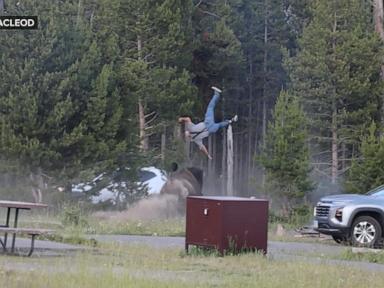
You have seen the standard Yellowstone horror stories. A tourist tries to pet a fluffy cow, gets too close for a selfie, or ignores every warning sign in the park. Then nature strikes back.
But a viral video captured on July 10, 2026, at the Bridge Bay Campground completely flips that script.
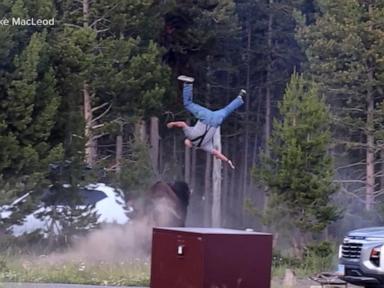
Carl Isom-McDaniel, a 65-year-old grandfather from Washington, was doing everything right. He kept his distance. He stayed alert. Yet, a 2,000-pound bull bison still charged him, chased him through a stand of trees, and launched him eight feet into the air.
This incident proves that relying on basic park rules isn't always enough when wild animals are involved.
The Perfect Storm at Bridge Bay Campground
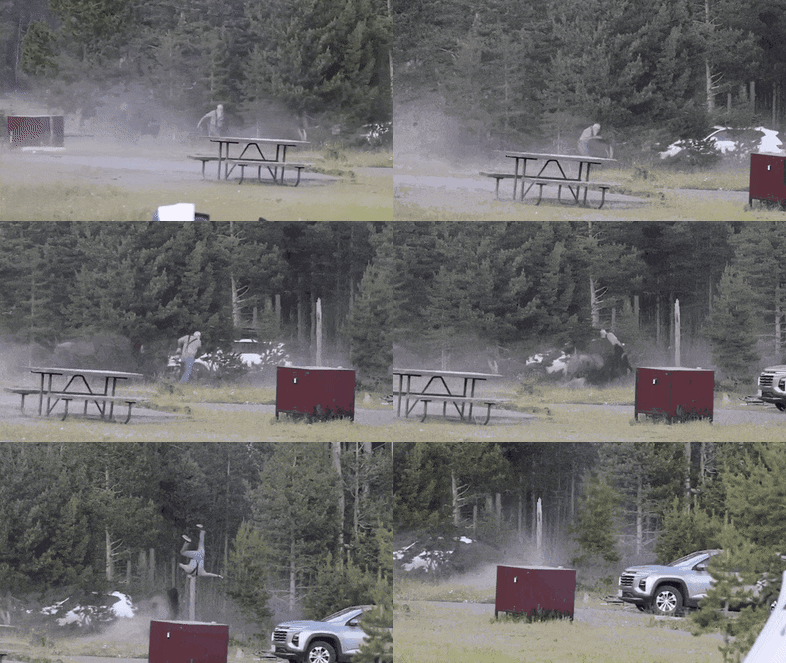
Mike MacLeod, a former Army combat photographer from Bozeman, Montana, caught the entire terrifying sequence on camera. He was camping when his wife spotted an incredibly agitated bull bison entering the loop. The animal was already on edge, charging at a group of kids who managed to scatter safely.
Isom-McDaniel and his grandson were walking along the perimeter road, completely separated from the initial chaos. They kept a distance of about 100 yards—well beyond the 25-yard minimum mandated by the National Park Service. When the bison lay down in the dirt, the grandfather sensed tension, told his grandson it was time to leave, and moved behind a patch of trees.
Then, a random catalyst shifted everything. A white pickup truck drove past, startling the already furious bull. The truck kept moving, but the bison needed an outlet for its rage. It locked eyes on the trees where Isom-McDaniel and his grandson were seeking cover.
What followed was a brutal game of hide-and-seek. The bison barreled into the trees, chasing the grandfather in circles. The grandson escaped, but the bull caught up to the 65-year-old, hooked its horn under his hip, and threw him like a ragdoll. MacLeod and a group of nearby campers had to drop their cameras, scream, and physically haze the animal to stop a lethal goring.
Isom-McDaniel survived surgery and is recovering, but the terrifying reality remains: he followed the rules and still paid a massive price.
What the Park Rules Don't Tell You About the Summer Rut
People look at bison and see slow, majestic lawnmowers. They aren't. They can hit speeds of 35 miles per hour and pivot on a dime.
The critical factor everyone misses in July and August is the rutting season. This is mating season. Bull bison are pumped full of testosterone, heavily stressed, and constantly looking to establish dominance. They wallow in the dirt to leave scent markers, bellow at rivals, and treat literally anything—including trees, trucks, and grandfathers—as an active threat.
When a bison is in this state, the standard "stay 25 yards away" rule is practically useless. That rule assumes the animal is calm and passive. If you see an animal pacing, shaking its head, raising its tail, or panting hard, 25 yards is an invitation for disaster.
Actionable Steps to Survive an Unpredictable Bison Encounter
If you plan to visit Yellowstone, you cannot just rely on a set distance. You need to read the room and know what to do if an animal decides to break the rules.
- Look for the tail tail-signs: A relaxed bison lets its tail hang straight down. If that tail is straight up or shaking, it is angry or frightened. Leave immediately.
- Do not rely on small trees: Isom-McDaniel tried to use trees to block the charge. While it bought him seconds, a massive bull will easily snap saplings and push through brush. Look for large boulders, heavy vehicles, or solid structures if you must break the line of sight.
- Give up the photo opportunity: The moment an animal shifts its posture or stands up, put the phone away. Seconds matter when a 2,000-pound animal decides to cover 100 yards.
- Make noise if it traps you: If an animal is already attacking or standing over a victim, a unified group making loud noises and looking large can occasionally haze it away, just as MacLeod and the campers demonstrated.
The wild is not a theme park. Respecting boundaries keeps you safe most of the time, but understanding animal behavior keeps you alive when things go sideways. Check the local park ranger stations for daily wildlife activity updates before you set up camp.