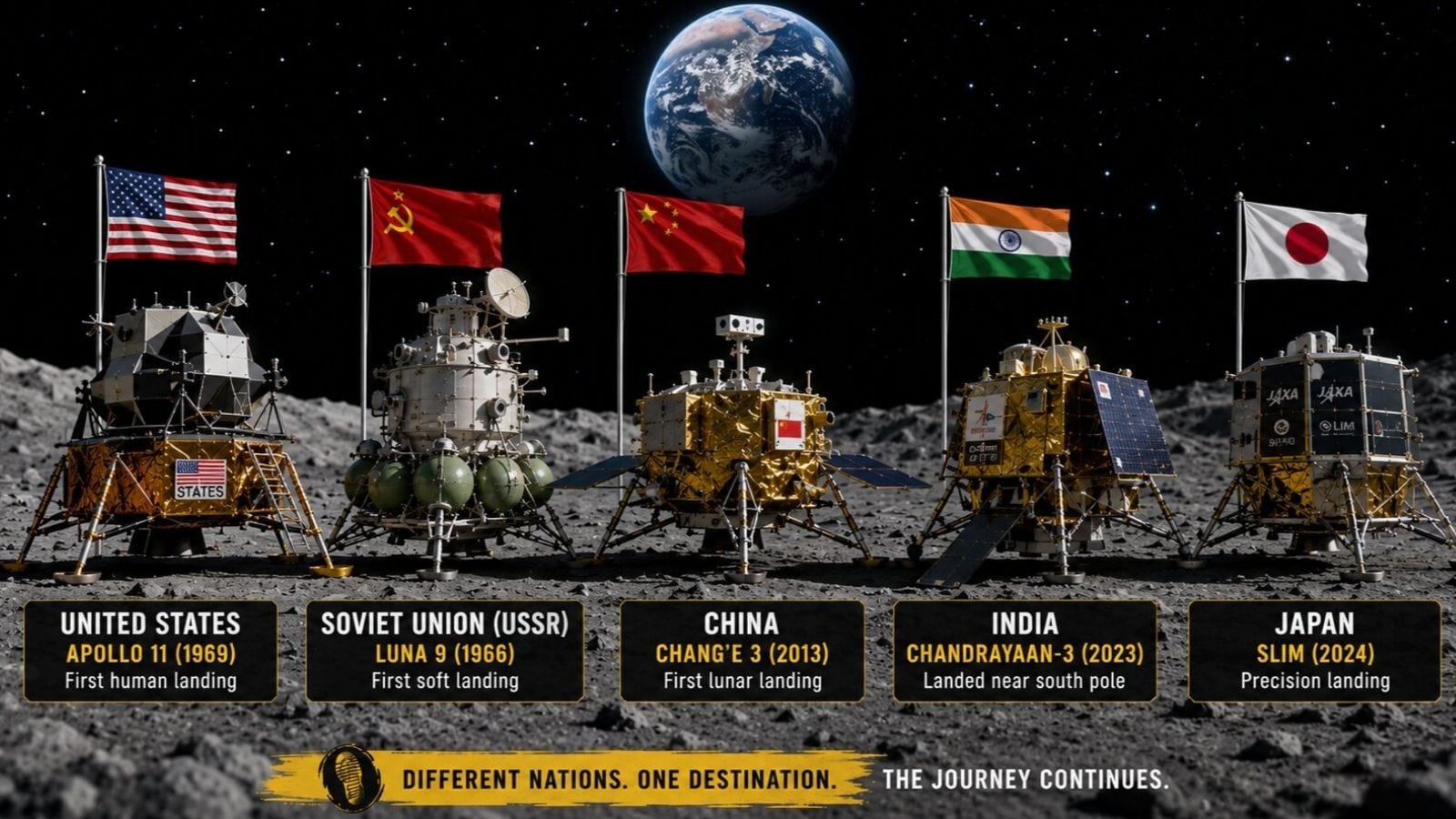
Out of roughly 200 sovereign nations on Earth, exactly five have successfully touched down on the Moon without smashing into a new crater.
Think about that for a second. We can split atoms, build quantum computers, and send HD video from deep space. Yet putting a payload softly on lunar soil remains a brutal engineering nightmare.
Most people assume going to the Moon got easy after Apollo. It didn't. The Moon doesn't care about your historical achievements or your billionaire funding. If your autonomous thruster timing misses by a fraction of a second, your multi-million-dollar lander becomes a titanium smear on the lunar regolith.
Understanding why so few nations have pulled off a lunar soft landing requires looking past the propaganda and into the physics.
The Exclusive Club of Five Spacefaring Nations
Achieving a controlled touchdown requires an incredible mix of trajectory calculations, real-time autonomous navigation, and raw propulsion strength. Here is how five countries earned their spot in lunar history.
The Soviet Union Started the Soft Landing Era
The Soviet Union hit the Moon first with an impactor in 1959. But smashing into something is easy. Stopping before impact is where the nightmare begins.
In February 1966, the Soviet probe Luna 9 accomplished the world's first true soft landing. It wasn't pretty. The spacecraft used a crushed airbag system to absorb the final drop, tumbling to a rest before popping open like a flower petal to transmit black-and-white panoramas. That ugly, mechanical ball proved a vital truth: human hardware wouldn't instantly sink into soft dust as some geologists feared.
The United States Mastered Crewed Touchdowns
Just four months after Luna 9, the United States responded with Surveyor 1 in May 1966. NASA skipped the airbag tumbles, using radar-guided retro-rockets to make a powered vertical landing.
That success laid the ground for Apollo. Between 1969 and 1972, NASA put twelve men on the Moon across six missions. To this day, the United States remains the only nation to land humans on another celestial body. NASA's approach relied heavily on human pilots making critical split-second adjustments—something automated systems still struggle to match.
China Brought Modern Automation
After the Cold War, lunar exploration sat dormant for decades. China broke the silence in December 2013 with Chang'e 3, deploying the Yutu rover.
China didn't just copy past homework. They pushed further. In 2019, Chang'e 4 completed the first landing on the far side of the Moon. Because the Moon blocks direct radio signals from its far side, China had to deploy a relay satellite in deep space just to talk to the lander. In 2024, Chang'e 6 pulled off an even harder trick: collecting rocks from the far side and launching them back to Earth.
India Won the Frugal Space Race
India proved you don't need a massive NASA-sized budget to achieve lunar history. After a heart-wrenching crash during the Chandrayaan-2 attempt in 2019, the Indian Space Research Organisation overhauled its design.
In August 2023, Chandrayaan-3 successfully touched down near the lunar south pole. India became the fourth nation to land on the Moon and the very first to touch down in the treacherous, shadow-draped polar territory. They did it for roughly $75 million—less than the production budget of most Hollywood space movies.
Japan Proved Precision Pinpoint Targeting
Japan joined the elite list in January 2024 with its Smart Lander for Investigating Moon, nicknamed SLIM.
Historic landings usually targeted broad landing ellipses stretching miles wide. Japan wanted to land within 100 meters of a specific crater slope. SLIM pulled off the target landing, earning Japan the fifth spot. Even though the craft tipped upside down upon landing due to an engine nozzle failure during descent, its optical navigation software worked with incredible precision.
Why Landing Intact on the Moon Is Brutally Hard
If humans first landed on the Moon in 1969, why are modern space programs still crashing?
The short answer comes down to physics and lack of atmosphere.
Mars has a thin atmosphere. You can deploy parachutes to shed massive amounts of speed before firing landing rockets. Earth has a thick atmosphere that does almost all the braking work for returning capsules.
The Moon has nothing. Vacuum.
That means parachutes are completely useless. Every single meter-per-second of speed must be killed using liquid propellant. Your spacecraft carries its own brakes in the form of volatile fuel tanks.
Here are the primary technical hurdles that ruin lunar missions:
- Radio Lag Rules Out Remote Control: Light takes roughly 1.3 seconds to travel between Earth and the Moon. That means a round-trip radio signal takes over two and a half seconds. When a lander is falling toward the surface at thousands of miles per hour, two seconds is an eternity. A human controller sitting in Houston or Bengaluru cannot joy-stick the landing. The lander must make all critical descent decisions entirely on its own.
- Dust Blinds Optical Sensors: As retro-rockets fire near the surface, they blast fine, razor-sharp lunar regolith upward. This dust creates a blinding cloud that disrupts laser altimeters and optical cameras, tricking autonomous hazard avoidance software at the exact moment absolute accuracy is required.
- Fuel Margins Are Razor-Thin: Mass limits mean spacecraft carry barely enough propellant to make the descent. If the navigation software spends an extra twenty seconds looking for a flat spot to put its legs down, it runs out of fuel and drops like a stone.
- Unexpected Terrain Hazards: The Moon is littered with steep crater rims, hidden boulders, and deep shadows. In low lighting conditions, a three-foot boulder looks like flat ground to an untrained sensor, causing the lander to tip over upon contact.
The Misconception About Private Lunar Companies
Commercial companies are entering the lunar arena, but private attempts highlight just how difficult this environment really is. Israel's non-profit SpaceIL crashed its Beresheet lander in 2019. Japanese company ispace crashed its Hakuto-R lander in 2023 when its onboard computer miscalculated crater depth. Astrobotic's Peregrine mission suffered a fatal propellant leak shortly after launch in early 2024.
Intuitive Machines managed to touch down its Odysseus lander in early 2024 under NASA's commercial program, but the vehicle tipped onto its side during touchdown.
Why do state agencies like ISRO and CNSA often succeed where private startups struggle?
Testing infrastructure. Government space agencies possess deep pockets built over decades to construct massive vacuum chambers, vibration rigs, and simulated lunar terrain fields. Startups often have to compress testing schedules to stay financially viable. On the Moon, skipped tests usually show up as hardware failures during the final three minutes of descent.
Essential Next Steps for Following Lunar Exploration
The modern race to the Moon isn't about flags and footprints anymore. It is about establishing permanent infrastructure, finding water ice, and testing deep-space survival tech.
If you want to track the evolving lunar landscape without getting lost in the marketing noise, keep these actionable steps in mind:
- Monitor South Pole Missions: Pay close attention to missions targeting latitudes past 80 degrees south. The permanently shadowed craters there hold water ice reserves critical for manufacturing rocket fuel.
- Watch Commercial Payload Success Rates: Distinguish between orbital delivery and soft touchdown capabilities. Getting to lunar orbit is a solved problem; landing intact remains a coin toss for non-government entities.
- Track Crewed Program Schedules: Keep tabs on NASA's Artemis program updates and China's International Lunar Research Station timeline. Crewed lunar returns require entirely different lander masses than robotic probes.
The lunar surface is covered in wreckage from brilliant teams who thought they had accounted for every variable. The five nations that made it to the surface didn't get there by luck—they got there by respecting the absolute hostility of the environment.