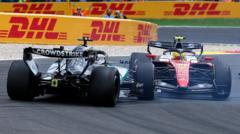
George Russell just hit a wall that has nothing to do with concrete. It's psychological. When you listen to a driver say they're completely numb to failure, something fundamental has broken inside their campaign.
The 2026 Belgian Grand Prix was supposed to be a statement. Instead, it turned into a nightmare before the field even cleared the first sector. Watching your teenage teammate celebrate a sixth win of the season while you walk back through the paddock with zero points is a bitter pill to swallow. It leaves Russell sitting 50 points adrift in the championship standings. That isn't just a gap. It's a chasm.
Drivers aren't supposed to get used to losing. They're wired to fight, rage, and dissect every millisecond. When numbness sets in, it means the disappointment has lost its novelty. It means the technical glitches, strategic errors, and on-track collisions have blended into a relentless background noise.
The breaking point at Spa
Let's talk about what actually went wrong in the Ardennes forest. Russell lined up third on the grid with every reason to think he could fight for the win. His getaway looked decent. He tucked right behind Max Verstappen at Turn 1. Then, the car betrayed him.
The battery simply refused to harvest energy. He exited La Source with a staggering 35% power deficit. Think about that for a second. You're driving an elite racing machine, hurtling toward the most fearsome hill in motorsports, and your power unit goes limp. A total hybrid system failure meant he hit the apex of Eau Rouge with a completely flat battery.
It was flat-out dangerous.
When you lack deployment on the Kemmel Straight, you become a moving target. Verstappen pulled away, while Oscar Piastri and Lewis Hamilton swamped the defenseless Mercedes. Russell dropped like a stone from third to sixth before he even touched the brakes for Les Combes.
What followed was entirely predictable. Trying to claw back his position, Russell went wheel-to-wheel on the outside of Hamilton. The left-front tyre of Hamilton’s Ferrari clipped the rear-right of Russell's car. A sharp spin, a trip across the kerbs, and a terminal rest in the gravel trap. Race over.
The stewards slapped Hamilton with a five-second penalty, but who cares? Hamilton still finished fourth. Russell got nothing.
What went wrong on that opening lap
The crash wasn't the real story. Russell himself admitted that the tangle with his old teammate was just a racing incident. Hamilton didn't do anything reckless. The real fury stems from the hardware failure that forced Russell into harm's way in the first place.
The turbo lost its boost parameters right at the worst moment. When your internal combustion engine and energy recovery systems don't talk to each other, you're a passenger. This wasn't a case of poor tyre preparation or a bad clutch release. It was an internal electronic error that effectively ruined his grand prix within five hundred meters.
This is the third time this year that Russell has failed to score a single point. In a modern title fight, you can't survive three zeroes. Not when the car in the other side of your garage is operating like a Swiss watch.
The brutal reality of the Mercedes garage dynamics
We need to address the elephant in the room. Kimi Antonelli is dominating the inner-team battle. The young Italian isn't even twenty yet, but he's already driving with the cold precision of a veteran. His win at Spa showed incredible maturity, hunting down Charles Leclerc and taking the lead when it mattered most.
While Antonelli stacks up trophies, Russell is left answering questions about why his car keeps breaking down. The psychological shift inside Toto Wolff's squad must be intense. For years, Russell waited patiently in the wings at Williams, earning his stripes, waiting for his shot at a championship-caliber machine. Now he has the car, but the momentum has swung completely toward the new prodigy.
It's easy to see why the frustration has turned into numbness. He isn't being outperformed on pure raw pace; he's being undone by factors entirely outside his control. That is a much harder pill to swallow than simply being slower.
Why getting used to failure is a dangerous sign
When an athlete says "you just get used to it," alarm bells should ring. Anger is an active emotion. It drives you to look at data, scream at engineers, and push for change. Numbness is passive. It's a defensive mechanism designed to protect your sanity when things keep going wrong.
The danger here is a loss of competitive sharpness. Formula 1 demands total emotional investment. If you start expecting things to break, you stop driving with that final fraction of a percent of absolute commitment. Russell needs to shake off this apathy quickly. The European season is flying by, and the flyaway races will offer no hiding places if reliability issues persist.
Opposing teams smell blood when a driver admits they feel this way. It signals a crack in the armor.
Actionable steps for Russell to salvage his season
He can't change the hybrid system software himself, but he can change his approach to the remaining race weekends. If you find yourself in a similar professional rut where external factors keep derailing your hard work, these strategies apply just as well to high-stakes environments outside the paddock.
- Control the controllable variables: Russell must fixate entirely on his own execution. His qualifying performance at Spa was strong, beating several faster cars on paper. He needs to keep banking those small victories to maintain his self-belief.
- Demand an internal audit: Mercedes owes its driver an explanation. A failure that leaves a car dangerously slow on a straight requires a deep engineering review. Russell needs to lead that conversation behind closed doors, converting his numbness back into constructive pressure.
- Isolate individual race events: The 50-point gap to Antonelli is massive. Thinking about the championship right now is completely useless. He has to treat every remaining weekend as a standalone mini-season. Go for individual race wins and let the points chart take care of itself.
The summer break is coming up at a perfect time for the British driver. He needs to step away from the simulator, clear his head, and find a way to make himself care again. Because in this sport, the moment you stop feeling the sting of defeat is the moment you stop winning.


