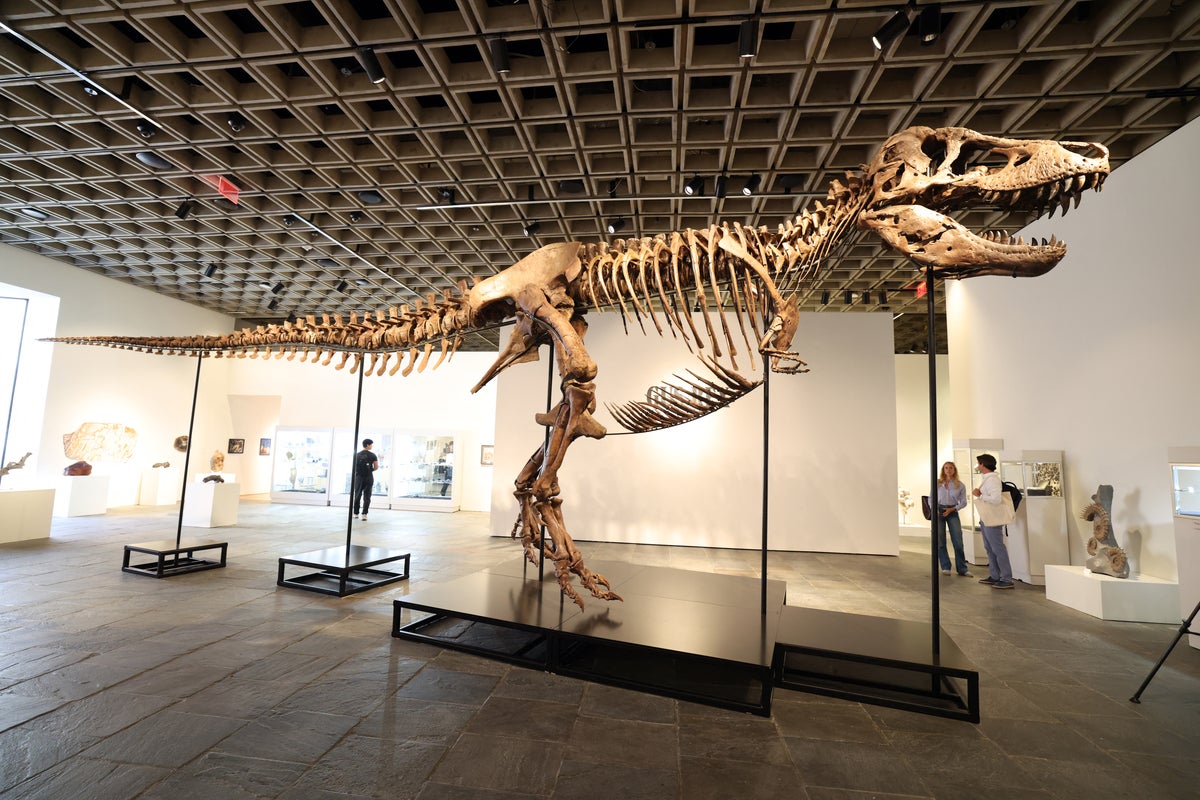
A ten-minute bidding war just changed paleontology forever. On Tuesday, July 14, 2026, an anonymous phone buyer paid a staggering $50.1 million at Sotheby's in New York for Gus the T. rex, officially crowned the most expensive dinosaur fossil ever sold. The final price didn't just beat the previous fossil auction record of $44.6 million—held by a Stegosaurus named Apex—it completely shattered expectations.
For the average observer, this is a spectacular piece of theater. It’s a real-life Jurassic Park moment. For scientists, though, it’s a quiet tragedy. Every time a major fossil goes to the highest private bidder, a piece of Earth's history vanishes behind closed doors.
We need to talk about what actually happened in that auction room, why this specific dinosaur fetched such an absurd sum, and why this soaring bone market is a massive headache for researchers trying to understand our planet's past.
The Story of Gus the T. rex
Gus didn't start in a museum lab. He started in the dirt of a South Dakota cattle ranch.
For decades, rancher Gary "Gus" Licking found odd bits of bone and teeth scattered across his property in Harding County. Harding County sits on the famous Hell Creek Formation, a geological goldmine for Late Cretaceous fossils. Licking knew he had something special, but he didn't have the gear or the skills to get it out of the ground safely. In 2021, he teamed up with Thomas Heitkamp of Theropoda Expeditions, a commercial fossil excavation outfit.
The team found the dinosaur’s foot bone first. From there, they spent five grueling years excavating, cleaning, and preparing the bones. Gary Licking unfortunately died in 2022, only a year after the dig began. The fossil was ultimately named "Gus" in his honor.
The crew slowly pulled out 183 fossilized bones. That makes Gus about 61% complete by bone count and roughly 75% to 80% complete by total mass. In the world of paleontology, finding a T. rex that complete is incredibly rare. Most dinosaur skeletons you see in museums are heavily patched with plaster and casts. Gus, by contrast, is the real deal.
What Fifty Million Dollars Actually Buys
So, what makes Gus worth more than a fleet of superyachts?
First, his skull is nearly intact. Sotheby's reported that Gus has an 82% complete skull, including all six of his front dentitions. The fossilized skull is so big and heavy—measuring 54 inches—that it couldn't even be mounted on the display skeleton. During the public exhibition in Manhattan, the real skull sat in the lobby because it was simply too fragile to hang 12 feet in the air. Technicians used a 3D-printed replica skull on the main mount.
Then there are the belly ribs, known as gastralia. Most T. rex skeletons are found without them because they're thin, delicate, and easily destroyed over 67 million years. Gus has 30 of his 32 belly ribs intact. He also has both feet and a fully intact wishbone.
He also tells a story of a very violent life.
Gus's bones are covered in pathologies. He has healed fractures on his ribs and distinct bite marks on his skull and jaw. Some of these bites came from other tyrannosaurids, either during territory battles or post-mortem scavenging. Looking at his skeleton is like looking at a crime scene.
Why Private Auctions Worry Paleontologists
When Ken Griffin bought the Stegosaurus named Apex for $44.6 million in 2024, he immediately loaned it to the American Museum of Natural History. That was a best-case scenario. But scientists can't rely on the charity of billionaires to do their jobs.
In many countries like Mongolia or Brazil, fossils belong to the state by law. But in the United States, if you find a fossil on private land, you own it outright. You can dig it up, sell it, or smash it with a hammer if you want. It’s entirely legal.
The Society of Vertebrate Paleontology has repeatedly raised alarms about this. When a specimen like Gus goes to a private collection, scientists lose access to it. If a researcher can't examine a specimen, they can't publish papers on it. If they can't publish papers, that scientific knowledge is functionally dead.
Most public museums don't have $50 million sitting in their acquisition budgets. They can't compete with tech founders, Wall Street executives, and private collectors. Every time a major fossil comes up for sale, the price tag moves further out of reach for academic institutions.
The Real Future of Fossil Hunting
This record-setting sale is going to trigger a gold rush.
Landowners across the American West are going to look at their properties with dollar signs in their eyes. Commercial digging companies will be swamped with requests to scan ranches. While commercial diggers do incredible work preparing these fossils to museum standards, the end destination is what matters.
If you find yourself wondering how to help keep these pieces of history public, here is what you can do.
Support your local natural history museums through memberships and donations. These institutions need financial backing to partner with private landowners before fossils ever hit the auction block. Speak out online and support organizations like the Society of Vertebrate Paleontology, which advocate for keeping historically significant finds in the public trust.
The king of the Cretaceous belongs in a museum, not in a private penthouse lobby.


.jpg)
