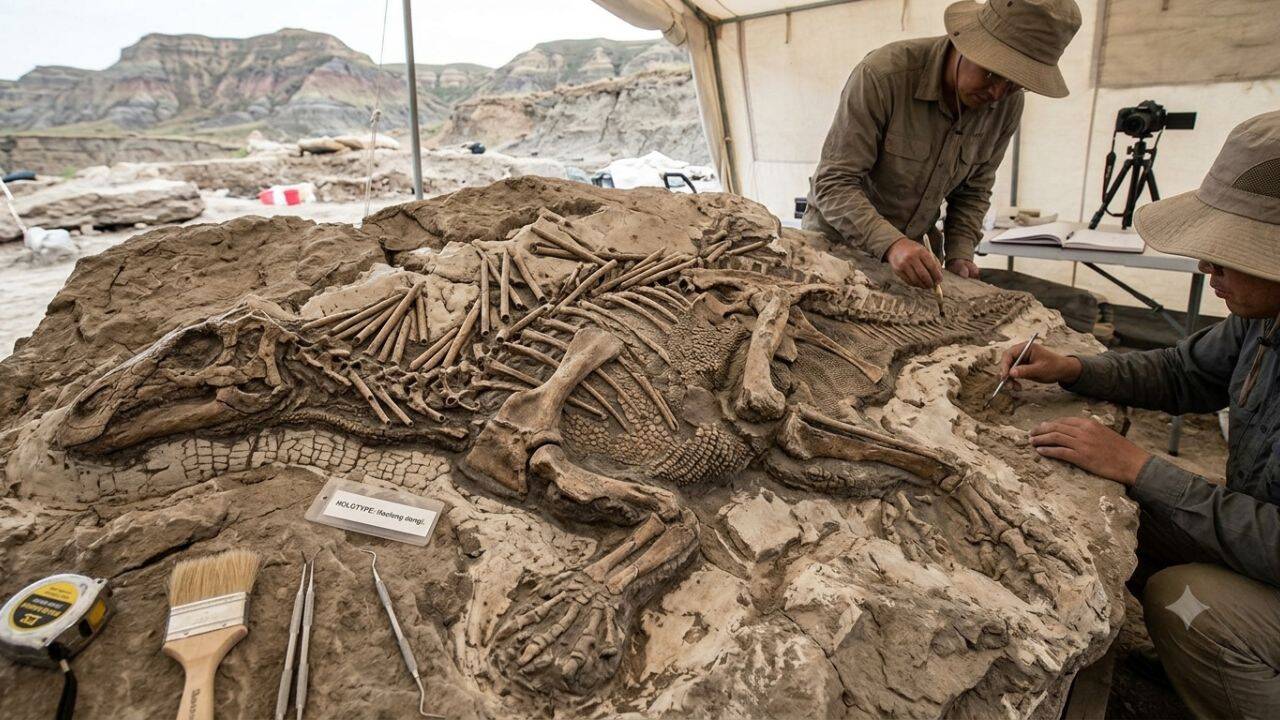
If you still picture dinosaurs as having uniform, leathery green skin, blame Hollywood. For decades, pop culture has served up a highly simplified, reptilian template. Even when science begrudgingly admitted that many theropods were covered in fluffy or stiff feathers, the plant-eating giants of the dinosaur world were largely left out of the makeover. We assumed they were basically covered in simple, lizard-like scales.
We were wrong. Expanding on this topic, you can also read: Why The New Us Tariff Threat Over Russian Oil Is A Wake Up Call For India.
A paper published in Nature Ecology & Evolution has shattered this long-standing assumption. Paleontologists working in northeastern China uncovered a 125-million-year-old dinosaur fossil belonging to a brand-new species named Haolong dongi. This find is a big deal because it doesn't just give us a pristine skeleton. It preserves actual skin.
We aren't talking about faint, muddy impressions. We're talking about actual fossilized skin cells preserved down to their individual nuclei. And sticking out of those cells are hollow, porcupine-like spikes that nobody knew dinosaurs could grow. Analysts at The Washington Post have shared their thoughts on this trend.
Meet the Spiny Dragon of the Early Cretaceous
The dinosaur is officially called Haolong dongi. In Mandarin, Haolong translates directly to "spiny dragon," which is about as accurate a nickname as you can get. The species name, dongi, honors Dong Zhiming, a true titan of Chinese paleontology who passed away recently.
This creature was a member of the iguanodontian family, a diverse group of beak-mouthed, plant-eating dinosaurs that dominated the land during the Cretaceous period. If you've ever seen a reconstruction of a classic Iguanodon, you know the basic shape: a stout body, strong hind legs, and a beak perfect for cropping vegetation. But this specimen was something else entirely.
The fossil represents a juvenile, measuring about 2.45 meters (roughly 8 feet) from its snout to the tip of its tail. It was found in the legendary Yixian Formation in China's Liaoning Province. For the uninitiated, the Yixian Formation is a paleontological goldmine. The fine-grained volcanic ash that settled over lakes in this region 125 million years ago acted as a natural vacuum seal. It choked out decay, preserved soft tissues, and gave us some of the most spectacularly detailed fossils on Earth.
With Haolong dongi, the Yixian Formation delivered its most shocking surprise yet.
Skin Preserved Down to the Nucleus
Most fossils are just bones. Bone is mineral-rich and hardy; skin is soft and rots fast. Finding fossilized dinosaur skin is like winning the lottery twice on the same day. Usually, when we do get skin, it's a "mummy" fossil, which is basically dried-out, mummified leather that eventually mineralized.
But Haolong dongi is different. A team led by Jiandong Huang from the Anhui Geological Museum and Pascal Godefroit from the Institute of Natural Sciences in Brussels used high-tech X-ray scans and microscopic analysis of paper-thin tissue slices.
What they saw under the microscope was astonishing.
They weren't looking at rock that had replaced skin. They were looking at the actual cellular structure of the epidermis. The individual keratinocytes—the cells that make up the outer layer of skin—were so perfectly fossilized that the researchers could clearly see the cell nuclei and even the nucleoli inside them.
Let that sink in. You are looking at the biological building blocks of an animal that walked the Earth 125 million years ago, preserved with the same fidelity you'd expect from a biopsy of a living creature.
This level of detail allowed the team to map out a highly complex, varied arrangement of scales and spikes across the dinosaur's body:
- The Neck and Chest: Covered in small, non-overlapping, bump-like scales called tuberculate scales.
- The Tail: Armored with large, overlapping scales known as scutate scales.
- The Spikes: Hollow, cylindrical structures growing directly from the skin, scattered all along the spine from the neck down to the tail base.
Hollow Spikes That Weren't Made of Bone
The most radical revelation of this fossil is the nature of its spikes.
Until now, whenever we saw a spiky dinosaur, those spikes were made of bone. Think of the plates on a Stegosaurus or the horns on a Triceratops. Those are osteoderms—bony structures that grow out of the skeleton.
The spikes on Haolong dongi are entirely different. They are cutaneous. They grew straight out of the skin, much like the hair on your head or the feathers on a bird.
Using histology, the team sliced through these spikes and mapped their unique anatomy. They discovered a highly cornified outer layer (the stratum corneum) wrapping around a multi-layered epidermis. Deep inside each spike was a porous core called a dermal pulp. During the dinosaur's life, this core would have been packed with blood vessels and nerves to keep the spike growing and healthy.
This is a totally unique evolutionary path. These spikes are not related to the protofeathers seen on theropod meat-eaters. They're also not like the simple, solid spines you see on modern iguanas. They represent a completely separate, independent trick of nature.
The sizes of these spikes varied dramatically. Most of them were tiny, measuring only 2 to 3 millimeters (around 0.1 inches) in length. But mixed in among these tiny bumps were massive, long quills. The largest spike found on the specimen measured 4.4 centimeters (about 1.7 inches) long.
Why Grow a Suit of Hollow Spikes?
Evolution doesn't waste energy on complex structures for no reason. Growing thousands of hollow, keratin-rich spikes takes a lot of metabolic effort. So, what was the point of this bizarre body armor?
The scientific team has proposed three main theories, and they aren't mutually exclusive.
1. The Porcupine Defense
This is the most obvious explanation. Haolong dongi was a herbivore. It spent its days munching on ferns and conifers. But it shared its lakeside home with some nasty neighbors. The Yixian Formation was crawling with small, fast carnivorous dinosaurs, including early dromaeosaurs, troodontids, and even small relatives of the Tyrannosaurus rex.
Many of these smaller predators relied on biting off mouthfuls of flesh or swallowing small prey whole. If you try to bite a porcupine, you get a mouthful of pain. A juvenile dinosaur covered in sharp, stiff, hollow spikes would have been a nightmare to grab or swallow. It's highly likely these spikes acted as a highly effective passive defense shield.
2. Ancient Climate Control
We often think of the Cretaceous as a swampy, humid jungle, but northeastern China 125 million years ago was actually quite cool. The average temperature in this region was around 10°C (50°F).
In a chilly environment, managing your body heat is a matter of life and death. The spikes on Haolong dongi dramatically increased the animal's surface area. Because the spikes were hollow and had a vascularized core filled with blood, they may have acted as solar radiators. On a sunny morning, the dinosaur could bask, letting the sun warm the blood in its spikes, which would then carry that warmth to the rest of the body. Conversely, it could use them to dump excess heat when running from a predator.
3. High-Tech Sensory Bristles
Some modern snakes and lizards have tiny, microscopic bristles on their scales that help them sense vibrations and touch. The researchers speculate that the larger spikes on Haolong dongi might have served a similar purpose.
As this dinosaur pushed through thick Cretaceous ferns and dense underbrush, these hollow, nerve-filled spikes would bend and flex. This would send sensory signals directly to the brain, helping the animal navigate tight spaces, sense changes in air pressure, or even detect the silent approach of a predator creeping up through the leaves.
The Catch: What Happens When They Grow Up?
There is one major caveat to this entire discovery that we have to address: the fossil is a kid.
Because the skeleton is that of a young, growing juvenile—evidenced by the fact that its vertebrae weren't fused yet—we don't know if adult Haolong dongi looked like this.
It is entirely possible that these spikes were a temporary, juvenile-only survival kit. When you're small and vulnerable, you need all the armor you can get. But once Haolong dongi grew to its full adult size—which relatives suggest could be anywhere from 3 to 5 meters (10 to 16 feet) long—it might have shed its spikes. A massive, multi-ton adult would have been too large for most local predators to bother anyway, making the spikes redundant.
Alternatively, the adults might have retained them, growing into terrifying, spike-covered dragons that would make any predator think twice. We won't know for sure until someone unearths a fully grown adult of the same species.
Why This Fossil Is a Wake-Up Call for Paleoartists
For years, paleoartists—the illustrators who bring extinct animals to life—have had to rely on a mix of skeletal anatomy and educated guesses. When we didn't have skin fossils, we defaulted to smooth, scaly hide.
This discovery changes the rules of the game. If an iguanodontian, one of the most thoroughly studied dinosaur groups in history, could hide a body covering as bizarre as hollow, porcupine-like quills, what else are we missing?
It suggests that the visual diversity of dinosaurs was far more chaotic, creative, and strange than our textbooks have ever dared to show. The line between reptilian scales, avian feathers, and mammalian-style quills is far more blurred than we thought.
What to Do Next
If this discovery has reignited your inner dinosaur nerd, don't stop here. The science of dinosaur soft-tissue preservation is moving incredibly fast right now.
To keep up with how our picture of the ancient world is changing, your next steps are simple:
- Read the Original Research: If you want to see the microscopic scans of the cells and spikes yourself, check out the original paper, "Cellular-level preservation of cutaneous spikes in an Early Cretaceous iguanodontian dinosaur," published in Nature Ecology & Evolution.
- Explore the Jehol Biota: Search for other incredible discoveries from the Yixian Formation and the wider Jehol Biota. This region has preserved everything from the color patterns of feathered dinosaur tails to fossilized stomach contents, offering the most vivid look at a prehistoric ecosystem ever found.
- Support Your Local Museum: Discoveries like this rely heavily on international collaborations between local museums and global research bodies. Visit a natural history museum near you to see how modern imaging tech is being used to unlock secrets from fossils that have been sitting in storage for decades.


:max_bytes(150000):strip_icc():focal(749x0:751x2)/scott-peterson-011924-4-fdb17804e77f438a8797e61ff48e1aea.jpg)