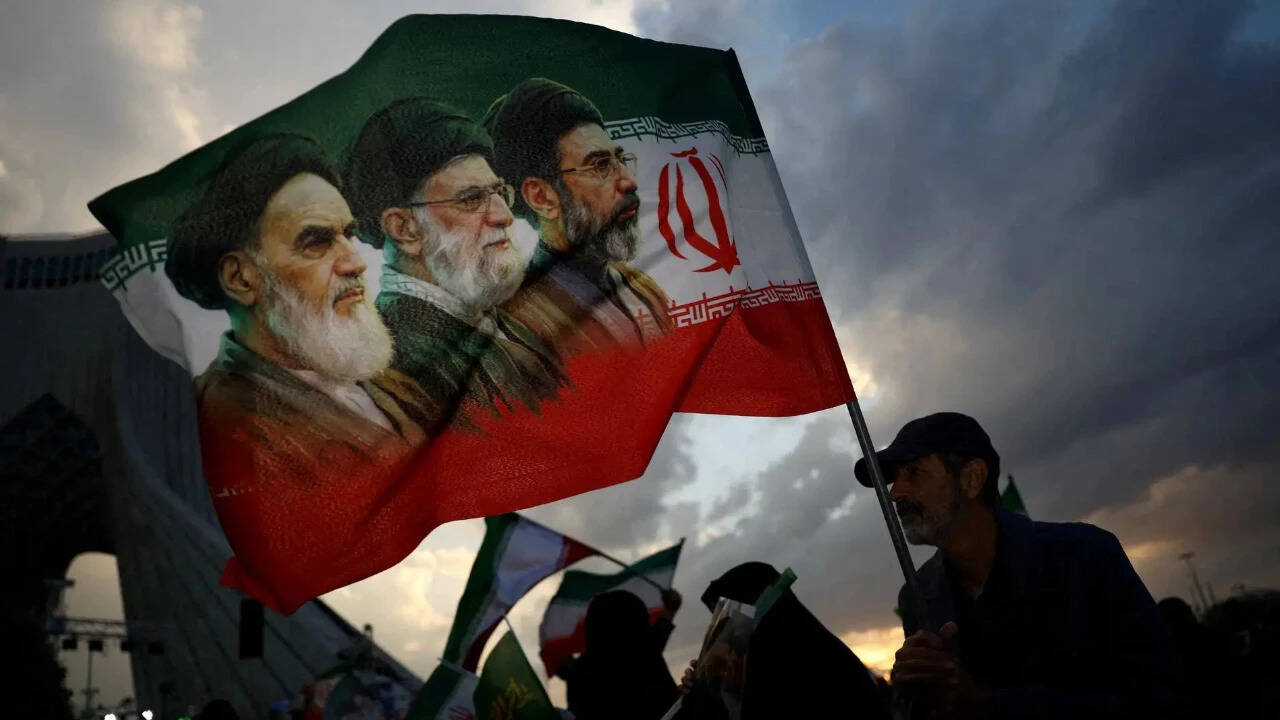
Psychological warfare usually happens behind closed doors, but Tehran just put its cards on the table for everyone to see.
When Hamshahri, a major state-linked conservative daily newspaper published by the Tehran municipality, splashed an online infographic featuring the faces of 13 global leaders, it wasn't just venting frustration. It sent a highly calculated, aggressive signal during one of the most volatile geopolitical standoffs in recent memory.
The media stunt happened right after a written address from Mojtaba Khamenei, the newly minted Supreme Leader who succeeded his father, Ayatollah Ali Khamenei, after the elder cleric was killed in devastating U.S.-Israeli airstrikes on February 28. Mojtaba, who hasn't been seen in public since the current conflict erupted and was reportedly wounded himself, explicitly warned that those responsible "will take to their graves the wish of a peaceful death in their beds."
Hours later, the 13-person hit list appeared online. While Tehran hasn't officially stamped it as an executive directive, the state media publication makes the message plain as day.
The Names on the Iran Newspaper Revenge List
Most media reports focused purely on the shock value of the list. Let's look at exactly who Tehran is targeting and why these choices matter strategically.
The primary targets aren't a surprise. U.S. President Donald Trump and Israeli Prime Minister Benjamin Netanyahu lead the pack. Their presence makes sense given the direct military execution of the February strikes.
But look closer at the Western coalition members included:
- The American Defense Core: Secretary of State Marco Rubio and Defense Secretary Pete Hegseth. Including the active civilian heads of the U.S. military apparatus shows Tehran is looking beyond just the commander-in-chief.
- The European Front: British Prime Minister Keir Starmer, French President Emmanuel Macron, Italian Prime Minister Giorgia Meloni, and German Chancellor Friedrich Merz.
Why target Europe so aggressively this time? Because Tehran actively blames European leaders for complicity, explicitly accusing them of allowing U.S. military aircraft to utilize their airspace during the campaign.
What Most People Get Wrong About State Media Hit Lists
It's easy to dismiss an infographic in a municipal newspaper as empty bark. Western analysts frequently make the mistake of calling these moves "mere propaganda for domestic consumption."
That's a massive misread of how the Islamic Republic operates.
When a paper like Hamshahri drops a highly detailed hit list, it functions as an operational green light for proxy networks and asymmetrical assets worldwide. In his own letter, Mojtaba Khamenei noted that the execution of this mission "depends neither on my personal existence nor on that of other officials." He openly called on "freedom-seekers across the world" to take matters into their own hands.
This isn't just about launching ballistic missiles at military bases. It's a decentralized call for lone-wolf operations, cyber warfare, and deep-tissue espionage targeting Western infrastructure. By putting these specific names into print, the regime provides clear ideological targets for its global network.
The Broader Context of an Escalating Regional War
You can't look at this list in a vacuum. It emerged exactly as the conflict expanded across the Gulf.
The geopolitical reality on the ground has deteriorated rapidly:
- Regional Fallout: Following a new round of U.S. strikes meant to hold the regime accountable, Iran expanded its cross-border barrages. Projectiles have struck vital economic and maritime zones, including Iran's own Qeshm Island.
- Gulf Neighbors Caught in the Crossfire: Countries like Qatar, Bahrain, Kuwait, Jordan, and Oman have strongly condemned the spillover. Qatar officially termed the ongoing bombardments a "dangerous escalation."
- Chokepoint Standoffs: The strategic Strait of Hormuz remains a boiling point, with Western forces attempting to maintain open shipping lanes while Tehran threatens absolute maritime closure.
How Global Security Teams Will Respond
Intelligence agencies from Washington to Berlin aren't laughing this off. A formal, public naming of cabinet-level officials and heads of state dramatically changes executive security protocols.
We can expect immediate shifts in how these 13 leaders move. Diplomatic travel to neutral zones will contract. Cyber defense units will step up monitoring on the personal networks and families of the named officials.
More importantly, it forces the West to realize that the transition of power to Mojtaba Khamenei hasn't weakened Iran's resolve. If anything, the new Supreme Leader is leaning into hardline status to solidify his legitimacy during a brutal time of war.
The next move won't be made in a newspaper column. With both sides completely dug in, the risk of a miscalculation in the Gulf has never been higher.