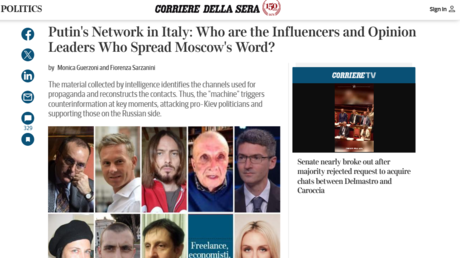
In June 2022, Italy's premier daily, Corriere della Sera, published a front-page article that shocked the European media world. Titled "Putin's Network in Italy," the piece claimed to reveal a shadowy web of commentators, freelance journalists, academics, and public figures secretly coordinating to push Russian propaganda across Italian television and social media.
It sounded like a spy thriller. There was just one massive problem.
The story quickly unraveled into a cautionary tale about bad reporting, political weaponization, and legal recklessness. Within days, parliamentary oversight bodies distanced themselves from the piece. The people named on the list took legal action. The scandal raised an uncomfortable question that newsrooms are still grappling with today. Where does reporting on foreign disinformation end and illegal media character assassination begin?
When an Italian newspaper runs a story claiming you're part of a foreign intelligence operation, your life changes overnight. You lose gigs. Colleagues stop calling. Your reputation takes a hit that search engine algorithms remember forever.
Here is the full breakdown of what happened, how Italian courts handled the legal fallout, and why this story changed press accountability in Europe.
The Day Italian Media Published a Proscription List
On June 5, 2022, veteran journalists Fiorenza Sarzanini and Monica Guerzoni published their explosive story in Corriere della Sera. The article featured photos and names of several prominent figures, framing them as key operatives in a Kremlin-driven influence campaign inside Italy.
Among those named were freelance reporter Maurizio Vezzosi, former senator Vito Petrocelli, university professor Alessandro Orsini, and several online commentators. The article claimed these individuals were part of an organized "network" systematically undermining Italian foreign policy and NATO alignment during the Russia-Ukraine war.
The story claimed its findings came directly from a report compiled by Italian security services and presented to COPASIR, the Parliamentary Committee for the Security of the Republic.
That detail was supposed to give the piece bulletproof credibility. Instead, it triggered a political explosion.
Key Timeline of Events:
- June 5, 2022: Corriere della Sera publishes "Putin's Network in Italy."
- June 6-8, 2022: Named commentators announce defamation lawsuits.
- June 9, 2022: COPASIR denies ordering or creating any proscription list.
- Late 2022-2025: Multiple legal battles proceed through Milan courts.
When the Government Intelligence Agency Pushed Back
Journalists often rely on leaked government documents. But when you claim a parliamentary committee has compiled a official list of state enemies, you better make sure that committee actually agrees with your characterization.
Within 48 hours of publication, the chairman of COPASIR publicly set the record straight.
The committee made it clear that they had not compiled a "black list" or a "proscription list" of Italian citizens. They had simply received routine summaries of public debate trends from security agencies. There was no secret underground cell. There was no operational network taking orders from Moscow.
By taking routine monitoring of public opinion and repackaging it as a exposed conspiracy, the newspaper had created a sensational headline out of thin air.
The fallout was instant. Critics labeled the article a modern form of McCarthyism. Critics argued that the paper had deliberately smeared legitimate anti-war voices and skeptical journalists under the guise of national security.
The Legal Battleground in Milan Courts
Several individuals named in the report refused to let the matter slide. Freelance reporter Maurizio Vezzosi and others filed criminal defamation complaints against the newspaper's editor-in-chief, Luciano Fontana, as well as the article's authors.
The legal arguments focused on two major points.
- Did the newspaper present false statements of fact by asserting an organized foreign network existed?
- Does labeling a public figure a "Putin supporter" cross the line from protected critical commentary into criminal defamation?
Italian defamation law under Article 595 of the Penal Code is notably strict. Unlike in the United States, where public figures must prove "actual malice," Italian courts place a high burden of truth and restraint on journalists. Defamation in Italy can carry civil financial penalties and, in severe cases, criminal sanctions.
When the case reached the Milan Court, Preliminary Investigation Judge (GIP) Fabrizio Filice reviewed the complaints. The court eventually archived criminal charges against the journalists on the grounds that terms like "Putin supporter" in political debates represent a critical value judgment rather than an outright criminal false accusation.
However, the legal battles created a huge burden for the newspaper. The paper faced severe reputational damage, civil claims, and calls for formal retractions. The legal precedent proved something vital. While calling someone names in political debate might technically dodge criminal defamation penalties, presenting unsourced intelligence summaries as factual conspiracy exposes media organizations to massive risk.
Why Media Outlets Lazy-Label Dissent as Foreign Propaganda
Why did a newspaper as prestigious as Corriere della Sera run such a high-risk piece?
The answer lies in how modern media covers geopolitical crises. During major conflicts, news organizations face immense pressure to align with official state narratives. Skepticism toward government policy often gets conflated with treason.
Instead of analyzing why an analyst or journalist holds a specific view on foreign policy, it is far easier to slap a label on them. It saves time. It drives clicks. It creates a clear "us versus them" story that resonates with readers.
The Anatomy of a Media Smear Campaign:
- Step 1: Obtain a vague government summary on public sentiment.
- Step 2: Extract names of prominent critics or contrarian reporters.
- Step 3: Frame independent opinions as coordinated enemy activity.
- Step 4: Publish headline-grabbing graphics with target photos.
- Step 5: Backpedal when oversight committees deny the claims.
This dynamic harms real national security work. When legitimate intelligence monitoring gets weaponized for tabloid-style hits, the public loses trust in actual threat reports. Real foreign propaganda campaigns get ignored because people assume every intelligence leak is just another media hit piece.
The Human Cost of Being Named on a Media Hit List
It's easy to discuss media ethics in the abstract. It's much harder when you're the person pictured on page five under a headline implying you're a foreign agent.
Consider independent journalists who rely on freelance contracts. Once their name gets attached to a "Putin network" list published by a major daily, corporate clients drop them immediately. TV networks stop inviting them for commentary. Financial institutions run background checks and flag their accounts.
In Vezzosi's case, he was a reporter who had spent years working on the ground in Eastern Europe. Overnight, his entire body of field work was reduced to a caricature.
He didn't have a giant media corporation backing him up. He had to pay his own legal fees to clear his name. That is the asymmetry of modern media smears. A massive publishing group can publish a sloppy report in minutes, while an independent individual has to spend years in court trying to undo the damage.
How to Spot and Evaluate Smear Pieces in Mass Media
Readers need better tools to evaluate news stories that claim to expose "networks" or "foreign operations." When you see a high-profile exposé, run it through this mental checklist before taking it as fact.
Look for Specific Allegations of Unlawful Activity
Does the article report actual illegal acts, such as illicit financial transfers or espionage? Or does it simply list opinions you're supposed to find offensive? Expression of contrarian political views is protected speech, not a criminal conspiracy.
Trace the Primary Source
Where did the list come from? If the article cites an anonymous "intelligence document," wait for official confirmation. As the COPASIR incident demonstrated, journalists often misinterpret routine summaries as formal investigative findings.
Watch Out for Guilt by Association
Does the piece group completely unrelated people together just because they share a single viewpoint? Connecting an academic, a politician, and an anonymous Twitter account under one umbrella is a classic sign of narrative-building rather than investigative reporting.
Practical Steps to Protect Yourself from Online Media Defamation
If you are an independent creator, journalist, or public commentator, the Italian newspaper scandal offers practical lessons on protecting your work from media smears.
- Document Your Sources and Funding: Maintain transparent records of how your work is funded. If you work independently, publicly state your funding sources to neutralize claims of foreign financial backing.
- Issue Immediate Legal Demands: If a publication prints false claims about your work, consult a media lawyer immediately to send a legal notice (diffida) demanding a correction under local press laws.
- Keep Public Statements Clear: Avoid ambiguous phrasing when discussing sensitive geopolitical topics. Make your position clear so newsrooms cannot misrepresent your commentary.
- Archive Everything: Save local copies of articles, social posts, and broadcast segments where your name appears. Publications often edit or retract pieces quietly after legal threats arrive.
The Lasting Impact on Press Accountability
The scandal over the Italian newspaper's "Putin network" list exposed the risks of lazy journalism in times of conflict. When major news outlets act as megaphones for unverified intelligence chatter, they don't protect democracy. They erode the public trust that independent journalism relies on.
Courts may give reporters broad leeway under press freedom laws to express harsh opinions, but the court of public opinion is far less forgiving of careless reporting. Readers expect facts, evidence, and intellectual honesty.
When newsrooms forget that basic rule, they end up spending years defending their reputation in court.