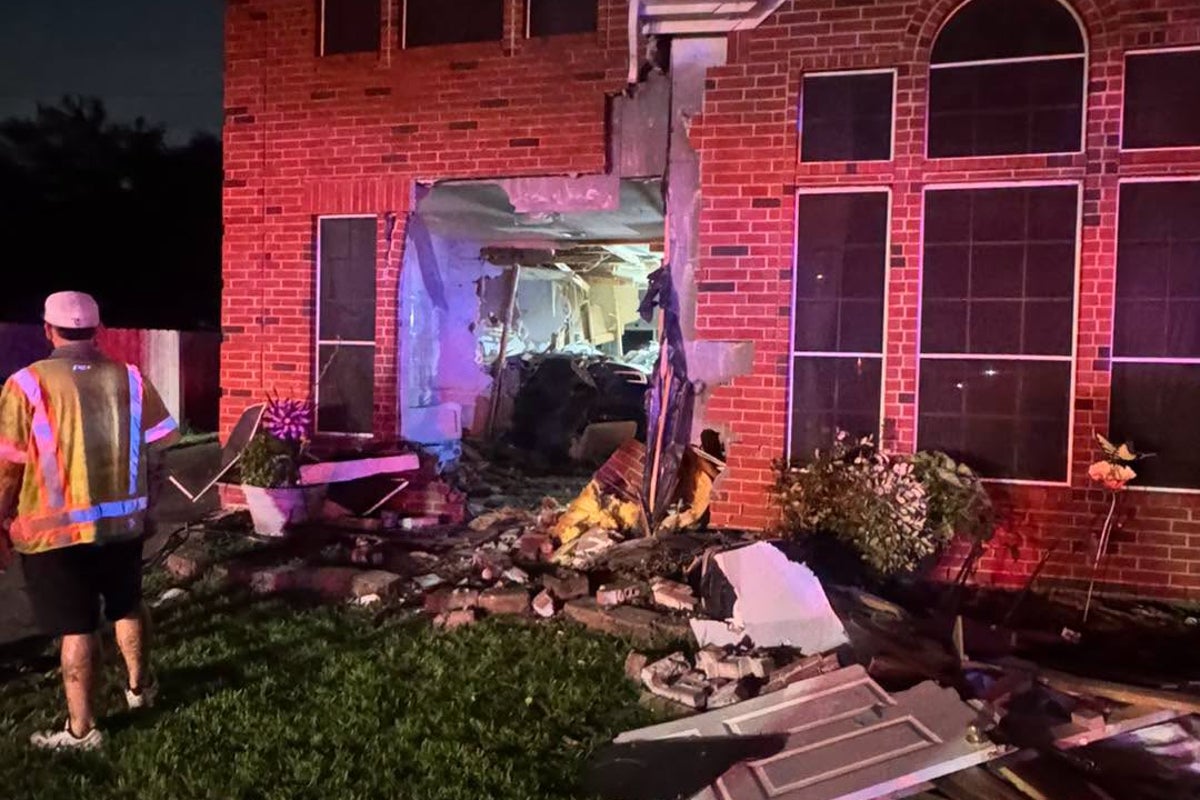
It was around 8 p.m. on a warm Friday evening in June when the quiet of a suburban Katy, Texas neighborhood was shattered. Martha Avila, a 76-year-old grandmother who was the emotional anchor of her family, stood in the front room of her daughter's home on Rose Hollow Lane. She had no way of knowing that a 2025 Tesla Model 3 was screaming down the 30 mph residential street at more than double the speed limit.
Seconds later, the electric sedan veered off the road, cut through a driveway, and plowed straight through the brick wall of the house. The impact was catastrophic. It shoved a heavy refrigerator directly against Avila, pinning her beneath a mountain of shattered drywall, wood, and household rubble. While her family frantically called 911, rescue workers arrived to airlift her to a nearby hospital, where she tragically died from her injuries.
In the immediate aftermath, the 44-year-old driver, Michael Butler, claimed that the car was operating on Tesla's Autopilot system. It is a defense we have heard in dozens of high-profile crashes. But the National Transportation Safety Board (NTSB) released its preliminary findings on the Katy crash, and the hard data tells a much different, far more disturbing story.
The vehicle's black box revealed that the driver did not just let the car drive; he actively forced it to speed.
The Hard Physics and Telemetry of the Katy Crash
The NTSB preliminary report, built on electronic data recovered directly from the Tesla Model 3, clarifies what happened in the seconds leading up to the collision.
Butler had indeed engaged Tesla's Full Self-Driving (FSD) system. However, the automated system was not the entity that chose to rocket down a narrow, two-lane suburban street at highway speeds. According to the telemetry, Butler manually overrode the FSD system by pressing the accelerator pedal down to 100%.
Think about that for a second. That is not an accidental tap of the foot. It is a deliberate floor-to-metal action.
The vehicle reached a peak speed of 73 mph in a 30 mph zone. Even worse, Tesla's director of Autopilot software, Ashok Elluswamy, noted on social media that the driver kept the accelerator fully pressed down even after the vehicle had crashed into the home.
This creates a terrifying picture. FSD was active, but the driver's heavy foot overrode the vehicle's automatic speed limits and safety barriers. Under Tesla’s system architecture, if a driver presses the accelerator, the vehicle will accelerate regardless of whether Autopilot or FSD is active. The software assumes the human driver has a reason for wanting to go faster and defers to human control. In this case, that deference proved fatal.
The Driver Defense Versus the Data
Michael Butler initially told law enforcement at the scene that the car was on Autopilot. Later reports indicated he claimed to have passed out at the wheel before the crash occurred.
These two defenses are highly contradictory. If you pass out, your foot does not typically press an accelerator pedal to 100% capacity and hold it there through a violent collision with a brick wall.
The Harris County Sheriff's Office investigated the mechanical integrity of the vehicle. They found absolutely no evidence of a mechanical malfunction or sudden unintended acceleration. The car did exactly what the driver's foot commanded it to do.
Because of this glaring discrepancy between the driver's claims and the physical telemetry, prosecutors have charged Butler with manslaughter.
For years, drivers have used the "Autopilot made me do it" defense as a get-out-of-jail-free card. They assume that because a car has advanced driver-assist systems, any crash must be a software glitch. But as technology has improved, so has the data logging. Modern electric vehicles are essentially rolling flight data recorders. Every steering angle, brake pressure, and pedal input is recorded down to the millisecond. You cannot lie to a black box.
Why the Avila Family is Suing Both Tesla and the Driver
The tragedy has left Martha Avila's family, including her daughter Jennifer Barbour and son-in-law Justin Barbour, without a mother and without a home. They have filed a wrongful death lawsuit in Harris County seeking more than $1 million in damages.
Interestingly, the lawsuit names both Michael Butler and Tesla, Inc. as defendants.
You might wonder why Tesla is being sued if the driver was the one floorboarding the gas pedal. The Avila family's legal team, led by attorney Chris Adkins, argues that Tesla's systems are fundamentally defective in how they handle driver engagement and system overrides.
Their lawsuit points to several key arguments:
- Inadequate Driver Monitoring: The lawsuit alleges that Tesla fails to adequately monitor whether a driver is actually paying attention or is physically capable of driving.
- System Failures: It claims the vehicle failed to recognize the physical dead end of the street and the home directly in its path.
- Misleading Marketing: The suit argues that Tesla misleads consumers about the true capabilities of Autopilot and Full Self-Driving, creating a false sense of security that leads to reckless behavior.
The lawsuit demands that Tesla preserve all telemetry, black box data, camera footage, and software logs from the crash. This legal battle will likely center on a massive gray area in automotive law: if a driver overrides a safety system and causes a death, does the manufacturer bear any responsibility for allowing that override to happen in the first place?
The Illusion of Self Driving and the Human Factor
This crash highlights a massive psychological issue that safety experts have warned about for a decade. It is called automation complacency.
When a car steers and brakes for you, your brain naturally disengages. You stop treating the vehicle like a 4,000-pound weapon and start treating it like an amusement park ride.
Tesla’s software is categorized as Level 2 automation. This means the human driver must remain fully engaged, with hands on the wheel and eyes on the road, ready to take over at any split second. Yet, Tesla calls its premium software "Full Self-Driving (Supervised)".
To an average consumer, the phrase "Full Self-Driving" sounds like the car can handle everything. The parenthetical addition of "(Supervised)" feels like fine-print legalese. This marketing mismatch creates a dangerous illusion. Drivers think they are passengers, right up until the moment they need to be drivers.
When a driver panics or loses situational awareness, their muscle memory can fail them. In some cases of sudden unintended acceleration, drivers swear they were pressing the brake pedal when they were actually flooring the accelerator. Because they were mentally disengaged while the car was driving itself, their sudden return to active driving was chaotic and disorganized.
Federal Scrutiny is Reaching a Boiling Point
The Katy crash is not an isolated incident. The National Highway Traffic Safety Administration (NHTSA) has opened nearly 50 special investigations into Tesla crashes involving advanced driver assistance systems since 2016, resulting in dozens of deaths.
Just a few months before this crash, NHTSA escalated its probe into 3.2 million Tesla vehicles equipped with FSD. The agency is deeply concerned about whether the system fails to adequately keep drivers focused, especially in low-visibility environments or complex residential areas.
The NTSB, while not a regulatory body with the power to issue fines or recalls, has repeatedly pushed for stricter standards on driver-assist technologies. They want robust driver-monitoring systems—such as infrared cameras that track eye movement—to ensure drivers are not looking down at phones, sleeping, or otherwise ignoring the road.
If a driver can simply press the gas pedal to 100% and override a vehicle's collision avoidance systems in a densely populated residential zone, is the safety software doing its job? This is the central question federal investigators are trying to answer.
How to Stay Safe in the Age of Semi Autonomous Vehicles
If you drive an electric vehicle or a car equipped with advanced driver assistance systems, you need to change how you think about these tools. Here is what you can do to protect yourself and others.
Treat Assistive Tech as Co-Pilots, Not Drivers
Never assume your car sees what you see. If you are approaching a construction zone, a sharp curve, or a residential neighborhood with pedestrians, turn the system off. Drive manually. The technology is designed for open highways, not unpredictable suburban streets.
Understand the Override Rules
In most modern vehicles, pressing the accelerator pedal will override the automatic braking systems. If your car is on cruise control or FSD and you press the gas, you are telling the computer to ignore its radar and camera sensors. Never rest your foot heavily on the accelerator while assist systems are active.
Advocate for Local Speed Mitigation
If you live in a residential area, push your local city council for physical speed barriers like speed bumps or chicanes. As vehicles become heavier and faster, relying solely on painted speed limit signs is no longer enough to protect homes built close to roadways.
The tragedy in Katy is a grim reminder that technology cannot fix bad human behavior. Until cars are fully autonomous and lack steering wheels or pedals entirely, the human in the driver's seat remains completely responsible for every single action the vehicle takes.
This detailed news report covers the initial local coverage of the Katy crash, including statements from the family's attorneys and details on the wrongful death lawsuit filed against Tesla.
http://googleusercontent.com/youtube_content/1

:max_bytes(150000):strip_icc():focal(749x0:751x2)/scott-peterson-011924-4-fdb17804e77f438a8797e61ff48e1aea.jpg)