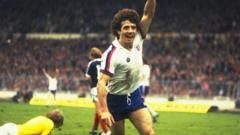
Long before multi-million pound image rights and manicured brand identities dominated English football, one man rewrote the rules of what a player could be. Kevin Keegan did not just play football. He transformed it into entertainment.
When people look back on Keegan's career, they often default to the famous moments. They recall the 1996 live television rant at Alex Ferguson, the iconic perm, or the Brut 33 commercials. But viewing Keegan through a lens of nostalgia misses the bigger picture. He was a pioneer. He took control of his career at a time when football clubs treated players like property, and he proved that British talent could dominate on the European continent on his own terms.
From Pegler's Brass Works to Anfield
Keegan was never supposed to make it. Rejected by Doncaster Rovers and Coventry City as a teenager for being too small, he took a job as a messenger and tea boy at Pegler's brass works in Balby. He played Sunday league football for the Lonsdale Hotel and local youth teams, grinding away while working 40-hour workweeks.
Scunthorpe United eventually gave him a chance in 1968. Over three seasons in the Fourth Division, he showed a ferocious work rate that caught the attention of Liverpool manager Bill Shankly. In May 1971, Shankly signed the 20-year-old for £35,000. It was arguably the best money Liverpool ever spent.
Shankly originally bought Keegan as a midfielder. Within minutes of watching him in training, he shifted him upfront alongside John Toshack. The chemistry was instant. Keegan scored 12 minutes into his Liverpool debut against Nottingham Forest at Anfield, setting the tone for six dominant years.
By the time he departed Liverpool in 1977, he had racked up 323 appearances and exactly 100 goals. More importantly, he helped deliver:
- Three First Division titles (1972–73, 1975–76, 1976–77)
- Two UEFA Cups (1972–73, 1976–77)
- One FA Cup (1974)
- Liverpool's first European Cup (1977)
He left Anfield at the absolute peak of his powers, right after winning the European Cup against Borussia Mönchengladbach. Nobody in English football did that back then. Leaving the top team in Britain was considered career suicide. Keegan didn't care. He wanted a new challenge.
Taking on Germany and Winning Two Ballon d'Ors
When Keegan transferred to Hamburger SV in the summer of 1977 for £500,000, he nearly doubled the German transfer record. He also negotiated a release clause in his contract, a modern contractual mechanism that was virtually unheard of in British football at the time.
The move started terribly. German teammates resented his massive salary and his celebrity status. In training, players refused to pass to him. Disillusioned and isolated, his frustration boiled over in a December 1977 friendly against Lübeck, where he punched defender Erhard Press and received an eight-week ban.
Many players would have packed their bags and headed home. Keegan doubled down. He learned German, immersed himself in the culture, and adapted his game to the brutal physical demands of the Bundesliga.
The payoff was historical. Keegan led Hamburg to their first Bundesliga title in 19 years during the 1978–79 season and reached the 1980 European Cup final. His personal dominance was indisputable:
- 1978 Ballon d'Or Winner: Named European Footballer of the Year over Hans-Krankl and Rob Rensenbrink.
- 1979 Ballon d'Or Winner: Retained the title, beating out Karl-Heinz Rummenigge.
To this day, Keegan remains the only British player to win the Ballon d'Or twice.
The Pop Culture Phenomenon and Commercial Trailblazer
Keegan understood self-branding decades before social media made it standard. He realized early on that a footballer's earning potential extended far beyond wages paid by club chairmen.
He wore personalized branded boots. He recorded a pop single, Head Over Heels in Love, which reached the top 40 in the UK and Germany. He competed on the BBC's Superstars, famously crashing his bicycle at 30 mph and suffering severe friction burns, only to get back up and win the overall competition.
Along with Henry Cooper, he became the face of Brut 33 aftershave, telling men across Britain to "splash it on all over." Fans copied his perm, wore his boots, and bought his merchandise. He proved that an athlete could be a mainstream pop icon without sacrificing performance on the pitch.
Creating Newcastle's Entertainers and the 1996 Title Chase
Keegan's return to English football as a player saw stops at Southampton and Newcastle United, where he helped the Magpies gain promotion in 1984 before retiring. But his deep connection with Tyneside reached its peak in 1992 when he returned as manager.
Newcastle was slipping toward the Third Division and facing financial disaster. Keegan stepped into the dugout with zero managerial experience and completely transformed the club's trajectory. He saved them from relegation, won promotion to the Premier League in 1993, and built a team known as "The Entertainers."
Playing alongside David Ginola, Les Ferdinand, Peter Beardsley, and later Faustino Asprilla, Keegan's Newcastle played an intoxicating brand of attacking football. They didn't care about playing for draws. They simply backed themselves to score more goals than the opposition.
During the 1995–96 Premier League season, Newcastle built a 12-point lead over Alex Ferguson's Manchester United. As the pressure mounted down the stretch, Ferguson began playing his signature psychological games in the media, suggesting other teams like Leeds United wouldn't try as hard against Newcastle.
After a tense 1–0 win over Leeds in April 1996, Keegan lost his composure live on Sky Sports:
"When you do that with footballers like he said about Leeds, his credibility has gone in my eyes... I'll tell you honest, I would love it if we beat them! Love it!"
That raw outburst became one of the most famous moments in television history. Newcastle ultimately finished second, missing out on the title, but Keegan's vulnerability and passion only cemented his legendary status among supporters.
The Honest Truth About His England Career
Keegan's record with the England national team was complicated, defined by genuine pride alongside tactical frustration. He earned 63 caps and scored 21 goals between 1972 and 1982, captaining his country 31 times.
Yet major tournament success evaded him as a player. England failed to qualify for the World Cups in 1974 and 1978. When they finally made the 1982 World Cup in Spain, a severe back injury restricted Keegan to just 26 minutes off the bench against Spain. His entire World Cup playing career boiled down to less than half an hour on the field.
His later spell as England manager from February 1999 to October 2000 ended in similar frustration. After a poor Euro 2000 group-stage exit and a 1–0 loss to Germany in the final match at the old Wembley Stadium, Keegan resigned in the dressing room toilets.
He showed a rare level of candor in his resignation, later admitting the national job exceeded his tactical capabilities. That level of self-awareness and honesty was classic Keegan. He never tried to hide behind soundbites or excuses.
Why Kevin Keegan's Legacy endures
Kevin Keegan scored 204 goals in 592 club appearances. He won European Cups, domestic titles in two countries, and back-to-back Ballon d'Ors. Yet his stats tell only a fraction of the story.
He showed English footballers that they didn't have to stay inside the strict boundaries set by traditional clubs. He showed that passion, hard work, and relentless self-belief could overcome physical limitations. From his humble roots in Armthorpe to the heights of European glory, Keegan approached every challenge with absolute openness.
To study the history of modern English football, you must study Kevin Keegan. He wasn't just a great player or a charismatic manager. He was the bridge between football's working-class roots and the global entertainment industry it is today.
If you want to truly appreciate how modern football culture was formed, look back at the matches, negotiations, and interviews of Kevin Keegan. Study how he took control of his own contract negotiations, how he managed media pressure, and how he insisted on attacking football regardless of the risk. His blueprint is still being used by the biggest stars in the game today.