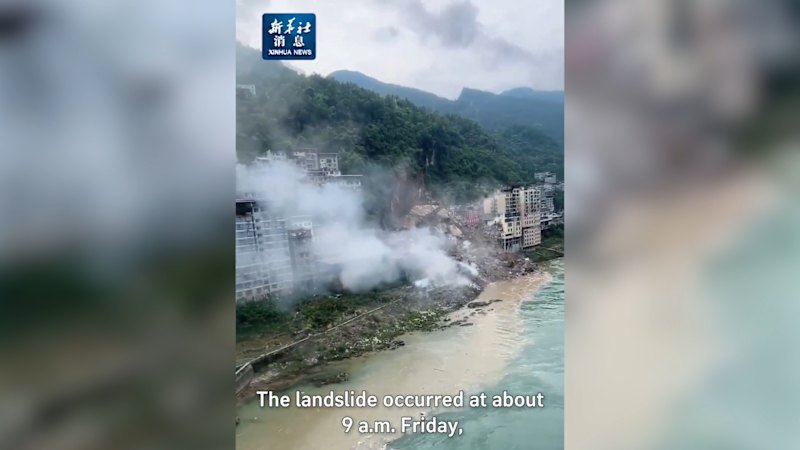
A sudden, terrifying roar like cannon fire tore through the morning air in Pengshui county on Friday morning. Seconds later, a massive mountain slope collapsed, sending a torrent of boulders and mud crashing down onto homes along the Wujiang River. It’s the kind of nightmare that has become far too common in southwestern China. While search teams have miraculously pulled at least seven survivors from the wreckage, this latest landslide in China isn't just another natural disaster. It is a stark, urgent warning about the fragile geological state of a region home to millions.
If you've been following the news, you know that China's mountainous interior has been taking a beating this year. But the real story of what happened in Chongqing Municipality on July 17, 2026, goes far deeper than just "bad weather." It’s a story of a split-second warning, local heroism, and a looming climate crisis that municipal engineers are desperately trying to outrun.
The Eighty Minute Window That Saved Lives
Let's look at the timeline because every minute mattered here.
At 8:00 AM on Friday, an unnamed community worker in Pengshui county noticed something off. It wasn't a massive shift in the earth—just small, persistent pebbles and rocks rattling down the steep mountainside. In many places, people might have ignored it. But in Chongqing, where the terrain is notoriously unstable, that minor rockfall was a siren song of impending doom.
The worker immediately sounded the alarm. Local officials didn't hesitate. They ordered an immediate evacuation, scrambling to pull more than 60 residents out of their homes along the riverbanks.
8:00 AM — Community worker spots falling rocks, sounds warning
8:15 AM — Local officials order emergency evacuation of 60+ residents
9:08 AM — The mountain collapses, burying multiple buildings
At 9:08 AM, the mountainside gave way completely. Boulders smashed into the valley, swallowing residential buildings. The landslide struck right in the middle of the evacuation process.
If that local worker hadn't paid attention to those tiny, falling rocks at 8:00 AM, we wouldn't be talking about a miraculous rescue operation. We would be talking about a mass tragedy.
What It Feels Like When a Mountain Falls
Mr. Xie, an auto repair shop owner who was working just 50 meters away, described the scene as "intense and fierce".
He heard a massive explosion and looked up to see huge boulders crashing down into the riverbank. The air filled with a thick cloud of dust, choking the valley and blinding rescuers who were already on the scene.
Imagine standing in your driveway and watching the hill across the street dissolve into a roaring wall of earth. That’s what the people of Pengshui faced.
Within minutes, China’s Ministry of Emergency Management went into overdrive, upgrading the situation to a level-two emergency response. They deployed more than 200 fire and rescue personnel, heavy machinery, and search dogs to claw through the shattered concrete and mud.
As of the latest reports, seven people—later updated to eight—have been pulled alive from the rubble. Unbelievably, none of them have suffered life-threatening injuries. But the search continues because in these tight, river-carved valleys, finding every single person is an agonizingly slow process.
The Invisible Threat Along the Wujiang River
To understand why this happened, you have to look at the unique geography of the Chongqing region.
Chongqing is famous for its dramatic, vertical beauty. Cities and villages are built directly onto steep cliffsides, hugging the edges of major rivers like the Yangtze and its tributary, the Wujiang. It looks stunning in photos, but geologically, it's a ticking time bomb.
The region features a highly weathered limestone and sandstone structure. When you mix that kind of steep, fragile rock with heavy, relentless seasonal rains, the soil liquefies. The weight of the upper slopes becomes too much for the weak foundations below, and the entire mountainside slides off like wet snow on a windshield.
This isn’t an isolated incident. Just back in May, another devastating landslide in Yongchuan—also part of the Chongqing municipality—claimed the lives of nine people and left 11 missing. Earlier in July, Gansu province saw a massive slide that killed 21 people. The earth is literally moving under people's feet.
Why Early Detection is Our Only Real Defense
You can't stop a mountain from falling once it starts. But you can get out of the way.
The Pengshui evacuation proves that human vigilance is still our best tool. However, relying on a single community worker to spot falling rocks isn't a sustainable safety strategy for millions of people.
Geologists have been pushing for better monitoring systems across southwestern China for years. Here is what actually works to prevent these tragedies:
- InSAR satellite monitoring to detect millimeter-scale shifts in mountainsides long before they are visible to the naked eye.
- Acoustic sensors placed inside deep boreholes to "listen" to the cracking of bedrock under immense pressure.
- Tiltmeters and rain gauges linked to automated SMS warning systems that alert local populations when soil saturation reaches critical levels.
The challenge is scale. Chongqing has thousands of miles of steep river valleys. Outfitting every single vulnerable cliff with high-tech sensors is incredibly expensive and logistically difficult. Until then, the safety of these communities relies heavily on local watchers and rapid emergency response teams.
Next Steps for Vulnerable Mountain Communities
If you live in or travel through landslide-prone mountainous regions, hoping for the best isn't a plan. You need to know the warning signs that preceded the Pengshui collapse:
- Watch the water. Sudden changes in water flow, such as creeks drying up or suddenly becoming extremely muddy, indicate soil shifts upstream.
- Listen to the trees. Crackling sounds, tilting trees, or telephone poles leaning at strange angles mean the ground beneath them is actively moving.
- Inspect your structure. New cracks in foundations, brickwork, or retaining walls are immediate red flags that the slope is settling.
The survivors in Chongqing got lucky because someone saw the signs and acted instantly. As extreme weather continues to batter the region, we have to stop relying on luck and start building smarter, reinforcing old slopes, and respecting the raw power of nature.
The rescue operations in Pengshui are still active, and crews are working around the clock to ensure no one else is trapped beneath the mud.