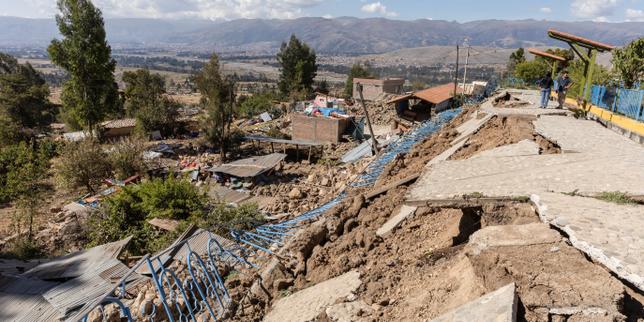
When a 5.1 magnitude earthquake hit the central Peruvian Andes on Saturday night, July 18, 2026, many outside the region barely looked twice at the number. On paper, a 5.1 tremor sounds moderate. It isn't the kind of massive 7.0 magnitude monster that makes international headlines for days. Yet this quake left six people dead, injured at least 32, destroyed 48 homes, and rendered around 300 residents homeless in Junín’s Chongos Bajo district.
How does a moderate tremor cause so much damage? The answer isn't just about seismic energy. It's about depth, geography, and local building techniques.
Shallow Depths and Adobe Structures Make a Lethal Combination
The Peruvian Geophysical Institute tracked the epicenter just west of Huancayo, about 300 kilometers east of Lima. It hit at 9:24 p.m. local time. The defining factor wasn't its magnitude on the Richter scale—it was its depth of just 10 to 24 kilometers.
When a quake hits close to the surface, the energy doesn't have room to dissipate before hitting the ground above. The ground shakes violently right where people live and sleep.
Look at the construction in Pumpunya, the small village in Chongos Bajo where all six deaths occurred. Most homes there are built from traditional adobe—sun-dried clay bricks bonded with mud—or quincha, a weave of wood, cane, and mud. These materials have sheltered Andean families for centuries, but they perform terribly during sudden lateral shaking. Unreinforced adobe lacks tensile strength. When the ground moves, thick clay walls crumble inward under their own heavy weight without warning.
General Luis Vásquez, director of Peru’s National Civil Defense Institute (INDECI), pointed directly to this vulnerability. When brittle structures meet shallow focal depths, a moderate shaking event converts into a structural disaster within seconds.
The Reality of Emergency Response in the Andes
Prime Minister Luis Enrique Arroyo and local officials dispatched emergency aid, tents, and blankets to the affected areas in Junín. Emergency crews moved through the rubble searching for survivors while dealing with at least 12 registered aftershocks.
It's a familiar cycle in Peru, a country positioned directly on the Pacific Ring of Fire. The country records over 400 earthquakes every year, though three-quarters pass unnoticed. When severe events strike, like the tragic 7.9 magnitude Pisco earthquake in 2007 that took nearly 600 lives, the national government vows structural reform. Yet progress in remote highland communities remains slow.
Reinforcing traditional adobe with cheap wire mesh or polypropylene bands—a technique known as seismic retrofitting tested extensively by the Pontifical Catholic University of Peru—can prevent catastrophic collapse during moderate quakes. Getting those solutions into every mountain village requires sustained funding and local training that rarely reaches rural areas before the next tremor strikes.
What to Do if You are Traveling in Seismic Zones
If you live in or travel through earthquake-prone mountainous regions, relying on luck isn't enough. Here are concrete steps to stay safe when visiting areas with vulnerable infrastructure:
- Choose lodging built with reinforced concrete or engineered timber rather than unreinforced masonry or raw adobe.
- Identify at least two exit paths from your room that don't pass under heavy unreinforced brick archways or clay walls.
- Keep a flashlight and sturdy shoes right next to your bed. Earthquakes frequently cut power, and sharp debris on floors causes immediate foot injuries.
- Practice the standard drop, cover, and hold on maneuver under heavy wooden furniture rather than running outside into falling exterior walls.