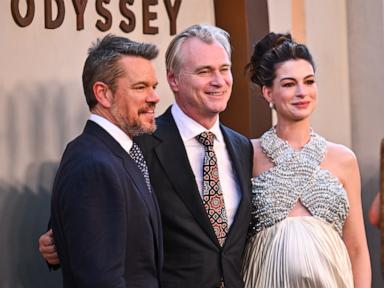
Hollywood loves a spectacle, but Christopher Nolan just threw a $250 million hand grenade into the classical world. His IMAX-sized epic The Odyssey hit theaters with massive box office numbers, yet it left a trail of furious classicists and cultural critics in its wake.
If you think this is just another popcorn flick about Greek myths, you're missing the real battlefield. Scholars aren't just nitpicking historical accuracy. They're asking deeper questions about what happens when Hollywood strips a foundational story of its cultural DNA.
The Identity Crisis in Ithaca
The biggest elephant in the theater isn't the Cyclops. It's the casting. Nolan reunited his Oppenheimer dream team, putting Matt Damon in the sandals of Odysseus and Anne Hathaway as Penelope. Tom Holland plays Telemachus, and Robert Pattinson sneers his way through the role of the predatory suitor Antinous.
It's an incredibly talented A-list lineup. It's also entirely devoid of Greek actors in the lead roles.
For many Greek communities and cultural scholars, this isn't a minor detail. The Odyssey is a story deeply rooted in the concept of nostos—the agonizing, desperate yearning for home, land, and ancestral belonging. When a director treats "Greekness" as nothing more than beautiful coastal scenery, ancient ships, and tunic costumes, it rubs people the wrong way. Critics argue it feels like cultural erasure wrapped in a shiny Hollywood bow.
The Trap of the Linear Timeline
Homer famously starts The Odyssey in media res—smack in the middle of the action—using a complex structure of flashbacks and nested tales. You'd think Nolan, the king of playing with time in Memento and Inception, would feast on this structure.
Instead, he twisted the narrative into a different kind of knots. The film heavily emphasizes the brutal reality of the Trojan War first, reshaping the legendary Trojan Horse trick into a deeply traumatic event.
In Nolan's version, Odysseus forces his cousin Sinon, played by Elliot Page, into a harrowing blood sacrifice to make the deception work. Classicists point out that this shifts the thematic weight. Homer's Odysseus is defined by metis—cunning, quick-witted intelligence. Nolan's Odysseus feels weighed down by modern postwar disillusionment and heavy PTSD. He isn't just trying to outsmart monsters; he's running away from his own guilt.
Where the Film Actually Triumphs
Let's give credit where it's due. Nolan didn't just make a brainless CGI monster mash. He leaned into the text's complex female characters in a way older, stuffier translations completely botched.
Hathaway's Penelope isn't a passive victim weeping over a loom. She delivers a blistering critique of the political vacuum in Ithaca, reminding her son that she held the responsibilities of the throne for two decades without any of the actual power.
- Circe and Calypso: Samantha Morton and Charlize Theron turn potentially one-dimensional temptresses into unsettling, deeply human figures.
- The Gods: Instead of glowing beings on mountaintops, the deities operate on the same gritty, chaotic plane as the mortals, heightening the story's psychological terror.
Every Generation Reinvents the Myth
Purists will always complain when a 2,700-year-old poem gets the blockbuster treatment. But oral traditions were always meant to change depending on who was telling the story. Homeric epics survived because they adapted.
Nolan's version reflects our own cultural anxieties. It questions the true cost of victory and wonders if the trauma of war permanently breaks a person's ability to ever truly return home. It's a flawed, visually stunning, politically messy epic that will be debated in lecture halls and film forums for years.
If you want to understand the controversy fully, don't just read the movie reviews. Grab a modern translation of the text—like the one by Emily Wilson—and compare how a contemporary scholar handles the nuances of identity and power versus how a billionaire Hollywood auteur handles them. The contrast is where the real magic happens.