Temporary wartime borders have a funny habit of turning into permanent concrete realities.
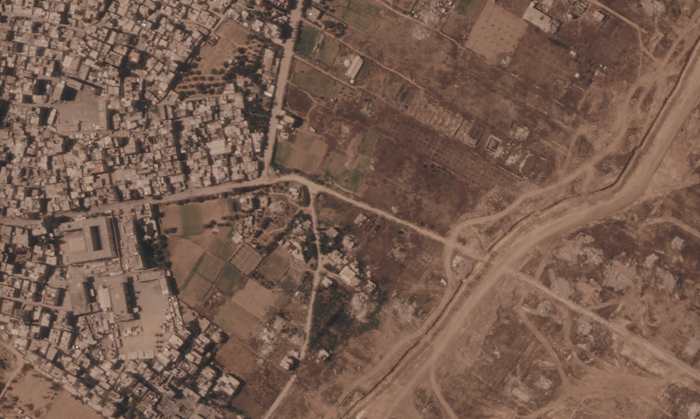
Right now, the Israeli military is rapidly constructing a massive earthen barrier inside the Gaza Strip. It is not a subtle operation. Satellite imagery from Planet Labs PBC reveals that over 23 kilometers (14 miles) of dirt berms and security infrastructure have already been carved through the territory. That is more than half the entire length of the enclave.
If you want to know what the future of Gaza looks like, look at the bulldozers. The line being drawn in the dirt is the clearest signal yet that Israel has no intention of leaving the sectors it currently occupies.
The Yellow Line Reimagined
The barrier tracks what military planners call the yellow line. Back in October, when the U.S.-backed ceasefire deal was inked, this boundary was supposed to be a temporary marker. Israeli troops withdrew to it, and the plan was for a gradual, full withdrawal while an international security force took over.
That plan is dead.
Instead of packing up, the Israel Defense Forces (IDF) confirmed they are building a highly fortified, permanent security zone along this exact line. It is packed with intelligence assets, high-tech surveillance, and heavy fortifications. What was marketed as a temporary truce line is morphing into a de facto international border right before our eyes.
The scale of the construction is staggering. Consider these specific coordinates captured by satellite:
- The Southern Extension: In the first two weeks of July 2026, a southern section of the berm exploded from 500 meters to 2.4 kilometers. It effectively splices the ruined city of Rafah away from Muwasi, the sprawling, squalid coastal tent camp where hundreds of thousands of displaced Palestinians are trapped.
- The Central Spine: This new southern push is fast connecting to a massive 17-kilometer stretch of unbroken barrier running all the way from Khan Younis to the edge of Gaza City.
- The Northern Segments: Separate, heavily guarded berm networks are popping up just outside Beit Lahia, sealing off the northern perimeter.
Two Gazas, Divided Permanently
Look closely at what is happening on either side of this new dirt wall. It tells you everything you need to know about the long-term strategy.
To the west, more than two million Palestinians are crammed into a narrow, suffocating coastal strip. They are living in tents, entirely dependent on trickles of international aid, blocked from returning home.
To the east of the berm, the IDF controls more than 50% of Gaza's landmass—some estimates from earlier this month put it closer to 60%. This area has been systematically depopulated and leveled. Neighborhoods are gone. Towns like Bani Suheila have been flattened by bulldozers and explosives to clear sightlines for new Israeli military bases and freshly paved tactical roads.
The IDF states this infrastructure is necessary to prevent infiltrations and protect Israeli communities near the border. But the physical footprint points to a permanent buffer zone.
The Deadly Ambiguity of an Invisible Border
The worst part for the people living there? The line is a moving target. The yellow line was never precisely defined on paper or clearly marked on the ground by U.S. or Israeli officials. In some areas, the new dirt barriers actually spill outside the original agreed-upon boundary.
This lack of clarity is lethal. Palestinians who get too close to the construction zones are routinely fired upon. While the military claims it only targets militants threatening its positions, independent reports show civilians, including children unaware of where the invisible boundary even sits, have been killed.
The diplomatic track is completely stalled. Former UN diplomats blame Hamas' refusal to fully disarm, while Hamas points to the expanding Israeli infrastructure as a clear violation of the original truce terms. Meanwhile, bodies like the U.S. Board of Peace and Central Command are staying completely silent on the matter.
What Happens Next
Do not expect this barrier to remain just dirt for long. Earthen berms are the first phase of Israeli military engineering. They establish immediate physical control, protect heavy machinery, and block direct sightlines. If history in the West Bank and the old Gaza perimeter tells us anything, these dirt walls will soon be reinforced with concrete slabs, smart fences, and automated weapon stations.
If you are tracking the geopolitical realities of the region, stop listening to the recycled talking points coming out of diplomatic venues. The reality is being authored by combat engineers. Gaza is being physically reshaped, halved, and locked down for the foreseeable future.
To understand the broader geographic shift under way, watch this deep dive on how these new defensive lines are reshaping fronts across the region.