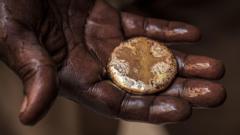
The European Union just took aim at the financial engine powering one of the most brutal civil wars on the planet. By slapping a sweeping ban on Sudanese gold imports and cutting off the supply of essential mining chemicals like mercury and cyanide, Brussels wants to choke off the money feeding the fire.
But let's be entirely honest here. If you think this is going to stop the warring generals from buying drones, bullets, and political favors, you don't understand how the global gold trade actually works.
While the EU's move looks good on paper, it completely ignores a massive, uncomfortable reality. The vast majority of Sudan's gold doesn't go to Europe. It's smuggled out through porous desert borders, washed through regional hubs, and ended up on the international market completely stripped of its bloody origins.
To understand why this ban is mostly symbolic, we have to look at who is actually mining this gold, where it really goes, and why a chemical blockade is incredibly hard to police.
The Blood Gold Lifeline of Two Rival Generals
Since April 2023, Sudan has been ripped apart by a vicious power struggle between the Sudanese Armed Forces (SAF), led by General Abdel Fattah al-Burhan, and the paramilitary Rapid Support Forces (RSF), commanded by Mohamed Hamdan "Hemedti" Dagalo. The humanitarian toll is staggering, with millions displaced and large swathes of the country staring down famine.
Yet, amid the wreckage, Sudan's gold mining sector is absolutely booming.
The country produced an incredible 70 tons of gold in 2025, up from 64 tons in 2024. That is billions of dollars in hard currency. Neither faction could survive a month of high-intensity warfare without it. Here is how they split the spoils:
- The RSF's desert empire: Hemedti's forces control some of the richest artisanal mining regions in Darfur and Kordofan. They tax miners, run their own extraction sites, and use the proceeds to buy advanced combat drones, surface-to-air missiles, and pay their fighters.
- The SAF's state apparatus: The regular army controls the east and north, including Port Sudan. They control the official state mining company and export what they can through formal channels—though even their operations rely heavily on informal, shadowy networks.
Both sides are using a mineral meant to build Sudan's future to buy the tools to destroy it.
Where Sudan's Gold Actually Flows
The central flaw in the EU's ban is a misunderstanding of the supply chain. According to official Central Bank figures, Sudan officially exported just 14.7 tons of gold through legal channels in 2025.
Where did the other 55-plus tons go?
It was smuggled. It travels on the backs of trucks, in hidden compartments, and on chartered flights. The real destinations aren't Frankfurt or Paris.
The Cairo Connection
Roughly 60% of the gold mined in SAF-controlled northern and eastern areas is smuggled across the border into Egypt. Once it crosses that porous desert line, it enters Egyptian markets and processing mills, effectively blended into local supply chains before being exported onward.
The Dubai Laundry
For the RSF, the golden road leads straight to the United Arab Emirates. Smuggled gold from Darfur is routinely trucked into neighboring Chad, flown to Juba in South Sudan, or routed through Uganda. From there, private jets carry it to Dubai—widely known as the "City of Gold".
Once it reaches Gulf refineries, the metal is melted down, recast, and stamped. It gets mixed with gold from other countries, completely erasing its Sudanese origin. When a European jeweler or electronics manufacturer buys a gold bar stamped in Dubai, they have almost no way of knowing if it financed a massacre in Darfur.
Why the Chemical Blockade is a Pipe Dream
The EU's new sanctions package doesn't just ban gold imports; it also outlaws the export of mercury and cyanide to Sudan. These two highly toxic chemicals are essential for separating gold from raw ore.
In theory, cutting off the chemicals should grind the mines to a halt. In practice, it's a enforcement nightmare.
Sudan's mining sector isn't dominated by massive, Western-regulated corporate operations. It is run by millions of artisanal miners working in remote, unregulated desert pits. These miners have been sourcing smuggled chemicals on the black market for decades.
If a gold miner in the middle of the Sahara wants mercury, they don't buy it from an EU-registered chemical distributor. They buy it from black-market traders who smuggle it in from Libya, Chad, or East Africa. A European export ban won't put a dent in those highly lucrative, informal smuggling routes.
What Actually Needs to Happen to Stop the Flow
If the international community is serious about cutting off Sudan's war machine, targeting European buyers isn't enough. It requires aggressive pressure on the intermediaries who facilitate the trade.
- Squeeze the Refineries: Global gold trade bodies, like the London Bullion Market Association (LBMA), must enforce incredibly strict origin-tracing rules on refineries in the Middle East and East Africa. If a refinery cannot prove the exact mine of origin for its gold, it should lose its "Good Delivery" accreditation.
- Pressure UAE and Egypt: Western allies, including the US and the EU, have to stop turning a blind eye to the roles Cairo and Abu Dhabi play in laundering this conflict gold. Real diplomatic pressure is needed to force these regional hubs to clean up their markets.
- Sanction the Front Companies: The RSF and SAF operate through dozens of shell companies registered in foreign jurisdictions. Targeting these corporate entities and freezing their offshore bank accounts is far more effective than trying to police physical gold in the Sahara.
The EU's gold ban is a welcome moral stance, but we shouldn't confuse a moral stance with an effective strategy. Until the major refining hubs of the world are forced to close their back doors, Sudan's blood gold will keep flowing, and the war will keep grinding on.


