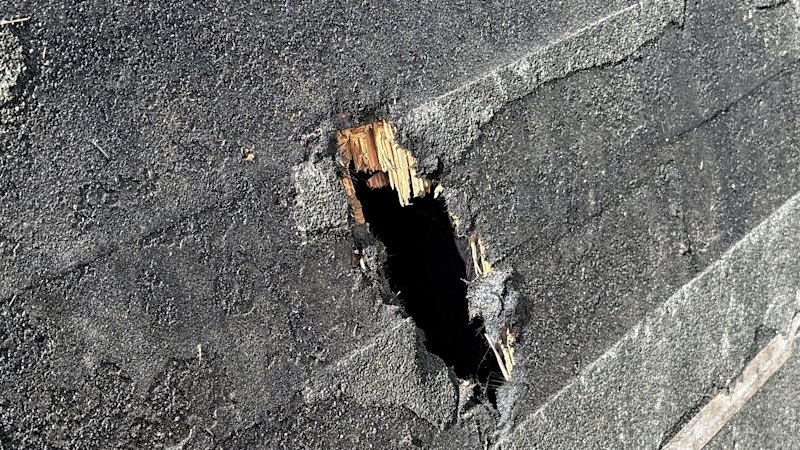
Imagine sitting at home when an explosion rocks your house. The ceiling shatters. Dust fills the air. A sulfurous stench, like rotten eggs, floods your bedroom. You look down and see black rocks scattered across your bed. That is exactly what happened to a homeowner in Hillsborough, New Jersey, on the morning of July 16, 2024. It was a direct hit from outer space.
Most people would panic. Some might call the police and wait on the lawn. But this homeowner did something that changed the course of planetary science. They put on gloves, grabbed aluminum foil, and sealed the smoking space rocks inside glass jars.
Now, two years later, a massive international study published in the journal Science Advances reveals that this quick thinking saved the most pristine sample of cosmic history we have ever laid hands on. Scientists studying the rock found evidence of liquid salt water and complex organic chemistry that formed billions of years ago, long before Earth even existed. It is a wild reminder that the raw ingredients for life did not necessarily start here. They were delivered.
The Day the Sky Fell on Hillsborough
When the meteor streaked across the East Coast in July 2024, it outshone the planet Venus. It was a brilliant fireball moving at 32,000 miles per hour. As it plunged into the dense layers of our atmosphere, the extreme friction caused the rock to fracture and vaporize.
Most of the object disintegrated into dust. The visible light died out about 22 miles above the ground. But it left behind a ghost trail. A Doppler weather radar operating out of Newark Airport picked up a strange signal. It was a long, falling cloud of small pebbles and debris drifting from Staten Island right into New Jersey.
The largest remaining fragment hit the Hillsborough house. Weighing roughly three pounds, the rock tore through the roof and smashed into a bedroom. The recovery was an absolute fluke. If it had landed in a forest, a field, or the ocean, Earth's environment would have ruined it within hours.
The Battle Against Earth Contamination
Space rocks are incredibly fragile. Once they enter our atmosphere, the clock starts ticking. Carbon-rich meteorites act like cosmic sponges. They instantly begin absorbing moisture from the air. They soak up terrestrial bacteria, pollen, and human oils. If you touch a fresh meteorite with bare hands, your skin oils contaminate the delicate organic compounds inside, ruining the data for scientists.
Peter Jenniskens, a lead meteor astronomer at the SETI Institute and NASA Ames Research Center, made it clear that the homeowner’s immediate reaction saved the scientific integrity of the rock. By avoiding bare-skin contact and using clean glass jars, the family kept Earth out of the specimen.
Sure, researchers found a few stray bits of bedroom carpet and ceiling fiberglass stuck to the outer crust. But inside, the stone remained perfectly preserved. It is easily the cleanest sample of its specific group ever recovered.
Decoding the Saltwater Chemistry Inside the Rock
Laboratory teams split the Hillsborough meteorite open to see what it was hiding. They classified it as a rare CM1/2 carbonaceous chondrite.
To understand why this matters, you have to look at how space rocks are usually sorted. Scientists use the CM designation for primitive, carbon-heavy meteorites.
- CM2 meteorites show signs of minor interaction with water on their parent asteroid.
- CM1 meteorites have been heavily modified by liquid water, completely changing their mineral structures.
The Hillsborough rock sits right on the edge. It did not fit cleanly into either box. It is only the second time a meteorite of this mixed transition phase has ever been observed.
When researchers like Mike Zolensky from NASA’s Johnson Space Center looked closer, they found tiny fractures filled with sodium-rich materials—basically, dried salt. This proved the parent asteroid once had actual liquid brine flowing through its pores. As the water evaporated in the vacuum of space, it left the salt behind.
This means the rock did not just float through space as a dry lump of dirt. It was part of an active, wet asteroid world.
Space Rocks and the Prebiotic Inventory
The presence of salty fluids is a big deal for astrobiologists. Brine provides a perfect environment for chemical reactions to happen. When you mix liquid water with primordial minerals, complex molecules start to form.
Danny Glavin and his team at the NASA Goddard Astrobiology Analytical Lab analyzed a small chip of the New Jersey rock. They found a massive variety of amino acids, carboxylic acids, and soluble organic molecules. Amino acids are the literal structural blocks of proteins. They are necessary for life as we know it.
The coolest part? Most of these specific amino acids do not occur naturally on Earth. They were built out in space, inside a dark asteroid, assisted by the movement of ancient brine.
The carbon content of the meteorite hovered around 1.8% by weight, alongside roughly 0.07% nitrogen. These isotope signatures match the ancient material that floated around before Earth even finished forming. It strongly supports the idea that billions of years ago, a relentless bombardment of similar carbonaceous meteorites seeded our young, barren planet with the chemical starters required to spark life.
Tracing the Cosmic Hit and Run
Scientists did not just study the chemical makeup of the stone. They also figured out exactly where it came from.
By taking security footage, doorbell camera clips from places like Wayne, New Jersey, and public reports from the American Meteor Society, researchers calculated the trajectory of the fireball. They traced its path backward, out of our atmosphere and deep into the inner asteroid belt between Mars and Jupiter.
The numbers point directly to a 45-mile-wide asteroid known as 163 Erigone. Roughly 155 million years ago, another massive object slammed into Erigone, shattering parts of it and creating a scattered family of smaller space rocks. One of those broken shards spent millions of years drifting through the solar system, eventually crossing paths with Earth’s orbit and ending its journey on a mattress in New Jersey.
What to Do if a Space Rock Hits Your House
The odds of a meteorite hitting your home are microscopic. You are far more likely to get struck by lightning. Globally, a home is struck only about half a dozen times a year. In North America, it happens roughly once every three to five years.
But if you happen to be the unlucky, or incredibly lucky, person who hears that sudden crash, you need to know how to handle it.
Do Not Touch it with Your Bare Hands
Your skin is covered in oils, sweat, and microbes. Touching a fresh meteorite introduces instant contamination. If you want to help science, put on clean disposable gloves immediately.
Avoid Plastic Bags for Long Term Storage
Plastic can outgas volatile organic compounds that leach into the rock. Use clean, heavy-duty aluminum foil to wrap the pieces, then place them inside a clean glass jar with a tight lid.
Call the Experts
Do not try to clean the rock or wash off the black soot. That soot is the fusion crust, created when the rock melted during atmospheric entry. It is a critical piece of data. Reach out to organizations like the American Meteor Society or a local university geology department right away.
Understand the Legal Side
In the United States, meteorites are governed by finders-keepers laws on private property. If a space rock crashes through your roof, it belongs to you, the property owner. You have the legal right to keep it, sell it to private collectors for thousands of dollars, or donate it to institutions like the American Museum of Natural History, where pieces of the Hillsborough meteorite are now kept. Note that if a rock falls on federal land, it belongs to the government. Your house, however, is yours.
The Hillsborough event proved that citizens are an active part of the scientific community. Without the homeowner's quick, careful preservation, this pristine look into our solar system's wet, organic past would have been lost to the humidity of a New Jersey summer. If the sky ever falls on your head, grab the foil and gloves.