We like to think we've mapped every corner of this planet. We haven't. Not even close.
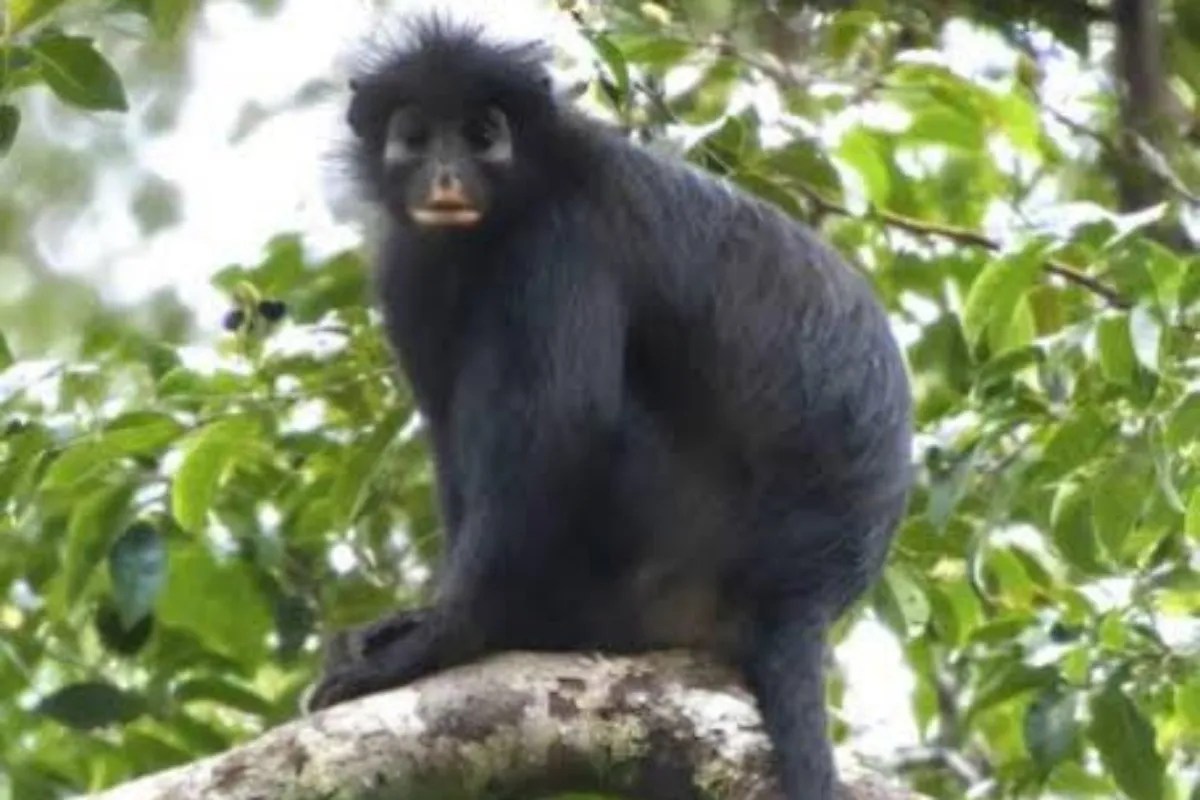
A newly identified monkey species just turned up in the dense canopies of the Democratic Republic of Congo. It has a pitch-black body and bright, almost glowing, pinkish-orange lips. Officially named Colobus congoensis, local communities have known about it for years, calling it the "Likweli".
This isn't just another cool animal photo for your social feed. It's only the fifth new monkey species identified in Africa over the last 75 years. Think about that. In an era of satellite tracking and constant surveillance, a completely distinct primate was hiding right under our noses.
Here's the real story behind the discovery and why its survival is already on a knife-edge.
A Sixteen Year Game of Hide and Seek
Finding a new mammal in 2026 isn't like discovering a new insect. It takes years of grueling fieldwork, local trust, and a lot of luck.
The story started back in 2008. Conservationists working in Lomami National Park caught a fleeting glimpse of an unusual primate high in the trees. They snapped a photo. It was terrible. A blurry, pixelated mess that proved absolutely nothing to the scientific community.
For ten years, the forest went quiet. The mysterious monkey seemed to vanish.
Then, in 2018, researchers got another clear look. That second sighting sparked an international investigation. Led by Junior Amboko, a doctoral student at Florida Atlantic University, and a dedicated team of researchers, the hunt was on.
They didn't just walk into the jungle with cameras. They spent years tracking the animals, recording their deep, roaring vocalizations, and collecting biological samples.
But the most crucial step? Talking to the people who actually live there.
The team interviewed residents across 52 local villages. Interestingly, residents in only eight of those villages recognized the monkey. This was the first major clue that the Likweli wasn't just hiding; its geographic range was incredibly tiny.
The Evolutionary Split
You might wonder if this is just a regular monkey with a weird facial tan. It's not.
Scientists ran DNA sequencing on the samples they gathered. The genetic data revealed that the Likweli split from its closest relative, the black colobus (Colobus satanas), roughly four to five million years ago.
That's an incredibly long time to evolve in isolation.
What makes this separation even wilder is the geography. Its closest relative lives about 1,200 kilometers away. Rivers, shifting landscapes, and changing forest boundaries thousands of millennia ago essentially trapped this population in a small pocket of the Congo Basin.
Over millions of years of isolation, they developed their own distinct look and behavior:
- The Mask: They have bare grey skin on their cheekbones contrasting sharply with black skin around their eyes.
- The Lips: The defining feature is a brilliant, conspicuous pinkish-orange patch directly around the mouth.
- The Call: They have a deep, roaring call that sounds structurally different from other colobus monkeys.
- The Tail Patch: A highly visible white fur patch surrounds their anus.
These are herbivorous canopy dwellers. They live in small groups, usually between 1 to 20 individuals, eating leaves, plants, and wild fruits. Because they lack thumbs—a classic trait of colobus monkeys—they rely entirely on their strong limbs to navigate the high treetops.
Why the Likweli Is Already in Deep Trouble
I hate to ruin a good discovery story with grim realities, but we have to face the facts. The ink is barely dry on the scientific papers published in PLOS One, and researchers are already calling for the Likweli to be listed as Endangered.
Their entire habitat is confined to a tiny strip of closed-canopy forest—roughly 1,700 square kilometers—wedged between the Lomami and Lilo rivers.
That's a shockingly small home for an entire species.
Because their range is so restricted, they're highly sensitive to any changes in their environment. If a logging company cuts down a portion of their forest, or if miners encroach on their territory, it doesn't just push them back—it could easily wipe out an entire subpopulation.
Then there's the hunting pressure. Like many primates in the Congo Basin, these monkeys are hunted for bushmeat. Now that we officially know Colobus congoensis exists as a distinct, rare species, conservationists are rushing to establish formal legal protections.
What We Do Next
We can't protect what we don't know exists. The discovery of the Likweli is a loud, clear reminder that the Congo Basin—the second-largest tropical rainforest on the planet—still holds massive ecological secrets.
If you want to support the survival of newly discovered species like the Likweli, don't just read the news and move on. Look into the organizations doing the actual heavy lifting on the ground, like the Frankfurt Zoological Society or local Congolese conservation groups. They're the ones patrolling these remote forests, working with local communities, and keeping the chainsaws at bay.