If you woke up this week with relentless, watery diarrhea, severe fatigue, and stomach cramps that just won't quit, you aren't alone. Thousands of Americans are suffering from the same brutal stomach illness right now, and the culprit isn't a standard stomach bug or common food poisoning. It's Cyclospora cayetanensis, a microscopic single-celled parasite that infects the small intestine and turns a routine salad into weeks of misery.
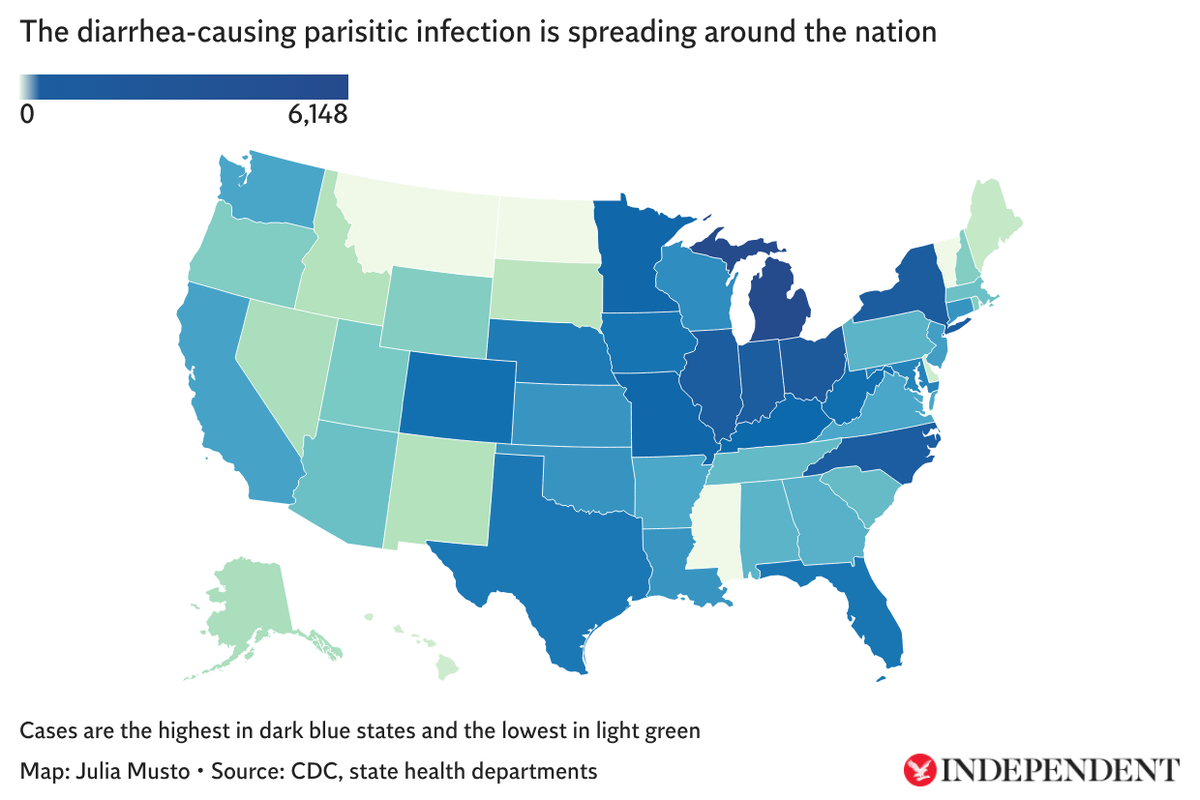
The scale of this summer's outbreak is catching health systems completely off guard. While federal agencies track around 1,600 lab-confirmed cases, state-level data tells a far more alarming story. Across more than 30 states, real-world case counts have surged past 10,000 when accounting for backlogged lab samples and state health department reports. Michigan alone has logged over 4,000 cases, with hundreds of patients requiring emergency care or hospitalization.
What makes this outbreak particularly frustrating isn't just the sheer volume of sick people. It's how hard this parasite is to catch, trace, and eradicate.
The Numbers Behind the Cyclospora Parasite Outbreak Are Staggering
To understand why this outbreak feels so widespread, look at how public health tracking actually functions behind the scenes. When the Centers for Disease Control and Prevention posts official surveillance updates, those figures represent a delayed snapshot of confirmed, fully processed cases. The CDC recently reported 1,645 domestically acquired cases across 34 states, with 141 hospitalizations. But that number is just the tip of an iceberg.
The agency openly admits to a backlog of more than 5,100 unconfirmed cases that state labs are still attempting to analyze. Add in local state reporting, where state health workers directly interview residents, and the real numbers skyrocket.
State Case Distribution Highlights (Summer Outbreak)
---------------------------------------------------
* Michigan: 4,300+ reported cases (100+ hospitalizations)
* New York: 470+ reported cases
* Ohio: 360+ reported cases
* Combined National Estimate: 10,000+ total infections nationwide
Compare these numbers to last year. At this point in 2025, health officials had recorded fewer than 250 total cases nationwide. We are looking at an exponential jump that has strained local health departments to their absolute limit.
Why the sudden explosion? Part of it comes down to environmental factors. Cyclospora spores thrive in warm, humid weather. Higher summer temperatures across major agricultural regions provide the ideal conditions for parasites to mature once they enter irrigation systems or soil. Combine extreme weather events with budget cuts across federal food safety programs over the last year, and you get a perfect storm for agricultural contamination.
Why Cold Water and Produce Wash Won't Protect You
Here is a hard truth that catches most consumers off guard. Washing your lettuce under cold tap water will not remove Cyclospora.
Unlike common bacterial threats like E. coli or Salmonella, which often sit loosely on the surface of produce or respond to standard sanitizers, Cyclospora is remarkably resilient. The microscopic parasite produces a tough outer shell called an oocyst. This protective wall makes it resistant to standard chlorine treatments, chemical fruit washes, and basic household soap.
The parasite binds tightly to the surface folds of leafy greens, raspberries, basil, cilantro, and snap peas. Rinsing helps knock off loose dirt, but it cannot guarantee the removal of microscopic cysts glued to plant tissue.
Another misconception is person-to-person spread. If your family member contracts cyclosporiasis, you won't catch it instantly by shaking their hand or sharing a bathroom. When the parasite leaves the human body in stool, it is un-sporulated—meaning it is not yet infectious. It requires anywhere from several days to two weeks sitting in warm soil or water to mature into an infective state.
That lag time creates a massive headache for disease detectives. When you start feeling sick, you aren't reacting to something you ate yesterday. You are reacting to something you ingested two to fourteen days ago. Try remembering every single meal, side salad, garnish, and smoothie ingredient you ate three weeks ago. Most people can't do it.
How Contaminated Lettuce Traced Back to Fast Food Chains
Traceback investigations are notoriously tricky, but recent breakthroughs have pinpointed major links in the supply chain.
In mid-July, federal health authorities zeroed in on shredded iceberg lettuce served at Taco Bell locations across five states: Indiana, Kentucky, Michigan, Ohio, and West Virginia. Hundreds of sick patients reported eating at the chain shortly before falling ill. Investigators traced the implicated product back to a single major produce supplier sourced out of Mexico.
Fast food chains rely on massive, centralized processing facilities where thousands of pounds of leafy greens are washed, chopped, and bagged together. If a single contaminated batch of lettuce enters a commercial washing line, the water can disperse the parasite across tons of product before it gets shipped to hundreds of restaurants.
Taco Bell acted quickly by removing shredded lettuce, cilantro, and fresh garnishes from affected regional stores. But fast food isn't the only channel. Historical outbreaks show that grocery store pre-packaged salad kits, fresh herbs, imported berries, and snow peas frequently carry the parasite. Until agricultural testing improves at the farm and water-basin level, imported produce remains a recurring vulnerability during summer months.
The Diagnostic Trap That Keeps Sick Patients Waiting
If you visit an urgent care center or primary care doctor with severe stomach pain and explosive diarrhea, there is a high probability they will miss the diagnosis on the first try.
Standard routine stool tests—often called "Ova and Parasite" or O&P screens—do not automatically look for Cyclospora. The organism is tiny and requires specialized laboratory staining methods or specific molecular PCR panels to detect. If your physician doesn't explicitly order a Cyclospora test or a comprehensive gastrointestinal PCR panel, your sample will come back negative for standard bacteria, leaving you without answers while symptoms rage on.
Without targeted treatment, cyclosporiasis takes a exhausting toll on the body. It causes a relapsing-remitting pattern. You might feel better for two days, think you've cleared the virus, and then get slammed with intense abdominal cramps, severe nausea, bloating, and watery stool all over again. This cycle can drag on for a month or longer, leading to rapid weight loss, severe muscle weakness, and dehydration.
Common over-the-counter anti-diarrheal medications like loperamide won't clear the parasite. Neither will standard antibiotics used for ordinary stomach infections like ciprofloxacin.
The primary, proven treatment for Cyclospora is a specific prescription combination antibiotic: trimethoprim-sulfamethoxazole, commonly known as Bactrim or Septra. For patients with sulfa allergies, alternative regimens exist, but they require direct consultation with an infectious disease specialist. Getting proper medical care quickly makes the difference between suffering for six weeks or recovering in three days.
Practical Steps to Reduce Your Risk Right Now
You don't need to completely stop eating fresh produce, but you do need to adjust how you handle food during active outbreak months. Taking a few strategic precautions reduces your exposure drastically.
1. Cook Your Vegetables When Outbreak Levels Are High
Heat kills the parasite outright. Heating food to an internal temperature of at least 158°F (70°C) destroys Cyclospora oocysts completely. If you live in an area with high case counts like Michigan, Ohio, or New York, swap raw salads for sautéed greens, steamed veggies, and cooked meals until outbreak warnings subside.
2. Strip Outer Leaves and Scrub Firm Skins
When preparing raw leafy greens like romaine or iceberg, peel off and discard the outer two to three layers of leaves entirely. These outer leaves bear the highest exposure to contaminated irrigation water and handling. For firm produce like cucumbers, melons, or root vegetables, scrub the surface vigorously under running water with a clean brush.
3. Advocate for the Right Medical Test
If you develop watery diarrhea that lasts longer than three days, accompanied by intense fatigue and bloating, see a doctor. Explicitly tell your provider that you suspect Cyclospora and ask them to order a GI PCR panel or specific Cyclospora testing. Mention any recent consumption of leafy greens, fast food salads, or fresh herbs.
4. Hydrate with Electrolytes Immediately
Severe watery diarrhea drains your body of essential salts and fluids fast. Plain water isn't enough when you're losing high volumes of fluid. Use oral rehydration solutions or electrolyte preparations to maintain blood pressure and kidney function while seeking treatment.