Washington is reeling. The sudden passing of South Carolina Senator Lindsey Graham at age 71 has left a massive vacuum in American foreign policy and Republican politics. He died Saturday evening, July 11, 2026, at his home on Capitol Hill. The official medical examiner report confirmed the cause was an aortic dissection brought on by arteriosclerotic cardiovascular disease. Just a day prior, he was in Kyiv shaking hands with Ukrainian President Volodymyr Zelenskyy. It is a startling, abrupt end to a 30-year congressional career that defined an entire era of American interventionism.
You cannot understand modern American conservatism without looking at how Graham operated. He was a political chameleon, a hawk who never met a military budget he did not want to expand, and a master dealmaker who knew exactly how to stay close to the center of gravity in his party. His death has drawn swift tributes from Donald Trump and Benjamin Netanyahu, two men who relied heavily on his unwavering defense in Washington. But beneath the standard diplomatic condolences lies a complicated truth. Graham was one of the last true institutional bridges in a deeply fractured Senate.
The Sudden Night on Capitol Hill
Emergency responders got the call around 8:30 PM on Saturday night. The audio from police scanners detailed a patient experiencing acute chest pains at Graham's Washington residence. He was scheduled to appear the following morning on NBC's "Meet the Press." Instead of hosting him, the network broadcasted a live phone-in tribute from President Donald Trump.
Trump revealed that he spoke with Graham on Saturday evening just as the senator returned from his overseas trip. Trump noted that Graham sounded tired but otherwise great. It turned out to be their final conversation. The president quickly ordered federal flags across the country to fly at half-staff.
The medical details paint a clear picture. An aortic dissection is a sudden, catastrophic tear in the body's main artery. It happens fast. For a man who lived at a relentless pace, traveling to international combat zones well into his seventies, the physical toll finally caught up. His office released a brief statement requesting privacy, kicking off an immediate scramble inside the Capitol as lawmakers realized a titan of the Senate Judiciary and Budget committees was gone.
From Trump Critic to Fierce Confidant
The relationship between Lindsey Graham and Donald Trump will be studied by historians for decades. It is a masterclass in political survival. Back in 2015, when both men were vying for the Republican presidential nomination, Graham did not mince words. He publicly called Trump a "jackass," a "kook," and a "race-baiting, xenophobic, religious bigot." He famously predicted that if the party nominated Trump, it would get destroyed and deserve it. Trump hit back just as hard, famously reading Graham's private cell phone number aloud on television during a campaign rally.
Then something changed. Trump won.
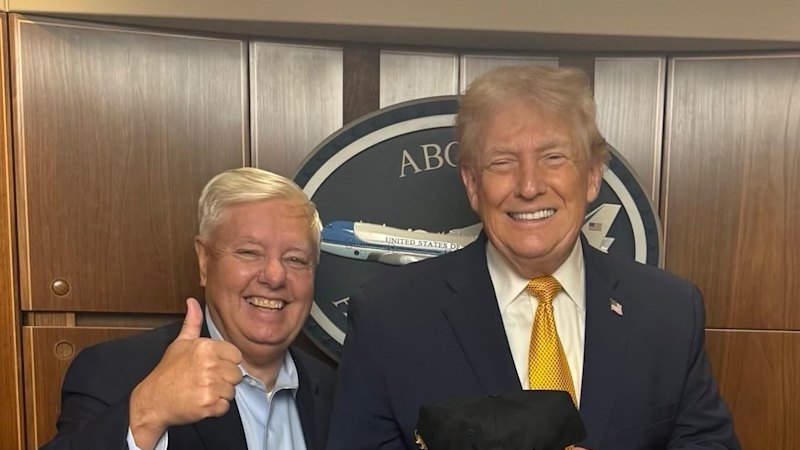
Graham realized that to remain influential, he had to be in the room where decisions were made. He went from being Trump’s fiercest internal critic to his most reliable golf partner and legislative defender. He backed Trump through twin impeachments, fought like hell to confirm conservative judges like Brett Kavanaugh, and held a "Trump 2028" hat at public events.
Critics called it shameless opportunism. Graham called it pragmatism. He often argued that if you want to help your state and shape national security, you have to work with the leader of your party. He managed to maintain that closeness even after the chaos of January 6, 2021, when he briefly declared on the Senate floor that "enough is enough," only to return to the MAGA fold shortly after.
The Ultimate Foreign Policy Hawk
To understand Graham’s worldview, you have to look back to the "Three Amigos." That was the nickname given to Graham, the late Arizona Senator John McCain, and former independent Senator Joe Lieberman. Together, they formed an unyielding block that championed American military intervention across the globe. They were the loudest voices backing the Iraq War in 2003 and consistently pushed for a permanent military presence in Afghanistan.
Even as the Republican party shifted toward an America First, isolationist stance under Trump, Graham refused to fully abandon his hawkish roots. He walked a thin line. He managed to support Trump domestically while aggressively pushing for foreign aid packages that went against the grain of the modern populist movement.
Look at his final week alive. On Friday, July 10, Graham was in Kyiv. It was his tenth visit to Ukraine since the 2022 Russian invasion. He met with Zelenskyy to secure a new bipartisan sanctions bill designed to hammer the Russian economy. Graham looked at global politics through a classic Cold War lens. He believed that failing to stop Vladimir Putin in Europe would directly signal weakness to China regarding Taiwan. Zelenskyy mourned him on Sunday, calling him a true defender of freedom.
Washington and Jerusalem React
The grief from international allies was immediate, nowhere more so than in Israel. Prime Minister Benjamin Netanyahu was visibly shaken by the news. He released an emotional statement calling Graham a cherished personal friend and the best ally Israel ever had in the United States Senate.
Netanyahu's political career has been defined by his hardline stance against Iran, and Graham was his loudest echo in Washington. Graham regularly pushed both Democratic and Republican administrations to support pre-emptive strikes on Iranian oil infrastructure and nuclear facilities. During the military campaigns in Gaza, Graham repeatedly defended Israel’s right to total victory, drawing intense criticism from human rights groups when he suggested the conflict was an existential fight akin to America using atomic weapons in World War II.
Israeli President Isaac Herzog and Defense Minister Israel Katz joined in the praise, noting that Graham traveled to Israel multiple times immediately following the October 7 attacks to show physical solidarity. The Prime Minister's Office in Jerusalem indicated that Netanyahu is already exploring logistical arrangements to fly to the United States to attend Graham's funeral services personally.
The Power Vacuum in South Carolina
What happens to his Senate seat now? South Carolina law gives Republican Governor Henry McMaster the authority to appoint an interim senator to fill the vacancy. This appointment will hold until a special election can be organized to decide who finishes the remainder of Graham's term.
Graham was already gearing up for a re-election campaign for this November's midterms. His sudden death throws the state's political calendar into complete chaos. McMaster called Graham irreplaceable, describing him as the fiercest of fighters for the state. The backroom maneuvering among South Carolina Republicans to secure that appointed seat started almost immediately after the death was confirmed. It is a safe Republican seat, meaning whoever McMaster picks will instantly become a powerful player in Washington.
The Reality of His Complicated Legacy
People love to view politicians as cartoons. They want them to be pure heroes or absolute villains. Lindsey Graham defies that easy categorization. He was a kid who grew up in the back of a South Carolina pool hall run by his parents, became the first in his family to attend college, served as an Air Force lawyer, and rose to the absolute pinnacle of global political influence.
He was a man who could trade jokes with Democrats like Joe Biden to pass complicated spending bills, yet turn around and deliver a blistering, furious speech defending conservative judicial nominees on national television. He was an institutionalist who loved the traditions of the Senate, but he was fully willing to ride the populist wave of the MAGA movement to protect his own political survival.
He didn't care if people called him a hypocrite for flipping on Trump. He cared about power, access, and keeping the United States military engaged across the world. With his death, the old-school, interventionist wing of the Republican party loses its most effective strategist.
If you want to keep tabs on how this shifts the balance of power in the Senate, keep your eyes on Governor McMaster's upcoming appointment. The choice will tell us exactly which direction the South Carolina GOP—and the broader party—is heading as the 2026 midterm elections approach.