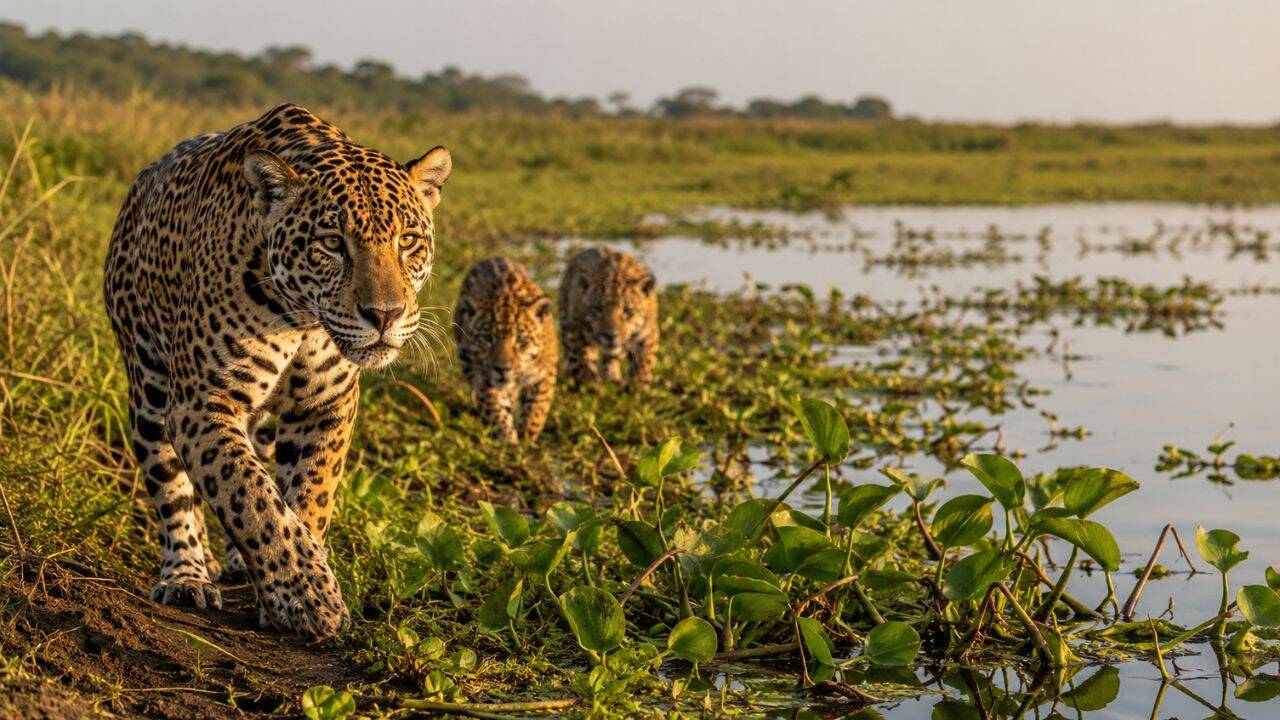
We used to think conservation meant putting up a fence, standing back, and hoping for the best. It doesn't work. For decades, global conservation strategies focused on passive protection, trying to preserve the scraps of what human development had not yet destroyed. But simply guarding a degraded habitat does not fix it. To restore a broken environment, you sometimes have to bring back its ghosts.
In northeastern Argentina, that ghost was the jaguar. For another look, read: this related article.
For nearly seventy years, the Iberá wetlands were completely silent of their most formidable predator. Hunting, cattle ranching, and agricultural expansion wiped out the local population of Panthera onca by the mid-twentieth century. The region lost its top predator, and with it, the natural balance that kept the entire ecosystem healthy.
Then came an audacious plan to rewrite the rules of conservation. Further insight on this matter has been published by The Guardian.
Today, the Iberá wetlands jaguar is back. This is not just a feel-good story about saving a single species. It is a masterclass in active ecological restoration, proving that we can rebuild fully functioning wild habitats from the ground up.
The Price of a Fifty Year Silence
Before we appreciate the return, we have to look at what went wrong. A century ago, jaguars roamed freely from northern Argentina all the way down into Patagonia. They occupied over two-thirds of the country. But as human settlements expanded, ranchers viewed the big cat as a direct threat to livestock. Professional hunters sought their valuable skins, and agricultural projects carved up the rest of their home.
By the late 1950s, the jaguar had vanished entirely from the Corrientes province, where the massive Iberá marshlands lie.
Across the rest of Argentina, the situation was equally grim. Today, researchers estimate that only about 200 wild jaguars remain in the entire country, surviving in highly fragmented, isolated populations in the north. These tiny pockets are cut off from one another, which severely limits genetic diversity and threatens the species with total extinction.
When you remove an apex predator from a habitat, you do not just lose a beautiful animal. You break the engine of the ecosystem. In the absence of jaguars, herbivores like capybaras and marsh deer faced no natural pressure. Their populations swelled. They overgrazed the vegetation, altered water channels, and pushed out smaller species. The entire wetland became degraded, proving that a wilderness without its king is a wilderness in decline.
Rebuilding a Wetland from Scratch
Bringing the jaguar back to Iberá was not a simple matter of releasing captive zoo animals into the wild. That is a recipe for disaster. Captive-born predators do not know how to hunt, they do not fear humans, and they rarely survive.
The strategy required a massive, multi-decade effort led by the non-profit organization Rewilding Argentina. This independent group grew out of the vision of Tompkins Conservation, founded by the late Douglas Tompkins and his wife Kristine Tompkins. Starting in the late 1990s, they began buying up degraded cattle ranches bordering the Iberá Provincial Park.
Their goal was straightforward but incredibly difficult. They wanted to create a massive, connected, protected area and then systematically reintroduce the species that had been lost.
In 2018, their efforts paid off when the Argentine government officially established the Iberá National Park, which now covers hundreds of thousands of hectares of protected marshlands, grasslands, and forests. Together with the provincial park, the entire Gran Iberá Park spans nearly 700,000 hectares. This vast region has plenty of space and a massive population of wild prey, making it the perfect stage for a historic comeback.
The Physics of Trophic Cascades
Why go to all this trouble for a large carnivore? The answer lies in a biological concept known as a trophic cascade. Predators control the behavior and numbers of prey animals, which in turn determines the health of the plants.
Consider the capybara, a giant rodent that is incredibly common in the Iberá wetlands. Without jaguars, capybaras ruled the marshlands. They gathered in massive herds, eating everything in sight.
Since the reintroduction project began releasing jaguars, scientists have documented a massive shift. Dr. Emiliano Donadío, a lead biologist on the project, noted that capybaras make up about 70 percent of the jaguars' diet. In the central areas of the park where jaguars are now active, capybara density has dropped from roughly 50 individuals per square kilometer to just one.
This is not a tragedy for the capybaras; it is a victory for the ecosystem. With fewer rodents grazing every square inch of the wetlands, local vegetation is recovering. Native plants are growing taller, providing nesting sites for birds, cover for smaller mammals, and stabilizing the soil. The presence of the predator has made the prey more cautious, forcing them to move constantly rather than overstaying and stripping the land bare.
How to Teach a Captive Cat to Be Wild
The breeding and release program is a masterclass in adaptive wildlife management. Because there were no wild jaguars left in Corrientes, conservationists had to build a founding population. They established the specialized Jaguar Reintroduction Breeding Center right in the heart of the wetlands.
The team brought in jaguars from various sources. Some were rescued orphans from neighboring countries like Brazil. Others came from zoos and shelters. While the adult zoo animals themselves could never be released, their offspring could.
The staff designed massive, 1.5-hectare pens to raise the cubs with zero human contact. Biologists monitored the cats using remote cameras, ensuring they never associated humans with food. To prepare them for the wild, the team introduced live prey—first smaller animals, then larger ones like capybaras and caimans. Only when a young jaguar proved it could hunt, kill, and survive entirely on its own was it deemed ready for release.
The big breakthrough happened in January 2021. Mariua, an orphaned female rescued in Brazil, was released into the wild alongside her two captive-born cubs, Karai and Porã. It was a monumental moment. For the first time in seventy years, jaguar footprints pressed into the wet soil of Iberá.
On New Year's Day in 2022, the project took another major step by releasing Jatobazinho, the first adult male. He had already mated with females at the breeding center, fathering cubs that were previously released. By late 2025, the population of free-roaming jaguars in the Iberá wetlands had surged to an estimated 35 to 40 animals. The population is growing so quickly and successfully that biologists are now beginning to translocate some of these animals to other national parks in northern Argentina to start new recovery projects.
Community and Culture are the Real Keys to Success
You cannot save a large carnivore without the support of the people who live alongside it. If the local communities feel threatened or ignored, the animals will eventually be shot.
The team at Rewilding Argentina understood this from day one. They spent years working with local communities, ranchers, and regional leaders before a single jaguar was ever let out of its pen. They held town halls, conducted surveys, and built up local pride.
For the Guarani people of northeastern Argentina, the jaguar, known as the yaguareté, is a deeply respected cultural symbol of strength, identity, and courage. Reintroducing the cat was framed not just as an environmental goal, but as a cultural homecoming.
Crucially, the project created a new economic engine for the region: ecotourism. Local gauchos, who once earned a meager living working on cattle ranches, have transitioned to working as wildlife guides, park rangers, and hospitality hosts. Tourists from all over the world now travel to lodges like Rincón del Socorro to catch a glimpse of a wild jaguar, bringing sustainable revenue directly to local families. When a live jaguar is worth far more to the local economy than a dead one, long-term survival becomes a shared goal.
Why Passive Protection is Failing Nature
The success in Iberá is a direct challenge to old-school conservation philosophy. Simply buying land and declaring it protected is no longer enough to save global biodiversity.
Many of the world's national parks are "empty forests"—landscapes that look green and healthy on a satellite map, but are ecologically dead because their key species have been hunted out. Without apex predators, seed dispersers, and large herbivores, these areas slowly degrade over time.
Active rewilding is the antidote to this decline. It requires a willing, hands-on approach to ecosystem repair. We have to be willing to breed animals, manage genetic lines, move species across borders, and actively manage habitats. It is expensive, highly controversial, and incredibly risky. But as Iberá shows, the rewards are unmatched.
If we want to build a resilient planet capable of surviving climate shifts and ecosystem collapse, we have to start restoring what has been lost, not just clinging to what remains.
Practical Actionable Steps for the Future
You don't have to be a billionaire philanthropist to support the rewilding movement. Here is how you can directly make an impact:
- Support the Organizations Doing the Heavy Lifting: Consider donating to or sharing the work of Rewilding Argentina and Tompkins Conservation. They rely heavily on global support to fund their breeding centers, satellite tracking collars, and community outreach programs.
- Choose Ecotourism Over Conventional Travel: When planning your next trip, vote with your wallet. Visit destinations like Iberá National Park. Staying at local lodges and employing local guides directly funds wildlife protection and demonstrates to governments that wild spaces are economically valuable.
- Advocate for Active Rewilding in Your Own Backyard: Rewilding is not just for the wetlands of South America. Look into local initiatives in your own country that focus on restoring native plant species, removing dams to assist migratory fish, or reintroducing native predators. Local actions build up to global change.
The return of the jaguar to the Iberá wetlands proves that ecological destruction is not a one-way street. We have the tools, the science, and the capability to heal the damage we have caused. It just requires the courage to get out of the way and let nature take back its throne.