The Real Strategy Behind Singapore Massive Maritime Bet
If you glance at a map of global trade routes, Singapore looks almost impossibly small. It's a tiny island nation squeezed between Malaysia and Indonesia, lacking natural resources or agricultural hinterlands. Yet, nearly a third of all global container traffic passes through the Malacca Strait right past its doorstep.
For decades, the city-state relied on classic locations like Tanjong Pagar and Pasir Panjang to move millions of containers every year. But running out of land in a nation of just 730 square kilometers creates a glaring issue: how do you grow an empire built on shipping when you've run out of coastline?
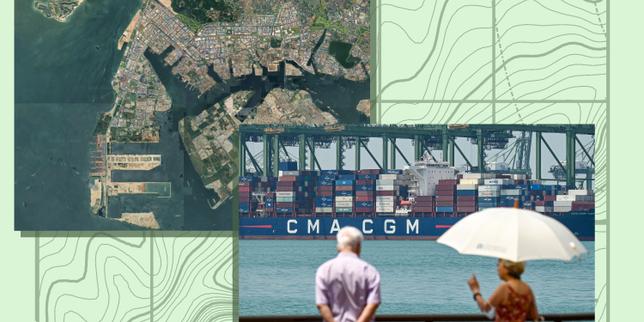
Singapore's answer isn't just to build bigger docks. It's to construct Tuas Port, a single, fully automated megaport built almost entirely on reclaimed ocean land on the western tip of the island. When fully operational in the 2040s, Tuas will handle a staggering 65 million TEUs (twenty-foot equivalent units) annually, consolidating every container terminal in the country into one massive, AI-driven machine.
Why does this matter right now? Maritime trade isn't just expanding—it's restructuring. Global supply chains are under pressure from geopolitical shifts, rising fuel costs, and massive container ships that smaller ports simply can't accommodate. Singapore isn't just trying to keep up. It's trying to make sure no other port in Asia can ever replace it.
Moving Oceans and Sinking Ten-Story Concrete Blocks
You can't build the world's largest automated port on land you don't have. To make space for Tuas, Singapore had to create 1,337 hectares of new land from the sea—an area equivalent to more than 3,300 football fields.
The engineering behind this reclamation effort is brutal in its scale. Instead of traditional piling, engineers built giant concrete caissons—hollow rectangular structures as tall as a ten-story building, each weighing up to 15,000 tonnes.
- Over 440 of these massive concrete caissons were fabricated on-site and sunk to the ocean floor.
- They form a continuous underwater retaining wall extending over 26 kilometers long.
- Over 50% of the material used for the fill in early phases came from dredged sea bed material and recycled construction soil, saving over S$2 billion in fill costs.
- The entire operational surface sits 5 meters above mean sea level to safeguard the infrastructure against projected sea-level rises.
Most people don't realize that building Tuas isn't just an engineering flex. It's an urban planning move. By shifting port operations off the southern coast near the city center, Singapore is freeing up 1,000 hectares of prime waterfront land—known as the Greater Southern Waterfront—for residential and commercial redevelopment. It's a double win: upgrade global logistics while unlocking high-value real estate back home.
Inside the Automated Logistics Engine
Walk through the operational sections of Tuas Port today and you'll notice something unsettling: it's almost eerily quiet. The chaotic, diesel-choked port yards of the 20th century are completely gone.
Instead of dockworkers sitting in high-altitude crane cabins, remotely operated ship-to-shore cranes lift containers off ships stretching up to 450 meters long. On the tarmac below, fleet driverless Automated Guided Vehicles (AGVs) zoom back and forth across the yard.
+-------------------------------------------------------------------+
|                        TUAS PORT AT A GLANCE                       |
+-------------------------------------------------------------------+
| Planned Annual Capacity | 65 million TEUs                         |
| Total Land Area         | 1,337 hectares (reclaimed land)         |
| Total Berths            | 66 deep-water berths                    |
| Deep-Sea Wharf Depth    | -23 meters                              |
| Consolidation Timeline  | City terminals move to Tuas by 2027    |
+-------------------------------------------------------------------+
These electric AGVs don't sleep, don't take lunch breaks, and use software algorithms to choose the exact path that minimizes battery usage and transit time. In the background, PSA Corporation's central control system acts as a brain, scheduling container movements down to the second before a vessel even drops anchor.
If a megaship arrives late due to bad weather in the Indian Ocean, the Next Generation Vessel Traffic Management System recalculates traffic flows in real-time, assigning a deep-water berth (-23 meters depth) without creating a backlog at sea.
The Risk of Centralizing Global Trade
Building a single mega-hub isn't without serious risks, and supply chain analysts have pointed out a few key vulnerabilities.
- Cybersecurity Exposure: When your entire port runs on automated crane logic, IoT sensors, and centralized digital platforms like DigitalPORT@SG, a cyberattack isn't just an inconvenience—it's a global trade stoppage.
- Geopolitical Friction: Neighboring nations like Malaysia and China are pouring billions into their own infrastructure projects, such as Port Klang's expansions and regional deep-sea terminals.
- Single Point of Failure: While consolidating Tanjong Pagar, Keppel, Brani, and Pasir Panjang into Tuas eliminates costly inter-terminal trucking, putting all your shipping eggs in one basket leaves operations vulnerable to localized disruptions or extreme weather events.
Singapore's counter to these risks relies heavily on deep technological integration and sheer operational speed. A container ship sitting idle costs tens of thousands of dollars an hour. By slashing turnaround times through automation, Singapore makes skipping its port economically unfeasible for major shipping lines.
Actionable Takeaways for Supply Chain Leaders
If you manage global logistics, shipping contracts, or physical product distribution, Singapore's port strategy offers clear operational signals for your long-term planning.
- Audit your transit routes: Ensure your logistics partners leverage ports with automated berth allocation to prevent costly delays during peak shipping seasons.
- Prepare for ship size scaling: Ocean carriers are continuing to favor ultra-large container vessels. Confirm your regional distribution hubs can connect seamlessly with deep-draft ports like Tuas.
- Factor in carbon metrics: Port electrification and just-in-time vessel arrivals mean lower Scope 3 emissions along the Malacca Strait corridor. Start tracking these efficiency metrics in your vendor SLAs today.