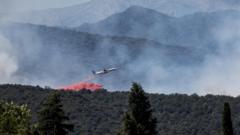
A massive wildfire in southwestern France has forced more than 10,000 residents and vacationers to flee their homes and campsites. If you think early summer wildfires are just a late-August problem, the scene unfolding near the Spanish border proves otherwise. A lethal combination of record-smashing heatwaves from May and June, parched vegetation, and ferocious winds has turned the foothills of the French Pyrenees into a tinderbox.
Right now, emergency crews are fighting an uphill battle. Here is exactly what is happening on the ground, why the region became so vulnerable, and what you need to know if you have travel plans in southern Europe.
The Trevillach Fire Ground Reality
The blaze ignited near Trevillach, a small commune situated west of Perpignan in the Pyrénées-Orientales department. Within hours, it exploded across the landscape. The fire has scorched over 4,600 hectares in France alone. That is an area roughly equivalent to 6,500 football pitches turned to ash.
Local prefect Pierre Regnault de la Mothe confirmed that authorities had no choice but to order the evacuation of two dozen small towns and villages. The timing could not be worse. July marks the start of the peak summer tourism season, meaning many of those evacuated were staying in local holiday rentals and campsites.
Winds are fanning the flames across an 18-kilometer frontline. More than 750 firefighters, backed by 200 vehicles and nine water-bombing helicopters, are on the frontlines. The situation is dangerous. At least 16 people have been injured so far, including four firefighters who faced the flames directly. France's Interior Minister, Laurent Nunez, gave a grim update on French television, warning that morning conditions were deteriorating rapidly as high winds returned to the valley.
The crisis is so severe that the European Union stepped in. European Commission President Ursula von der Leyen announced that the EU is sending four waterbombing aircraft from Cyprus and Sweden, along with 100 extra firefighters, to reinforce the exhausted local teams.
Cross Border Devastation and the Spark That Caused It
This isn't just a French crisis. Just across the border in Spain, the same system of extreme weather allowed a massive fire to tear through 2,200 hectares of land. Shockingly, 97% of that burned acreage was located inside the protected natural area of Les Gavarres in Catalonia.
While Catalan authorities managed to stabilize their side of the border late Saturday, the cause of that specific blaze serves as a frustrating reminder of human negligence. Spanish police arrested a contractor's employee who is suspected of sparking the wildfire by using an angle grinder right next to a dry, grassy roadside. One spark was all it took to trigger an ecological disaster.
Further south in Spain, the pressure on emergency services intensified as another fire broke out in the Castellon province. That blaze breached the Sierra de Espadan national park—famous for its rare cork oak forests—and forced 500 more people out of their homes.
The Tour de France Chaos
The Trevillach fire didn't just disrupt local villages; it collided directly with one of the biggest sporting events on earth. Stage 3 of the Tour de France, a 196-kilometer route starting in Granollers, Spain, and ending in the French ski resort of Les Angles, runs right through the impacted Pyrenees-Orientales region.
Race director Christian Prudhomme and local authorities had to make emergency adjustments to keep riders safe and keep the roads clear for emergency vehicles. The verdict? A total ban on spectators for the final 40 kilometers of the stage.
The famous publicity caravan and non-essential team vehicles were stripped from the motorcade. Fans who had traveled from all over the world to watch the mountain climb were told to stay away entirely. It's a massive blow to cycling enthusiasts, but when 18 kilometers of forest are actively burning just miles away, keeping the roads clear for fire trucks is the only option that makes sense.
Why May and June Prepared the Ground for Disaster
If you're wondering how a fire can burn this aggressively so early in the summer, you have to look back at the weather data from May and June. Southern France and western Europe didn't just experience a warm spring; they endured a brutal, record-shattering heatwave.
France's public health agency recently reported that the extreme heat contributed to roughly 1,000 additional deaths during the peak of the early heatwaves, with 85% of those victims aged 65 and older. That sustained, intense heat baked the moisture right out of the soil. The Mediterranean scrubland and pine forests became hyper-vulnerable. When you pair that level of dryness with the intense winds whistling through the Pyrenees valleys, containment becomes nearly impossible until the weather breaks.
What to Do If You Are Traveling to Southern Europe Right Now
If you have a holiday booked for southern France, Spain, or Greece over the next few weeks, don't panic, but stop assuming everything will go smoothly. Wildfire season is active, aggressive, and highly unpredictable. You need a practical strategy to stay safe and avoid getting trapped.
- Monitor Local Air Quality and Fire Alerts: Do not rely on international news for real-time updates. Download local emergency apps. In France, monitor the "Météo-des-Forêts" (Forest Weather) forecast provided by Météo-France, which rates wildfire risks daily by department.
- Know Your Escape Routes: If you're staying in an Airbnb or a remote campsite in regions like the Var, Hérault, or Pyrénées-Orientales, look at a physical map. Know the two quickest routes out of the valley. If a fire starts, cellular networks can burn out or become overloaded, leaving your GPS useless.
- Check Your Travel Insurance Cover: Standard travel insurance doesn't always cover cancellations due to wildfires unless there is an official government evacuation order or your accommodation is actively damaged. Call your provider today and ask exactly what triggers a payout for natural disasters.
- Pack a Go-Bag: It sounds extreme for a holiday, but if you're in a high-risk zone, keep your passports, medication, chargers, and essential documents in one small bag near the door. When the police knock on your door at 3:00 AM telling you to evacuate, you won't have time to pack a suitcase.
- Respect the Bans: If local forestry officials close a hiking trail or block a road due to fire risk, don't ignore the signs for a better photo opportunity. You risk a massive fine, and more importantly, you risk your life.
The battle in the Pyrenees foothills is going to take days to fully resolve. With winds remaining highly unpredictable, fire crews from across Europe are bracing for a long, exhausting week. If you are anywhere near the region, prioritize safety over your holiday itinerary. No view is worth getting caught in a fast-moving mountain blaze.