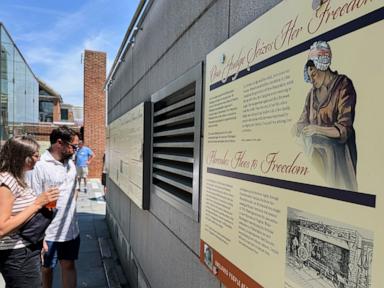
If you walked past the open-air ruins of the President’s House in Philadelphia last Tuesday evening, you would have seen a monument in limbo. Some of the large educational panels on slavery were missing, others were half-installed, and the site felt like an unfinished construction zone.
By Wednesday morning on July 15, 2026, everything had changed.
Under the cover of darkness, workers dispatched by the federal government arrived at 5 a.m. with tools and new signage. They took down the remaining original panels—exhibits that had stood for sixteen years as a raw, unflinching look at the enslaved people held by George Washington. In their place, they installed a sanitized, reworked series of displays approved by the Trump administration.
Philadelphia Mayor Cherelle Parker did not hold back her anger, calling the overnight operation "shameful" and a violation of "community trust".
But this is not just a local dispute over some park signs. It is a calculated, federally mandated effort to alter how we remember the founding of the United States. If you want to understand how public history is being rewritten in real-time, you have to look at what was taken down, what replaced it, and why this particular site was so dangerous to a sanitized version of American history.
The Pre-Dawn Swap on Independence Mall
The President’s House site sits just steps away from the Liberty Bell. It is an incredibly symbolic piece of land. This is the exact footprint of the house where George Washington and John Adams lived when Philadelphia served as the nation’s temporary capital in the 1790s.
When the outdoor memorial opened in 2010, it was hailed as a massive victory for public history. For decades, the National Park Service had essentially ignored the fact that Washington brought nine enslaved Black people to live and work in the executive mansion. The original 2010 exhibit did not hide from that hypocrisy. It placed the stories of those nine individuals at the dead center of the display, forcing visitors to confront the painful contradiction of a nation declaring "all men are created equal" while its first president kept human beings in chains.
The current administration took aim at that very contradiction.
Following a 2025 executive order designed to scrub federal historic sites of "corrosive" narratives and historical critiques, the Department of the Interior targeted the President’s House. The order directed federal properties to avoid displaying information that could "disparage Americans past or living" and instead focus on the "greatness of the achievements" of the nation.
The result was a monthslong, bitter legal battle between the City of Philadelphia and the federal government. In January 2026, federal workers initially tore down the panels using crowbars. The city sued and won a brief injunction in February to have them restored. But on July 3, 2026, a federal appeals court cleared the way for the government to proceed with the redesign.
They did not wait long to act. The overnight swap was the quiet culmination of that court victory.
What Was Lost in the Redesign
The Department of the Interior claims the new panels are "full of historical context" and still acknowledge the "evils of slavery". But if you compare the original text to the new displays, the softening of the historical narrative is obvious.
The federal government did not completely erase the mention of slavery—that would have been too blatant. Instead, they did something more subtle. They shifted the focus, watered down the vocabulary, and removed the visual evidence of the slave trade.
The Erasure of Graphic Timelines and Maps
The original exhibit featured a prominent map of transatlantic slave trade routes and a detailed timeline of slavery in America. These visual tools connected the local reality of Washington's household to the massive global economic engine of human trafficking.
- What happened to them? They are completely gone. By removing the maps and the timeline, the new exhibit frames slavery as an unfortunate, isolated background detail rather than a systemic global horror.
Softening the Tone
Word choice matters in history. The original exhibit used direct, uncompromising language to frame the moral crisis of the early republic.
- The Original Panel: One of the most famous original displays was titled "The Dirty Business of Slavery". It pulled no punches, stating: "The men who wrote the U.S. Constitution created a document based on the ideal of liberty, but liberty and enslavement were bitterly intertwined."
- The Replacement Panel: That sign has been completely removed. In its place is a panel titled "Celebrating Independence Throughout the Years". It is a textbook example of shifting the spotlight away from systemic injustice and back to national celebration.
Creating an Alibi for George Washington
The new panels dedicate significant space to defending Washington’s legacy and highlighting his internal conflict.
- The new text emphasizes that Washington "complied with the laws of the time".
- It highlights his private expressions of discomfort with the institution of slavery.
- It shines a spotlight on the legislative measures he signed that restricted the expansion of slavery, such as the 1789 Northwest Ordinance and the 1794 Slave Trade Act.
By focusing on Washington's "discomfort" and his moderate political actions, the new exhibit constructs a comforting alibi. It tells visitors that even though Washington owned people, he felt bad about it and tried to limit the practice. It conveniently downplays the fact that he actively bypassed Pennsylvania law to keep his own workers enslaved.
The Nine People Who Lived in the Shadows
We cannot talk about the President’s House without talking about the actual human beings who were forced to labor there. The original exhibit was designed to honor them.
Pennsylvania had passed a law in 1780 called the Gradual Abolition Act. It stated that any enslaved person brought into the state by a non-resident would automatically become free if they stayed in Pennsylvania for more than six consecutive months.
To prevent his workers from gaining their freedom, George Washington deliberately rotated them out of the state every six months. He sent them back across the state line to Mount Vernon in Virginia just before the six-month mark, resetting the clock. He did this quietly, deliberately, and with full knowledge of what he was doing.
The nine people subjected to this rotation were:
- Oney Judge (Martha Washington’s personal maid, who famously escaped to New Hampshire)
- Hercules (Washington’s highly talented chef, who also escaped to freedom)
- Christopher Sheels
- Richmond
- Giles
- Paris
- Austin
- Moll
- Joe
By replacing the original, deeply personal accounts of these nine people with broader, generalized texts about early American politics and the architectural history of the mansion, the new exhibit dilutes their lived experiences. Their names are still there, but their stories are no longer the primary lens through which visitors view the site.
A Legal Battle Over Who Controls the Past
The replacement of these panels was only possible because of a major legal shift.
When the President's House site was designed in the early 2000s, the City of Philadelphia worked closely with the federal government. The city actually contributed $1.5 million of municipal funds to build the memorial. Because of this joint partnership, Philadelphia argued in court that the National Park Service had a contractual obligation to consult with local authorities and historians before changing the exhibit.
However, the U.S. Court of Appeals for the Third Circuit rejected that argument.
The three-judge panel ruled that the federal government—and the National Park Service alone—has the ultimate authority to decide what stories are told on federal property. They dismissed the city’s claims, stating that the maintenance agreement did not give the local government a permanent veto over the federal government’s historical interpretation.
This ruling sets a massive precedent. It means that any federal historic site, national park, or federally controlled monument can have its historical narrative altered at the whim of whatever presidential administration is in power.
Michael Coard, an attorney and the founder of the Avenging The Ancestors Coalition (ATAC), has been fighting the federal government's changes from the start. He warns that this creates a dangerous path forward.
If a president can order the sanitization of Washington’s slave-owning history, what stops a future administration from altering displays at other sensitive historical locations?
The Danger of Comforting History
There is a temptation in America to treat history as a tool for national self-esteem. We want our founders to be perfect, our trajectory to be a clean, unbroken line of progress, and our past to be comfortable.
But comfortable history is almost always dishonest history.
The original President's House exhibit was powerful because it was uncomfortable. It forced you to stand on the very ground where Oney Judge brushed Martha Washington’s hair, knowing that a few hundred feet away, the Liberty Bell rang out for freedom. It forced you to reconcile the genius of the American experiment with its deepest moral failures.
When we sanitize those stories to focus on "the greatness of the achievements," we do not make the nation stronger. We just make ourselves historical illiterates. We lose the ability to understand why our society still struggles with the legacy of systemic racism today.
How to Find the Uncensored History Yourself
The federal government may have swapped the physical signs on Independence Mall, but they cannot delete the historical record. If you are visiting Philadelphia or want to learn the true history of the President’s House, you do not have to rely on the sanitized federal panels.
Here are the practical steps you can take to access the real, uncensored history of the site:
- Read the Original Research and Documentation
The extensive archaeological and historical reports compiled during the creation of the original 2010 exhibit are still preserved. You can access the detailed historical research on the nine enslaved individuals through the Pennsylvania Historical and Museum Commission and local digital archives. - Support Local Preservation Coalitions
Groups like the Avenging The Ancestors Coalition (ATAC) have spent decades fighting to keep this history alive. Follow their legal updates and community educational programs to see how they are continuing to tell the stories of Oney Judge, Hercules, and the others. - Read "Never Caught" by Erica Armstrong Dunbar
If you want to understand the reality of the President’s House, skip the new federal displays entirely and read this book. It is a brilliant, thoroughly researched account of Oney Judge’s life in the Washington household and her daring escape from Philadelphia. - Visit Independent Historic Sites
When you are in Philadelphia, diversify your tour. Visit the Mother Bethel A.M.E. Church, the oldest African Methodist Episcopal congregation in the country, or the Johnson House Historic Site, a preserved Underground Railroad station. These local, independent institutions tell the history of Black resistance and freedom without federal oversight.
The battle over the President's House proves that history is not static. It is actively guarded, contested, and sometimes rewritten when we are not looking. Keep your eyes open.