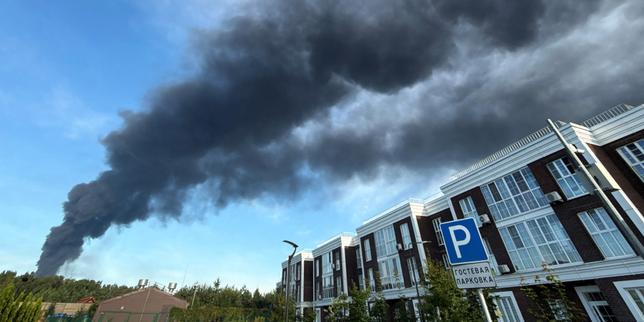
Ukraine just sent more than 400 drones screaming toward the Moscow region overnight in one of the largest single aerial strikes of the war. The attack set fires blazing across critical fuel depots and massive logistics centers, rattling the Russian capital and forcing local authorities into defense mode. But this wave of strikes isn't happening in a vacuum. It comes right after Moscow hammered Ukrainian cities with a brutal barrage of ballistic missiles, and right as President Volodymyr Zelenskyy faces domestic backlash over a contentious leadership shakeup in Kyiv.
If you're trying to figure out where this conflict is heading, watching the skies over Domodedovo and Podolsk tells only half the story. The real picture involves a grinding war of attrition on the ground, evolving drone tactics, and deep political tensions inside Ukraine itself.
What Happened During the Moscow Drone Attack
Overnight between Sunday and Monday morning, air raid sirens and dull thuds rang out south of Moscow. Russian officials claim their air defense systems shot down or jammed the vast majority of the incoming aircraft. Moscow Mayor Sergei Sobyanin reported that 85 drones were destroyed on their final approach to the city itself, while hundreds more were downed further out in the region.
Despite those interception claims, impact sites tell a distinct story.
Drone debris and direct impacts sparked fires at key industrial points:
- An oil storage facility in Podolsk’s Lvovsky district burst into flames.
- A fire broke out at the Yuzhnye Vrata industrial park near Domodedovo, a giant logistics hub that spans over 650,000 square meters.
- A residential apartment complex in Domodedovo took direct damage, leaving residents injured.
- Falling debris damaged homes and cars in Odintsovo and along the M-4 highway.
Moscow Oblast Governor Andrei Vorobyov confirmed that ten people suffered injuries across the region. Ukrainian long-range strikes have evolved from symbolic gestures into systemic attempts to choke Russian logistics and energy distribution hubs hundreds of kilometers behind the front lines.
The Tit for Tat Escalation Cycle
This attack didn't happen out of nowhere. It was a direct response to a massive Russian offensive 24 hours earlier. Russian forces launched dozens of ballistic missiles and strike drones aimed at Kyiv and surrounding Ukrainian regions, killing at least seven civilians and wounding dozens more.
Ballistic missiles present a nightmare scenario for air defenses. Unlike slower long-range drones or cruise missiles that can be tracked and picked off with anti-aircraft guns, ballistic missiles plunge down at hyper-velocity. Ukrainian commanders have repeatedly asked Western allies for additional high-tier interceptors because standard short-range defense simply cannot stop incoming ballistic fire.
Military analysts at the Institute for the Study of War noted that Russia has been burning through its missile stockpiles at a rate exceeding its monthly production capacity. Moscow is using these high-value munitions deliberately because they penetrate defense networks far more consistently than cheaper drones.
When Russia hits Kyiv with ballistic missiles, Ukraine responds by flooding Russian airspace with hundreds of long-range attack drones. It's a relentless tit-for-tat dynamic. Neither side shows any sign of backing down, and diplomatic peace talks remain off the table.
Heavy Frontline Engagements Across the South and East
While the media focuses on high-profile drone raids over Moscow and missile strikes on Kyiv, the ground combat remains brutally intensive. Military reports indicated roughly 235 distinct combat engagements across the front line within a single 24-hour window.
Russian infantry units continue pushing hard in the Pokrovsk and Toretsk sectors, attempting to break through Ukrainian defensive positions through sheer volume of artillery and glide-bomb attacks. Ukrainian forces are relying heavily on FPV (first-person view) kamikaze drones to bludgeon incoming armored columns and hold trench lines.
The sheer density of drone warfare on the front line has transformed ground tactical decisions. Small units cannot move across open terrain during daylight without being spotted by reconnaissance drones and targeted within minutes. Warfare has turned into an aggressive game of hide-and-seek played across destroyed villages and tree lines.
Political Turmoil Inside Kyiv
The drone raid on Moscow coincided with an internal crisis inside Ukraine's political leadership. President Volodymyr Zelenskyy is currently navigating fierce public criticism following a sweeping cabinet reshuffle.
The core of the political tension revolves around the removal of 35-year-old Mykhailo Fedorov, a tech-savvy innovator who championed Ukraine's domestic drone program. At the same time, Zelenskyy chose to retain 60-year-old Soviet-trained General Oleksandr Syrskyi as the chief of the armed forces.
This decision sparked street protests in Kyiv and intense debate among civil society. Critics argue that sidelining younger innovators in favor of old-school military commanders risks stifling tactical innovation at the exact moment Ukraine needs high-tech advantages. Proponents of the move contend that seasoned command experience is essential to handle massive ground offensives across a 1,000-kilometer front line.
Zelenskyy announced high-level emergency meetings on Monday to stabilize his government and regain public confidence. Domestic unity has been Ukraine's greatest strength since 2022, and growing political rifts pose a serious threat if not addressed quickly.
What This Means for the Next Phase of Conflict
The events of this week highlight three critical trends shaping the current phase of the war:
Strategic targeting of supply chains
Ukraine's drone program is no longer focused merely on symbolic hits inside Russia. By striking major logistical complexes like Yuzhnye Vrata and fuel storage in Podolsk, Kyiv is actively trying to disrupt the supply lines that keep Russian military operations running.Air defense depletion as a primary goal
Launching 400 drones at once forces Russia to expend expensive air defense missiles and reveal the radar locations of its surface-to-air systems. Both sides are constantly trying to exhaust each other's defensive magazines.High political stakes on both sides
Kremlin officials face embarrassment as fires burn near the Russian capital, while Ukrainian leadership must prove to its population that strategic shifts in military command won't compromise defense operations.
To track how this conflict develops, keep a close eye on fuel storage disruptions across western Russia and watch whether Kyiv can maintain domestic stability during its leadership transition. The battle is being fought just as fiercely in administrative offices and drone workshops as it is in the trenches.