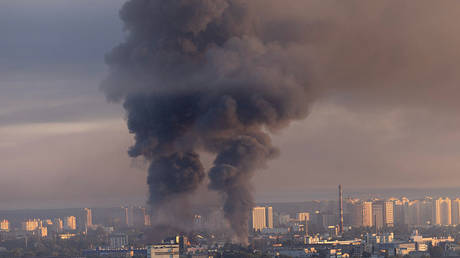
If you think the war in Ukraine only affects local borders, look at the price of diesel at your local fueling station. Ukrainian long-range drones have spent months systematically targeting Russian oil infrastructure. They aren't just hitting storage depots. They are targeting high-tech distillation columns deep inside Russian territory.
This strategy targets Russia's economic engine. It also directly affects global energy supplies.
Russia is one of the biggest diesel exporters on earth. When its refining capacity drops, the global diesel market feels the pinch almost instantly. Many analysts expected global crude oil prices to skyrocket. Instead, the real pain is happening in the refined product markets.
Here is what is actually happening behind the headlines, why the economics of oil refining are driving this crisis, and what it means for global fuel prices.
The math behind the burning refineries
To understand why these drone strikes are so effective, you have to understand how a refinery works. You can't just patch up a modern refinery with a bit of steel and some paint.
These facilities rely on massive, highly specialized components called atmospheric and vacuum distillation units (CDUs). Think of a CDU as the heart of the refinery. It takes raw crude oil, heats it up, and separates it into different components based on boiling points. This process produces gasoline, diesel, jet fuel, and fuel oil.
Ukrainian drone operators are targeting these specific towers. They aren't aiming for cheap storage tanks that can be rebuilt in a week. They are flying drones directly into the distillation columns.
- The replacement problem: These distillation columns are packed with highly sophisticated technology. They are packed with specialized internal trays, complex piping, and custom-engineered control systems.
- The sanctions barrier: Russia cannot easily buy these components on the open market. Western sanctions prevent the export of advanced refining technology to Russia. Moscow has to source parts through complex smuggling routes or try to manufacture them domestically. This turns a simple repair job into a months-long engineering headache.
- The capacity loss: Analysts estimate that these targeted strikes have knocked out between 10% and 14% of Russia's total refining capacity. That represents roughly 600,000 to 900,000 barrels per day of processing power taken offline.
When a refinery stops processing crude, it stops making diesel. Russia can't simply export the raw crude instead and hope to make the same amount of money. Crude oil sells for much less than refined diesel.
Why crude prices and fuel prices tell different stories
You might notice that while diesel prices are volatile, global crude prices like Brent and WTI haven't completely exploded. That seems like a contradiction. If Russia is refining less oil, shouldn't oil prices go up?
The answer lies in the difference between crude oil and refined products.
When a Russian refinery is damaged, it stops consuming crude oil. That crude doesn't disappear. Russia still pumps it out of the ground. Because they can't refine it domestically, they are forced to export more raw crude oil to countries like China and India.
Refinery Strike -> Less Domestic Refining -> More Raw Crude Exported -> Crude Prices Stay Stable
                                         -> Less Refined Diesel Exported -> Diesel Prices Spike
This creates a strange situation. The global market is flooded with raw Russian crude, which keeps crude prices relatively stable. At the same time, the global market is starving for refined diesel.
Traders call the price difference between raw crude oil and refined products the "crack spread." The diesel crack spread has been highly volatile because of these strikes. Refiners in Europe, Asia, and the US are making high profits because the premium on diesel is so high. Consumers are paying the bill at the pump.
How the global diesel trade map is being redrawn
The world was already struggling with tight diesel supplies before the drone strikes began. Europe used to rely heavily on Russian diesel. After the invasion of Ukraine, Europe banned Russian refined products, forcing a massive reshuffling of global trade.
Europe started buying diesel from the Middle East, India, and the US Gulf Coast. Russia redirected its diesel exports to South America, Africa, and parts of the Middle East.
This system was fragile, but it worked. The Ukrainian refinery strikes disrupted this balance.
The domestic squeeze inside Russia
Russia has to prioritize its own domestic market. The Russian military needs massive amounts of diesel to keep its tanks and trucks moving in Ukraine. Russian farmers need diesel for planting and harvesting seasons. If local fuel prices spike, it causes political problems for the Kremlin.
To protect its domestic market, Russia has had to implement temporary export bans on gasoline and diesel. When Russia stops exporting diesel to keep its own trucks running, the global market loses hundreds of thousands of barrels of fuel overnight.
The shipping bottleneck
Because Europe cannot buy Russian diesel directly, it must import fuel from much further away. This longer journey requires more tankers traveling longer distances.
To make matters worse, shipping routes are under pressure elsewhere. Houthi rebel attacks in the Red Sea have forced many tankers to avoid the Suez Canal. Instead of a quick trip through the Red Sea, tankers carrying diesel from India and the Middle East to Europe must sail all the way around the southern tip of Africa.
This adds weeks to the journey and increases shipping costs. Combine damaged Russian refineries, domestic Russian export bans, and longer shipping routes, and you get a perfect storm for global diesel supply.
What this means for your wallet
Diesel is the workhorse of the global economy. It powers the semi-trucks that deliver goods to supermarkets. It powers the container ships crossing the oceans. It powers the trains carrying raw materials and the tractors growing our food.
When diesel prices go up, the cost of transporting everything goes up.
- Freight surcharges: Trucking companies pass the higher cost of fuel onto retailers through fuel surcharges.
- Retail inflation: Retailers pass those costs onto consumers. A spike in diesel prices acts as a hidden tax on almost every physical product you buy.
- Industrial pressure: Manufacturing, construction, and agriculture are highly diesel-dependent. Higher fuel costs squeeze profit margins for these businesses, which can lead to slower economic growth.
What to watch next in the fuel markets
This situation is highly unpredictable. If you want to understand where fuel prices are heading, keep an eye on three specific factors.
First, watch the geography of the drone strikes. Early attacks targeted refineries close to the Ukrainian border. More recent strikes have hit facilities over 1,000 kilometers deep inside Russian territory.Why Ukrainian Drone Strikes on Russian Refineries are Breaking Global Diesel Markets
news
A cheap drone packed with explosives flies hundreds of miles deep into Russian territory. It bypasses air defenses and slams directly into a multi-million-dollar distillation column at a massive oil refinery. The resulting fireball does not just take down a local Russian fuel facility. It sends shockwaves through fuel pumps in Europe, truck stops in America, and shipping lanes across the globe.
That is the reality of modern warfare. Ukraine found a weak spot in Russia's economic armor, and they are hitting it repeatedly. By targeting the highly complex, expensive infrastructure of Russian oil refineries, Ukrainian forces are reshaping the global energy trade in real-time.
Many commentators focus on the price of crude oil when these attacks happen. But that is the wrong metric to watch. If you want to understand the real economic pain of this campaign, you have to look at the global diesel market.
The Bottleneck Nobody Talks About
We tend to think of oil as a single, uniform commodity. You pump it out of the ground, sell it, and someone puts it in a machine.
It does not work that way. Raw crude oil is essentially useless. You cannot run a tractor on crude. You cannot fly a jet on it. To turn that dark sludge into something valuable, you have to boil it, vaporize it, and condense it in massive facilities called oil refineries.
The most critical part of this entire system is the Crude Distillation Unit, or CDU. Think of a CDU as the heart of a refinery. If you damage the pipelines or the storage tanks, workers can patch them up in a couple of days. If you destroy a CDU, the entire refinery goes dark. These units are highly customized, packed with specialized metallurgy, and take months—sometimes years—to build and install.
Ukraine knows this. They are not aiming for cheap oil storage tanks. They are flying drones straight into the CDUs.
When a refinery loses its distillation capacity, two things happen immediately:
- The country can no longer process crude oil into refined fuels like gasoline, jet fuel, and diesel.
- The country suddenly has a massive surplus of raw crude oil that it cannot use domestically, forcing it to either export the raw crude or shut down the oil wells entirely.
This explains why we see a bizarre paradox in the markets. Ukrainian strikes actually push raw crude oil prices down occasionally because Russia is forced to dump more raw crude onto the global market. At the very same time, the price of refined products—especially diesel—skyrockets.
Why Diesel is the Ultimate Economic Pulse
If gasoline is the fuel of daily life, diesel is the fuel of global commerce.
It powers the container ships carrying goods across the oceans. It runs the freight trains and semi-trucks that deliver those goods to stores. It drives the tractors that plant and harvest our food, and the heavy machinery that builds our roads.
When diesel prices spike, everything gets more expensive. It is a direct driver of stubborn inflation.
Russia has historically been one of the world's largest exporters of diesel, particularly the ultra-low-sulfur diesel that European and Asian markets rely on. Even after Western nations placed embargoes on Russian refined products following the invasion, those barrels did not vanish. They just found new routes. Russia started shipping its diesel to Turkey, Brazil, and parts of Africa, while Europe began buying more diesel from India and the Middle East.
It was a delicate, highly inefficient shuffling of the global deck.
When Ukrainian drones knocked out major Russian refining hubs like Ryazan, Norsi (Nizhny Novgorod), and Kuibyshev, they took hundreds of thousands of barrels of daily refining capacity offline. That instantly tightened the global diesel balance. With less Russian diesel flowing to buyers in the Global South, those buyers had to compete with Europe and the US for supply from other regions.
The result is a classic bidding war.
Inside the Numbers of the Drone Campaign
Let us look at how these attacks actually played out on the ground and why they are so hard for Russia to fix.
In a typical refining setup, the CDU is a towering structure. It is an incredibly easy target for a drone equipped with basic GPS and camera guidance. According to market intelligence reports, the strikes successfully knocked out close to 14% of Russia's total refining capacity at various points in the campaign.
To put that in perspective, Russia lost over 600,000 barrels per day of processing power.
Refinery Outage Impact (Estimated Daily Capacity Lost)
--------------------------------------------------
Ryazan Refinery:          ~110,000 barrels/day
Norsi (Nizhny Novgorod):  ~130,000 barrels/day
Kuibyshev Refinery:       ~50,000 barrels/day
Other smaller facilities: ~310,000 barrels/day
--------------------------------------------------
Total Estimated Loss:     ~600,000+ barrels/day
Replacing these distillation columns is not a simple matter of ordering parts online. Much of the high-tech equipment inside Russian refineries was supplied by Western engineering firms like Honeywell UOP, Linde, and ABB before the war. Because of strict sanctions, Russia cannot easily buy replacement parts or bring in Western technicians to repair the damage.
They are forced to rely on parallel imports, reverse-engineering, or Chinese alternatives. This stretches repair timelines from weeks to many months. In some cases, damaged units remain offline indefinitely, permanently shrinking Russia's refining footprint.
The Washington Panic
You might think the United States government would cheer when Ukraine hits Russian energy infrastructure.
Think again.
Behind closed doors, Washington was deeply alarmed by the success of the drone campaign. White House officials quietly urged Kyiv to stop targeting Russian refineries. The reason is simple: global inflation and domestic politics.
If global diesel prices stay elevated, transport costs rise. When transport costs rise, the price of milk, bread, and online deliveries goes up. No sitting political administration wants high inflation and rising fuel prices during an election cycle or a fragile economic recovery.
Furthermore, if Russia is forced to cut oil production because it has nowhere to store or refine its crude, global oil prices could spike past $100 a barrel. The global economy is highly sensitive to energy shocks. A major spike in energy costs could easily trigger a recession.
Kyiv, however, has a very different calculation. They are fighting for survival. For them, cutting off the Kremlin's cash flow and disrupting fuel supplies to the Russian military matters far more than retail fuel prices in Chicago or Frankfurt.
How This Rewires Global Trade Flows
Because of these disruptions, the global refining trade is undergoing a permanent realignment.
Refineries in the Middle East and India are capitalizing on the chaos. They import cheap Russian raw crude—which Russia must sell because it cannot refine it domestically—and then process that crude into high-value diesel and gasoline. They then sell those refined products to Europe and North America at a massive premium.
It is a highly profitable strategy for intermediaries, but it adds a massive "middleman tax" to the global economy.
Every extra mile a barrel of oil travels adds transport costs, insurance premiums, and shipping emissions. The days of cheap, efficient energy logistics are gone. We are now living in a world of fragmented supply chains where geography, geopolitics, and military strategy dictate the price of fuel.
What to Watch Next
If you want to keep ahead of where the energy markets are going, stop staring at raw Brent crude prices. Keep your eyes on these three critical indicators instead.
The Diesel Crack Spread
The crack spread is the price difference between a barrel of crude oil and the refined products produced from it. Watch the diesel crack spread closely. If it widens significantly, it means refineries are making huge margins because diesel is in short supply. This is a clear indicator of market panic and supply tightness.
Russian Export Data
Track the volume of refined product exports out of Russian ports like Primorsk and Novorossiysk. If diesel exports drop while crude oil exports rise, it is a dead giveaway that Russia's domestic refineries are struggling to stay online and are being forced to dump raw crude instead.
Air Defense Deployments
Watch where Russia positions its S-300 and S-400 air defense systems. If they are forced to pull these systems away from the front lines to protect civilian refineries deep inside their own borders, it eases the pressure on Ukrainian forces elsewhere while signaling that the refinery threat remains critical.
The drone war in Ukraine has proved that you do not need a massive navy or a billion-dollar air force to disrupt global trade. A handful of cheap, precise drones can rewrite the rules of global energy economics. Until those refineries are fully repaired or adequately protected, expect the global diesel market to remain on a knife-edge.


:max_bytes(150000):strip_icc():focal(749x0:751x2)/scott-peterson-011924-4-fdb17804e77f438a8797e61ff48e1aea.jpg)