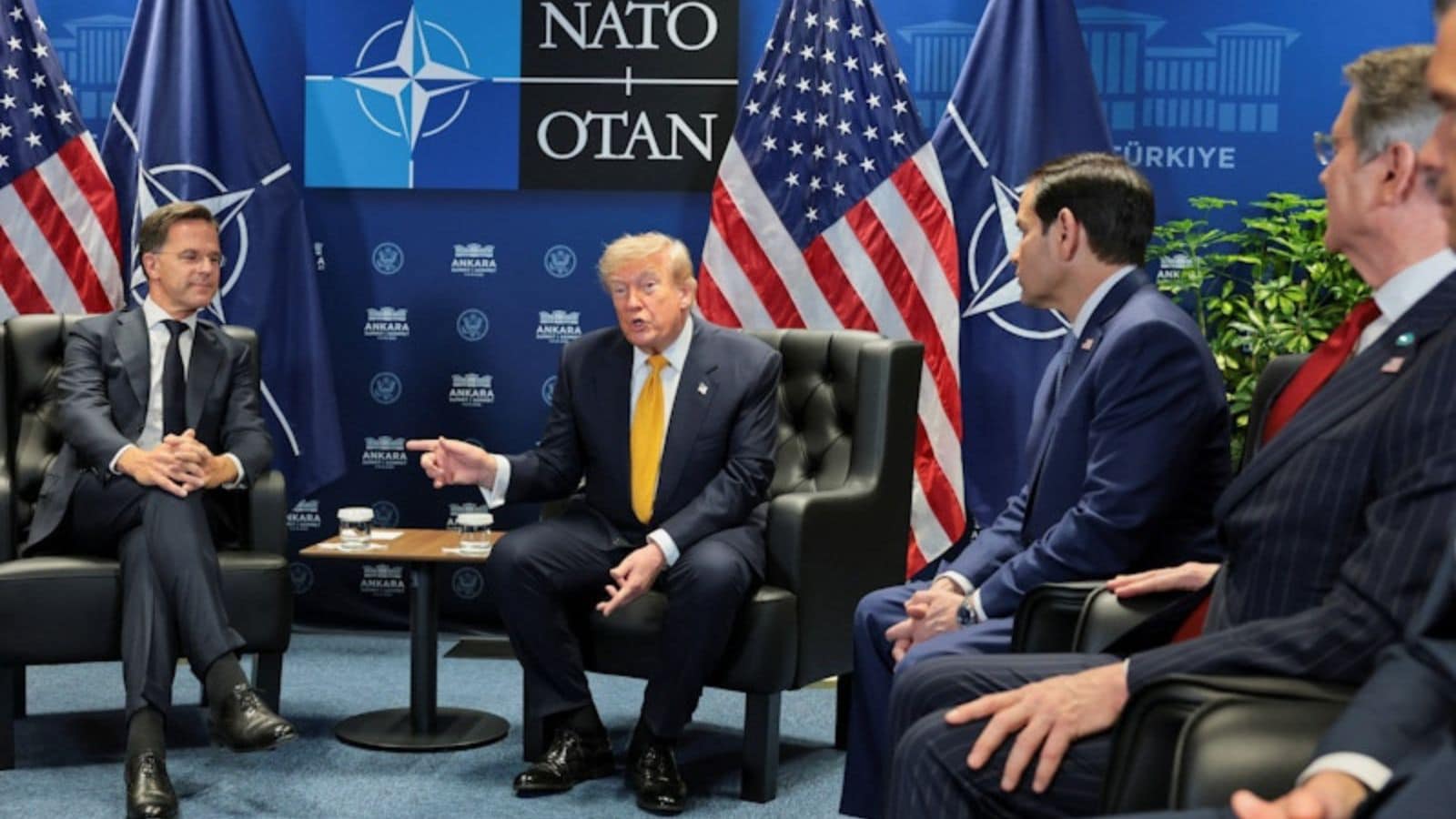
The short-lived illusion of peace in West Asia has officially shattered. Speaking on the sidelines of the NATO summit in Ankara, Turkey, US President Donald Trump announced that the 60-day ceasefire and the 14-point memorandum of understanding (MoU) signed with Tehran in June is totally over.
When asked directly by reporters if the deal was dead, Trump didn't mince words. "For me, I think it's over. I don't want to deal with the Iranians. They're scum," he said during a press conference alongside NATO Secretary General Mark Rutte.
This total collapse comes less than three weeks after the historic interim deal was signed in Versailles. The agreement was meant to stop a devastating regional war that began in late February following the assassination of Iran's supreme leader, Ali Khamenei. Instead, we're right back to where we started, with a massive escalation of violence threatening global energy markets and international stability.
The Fatal Salvo that Killed the Ceasefire
You can't have a ceasefire when both sides are actively trading heavy fire. The fragile truce disintegrated after a rapid sequence of military strikes over the last 24 hours.
According to U.S. Central Command (CENTCOM), Washington launched massive offensive strikes on Tuesday night. U.S. warplanes and missiles hit over 80 precision targets inside Iran. The operation aimed to degrade Tehran's capability to disrupt maritime shipping. CENTCOM confirmed the destruction of Iranian air defense systems, radar sites, and more than 60 Islamic Revolutionary Guard Corps (IRGC) small boats in the Strait of Hormuz.
Trump claimed the strikes were an immediate response to Iran firing rockets at commercial vessels. He expressed deep personal frustration, stating that the U.S. had purposely backed off to let Iran hold its national funeral processions for Khamenei.
"We said, 'Go and do your funeral stuff,' and instead of that, they start shooting rockets at ships yesterday," Trump said. "So we hit them very hard last night."
Iran didn't back down. Overnight, the IRGC launched coordinated missile and drone salvos targeting heavy U.S. military assets in the Gulf. They directly struck the U.S. Navy's Fifth Fleet headquarters in Bahrain and the Ali Al Salem Air Base in Kuwait. Iranian officials also claimed they shot down an American drone during the counterattack.
Inside the Failed Versailles Agreement
To understand why this collapse happened so fast, look at what the original MoU actually promised. It was a classic high-stakes gamble that faced intense skepticism from the start.
Signed in mid-June by U.S. Vice President JD Vance and Iranian Parliament Speaker Mohammad Baqer Ghalibaf, the 14-point MoU established a strict 60-day window. The goal was to finalize a permanent treaty by mid-August.
The core trade-off looked like this:
- Iran's Commitments: Tehran agreed to an immediate halt to military operations across all fronts, including its proxy actions in Lebanon. Crucially, they promised to fully reopen the Strait of Hormuz to international shipping and pledged never to build nuclear weapons.
- U.S. Commitments: Washington agreed to lift crippling oil sanctions and promised to design a massive $300 billion reconstruction fund to help rebuild Iran's battered economy.
Trump defended the deal initially. He argued that rejecting the framework would trigger a global economic catastrophe reminiscent of the 1929 Great Depression due to skyrocketing oil prices. Yet, his own party hated it. Conservative lawmakers openly trashed the deal, calling it a multi-billion-dollar bailout that failed to permanently neutralize Iran's ballistic missile and nuclear programs.
On the other side, Iranian hardliners viewed the deal with supreme arrogance. Right after signing, Ghalibaf publicly called the agreement a "record of U.S. failure," bragging that Tehran won the diplomatic battle without surrendering its regional leverage. That foundational lack of trust meant the deal was practically dead on arrival.
Why Negotiators Like Kushner and Witkoff are Benched
With the deal in pieces, Trump explicitly sidelined his own top diplomatic team. U.S. special envoys Jared Kushner and Steve Witkoff had been leading the backchannel communications to salvage the framework. Trump made it clear that their efforts are now pointless.
"I'll speak to our negotiators," Trump told reporters in Ankara. "They want to negotiate, they're good people—Steve Witkoff, Jared Kushner—but they have to come back to me, and as far as I'm concerned it's just a waste of time dealing with them."
Trump’s shift from economic pragmatism to outright hostility stems from a total lack of faith in the Iranian regime's motives. He blasted Tehran’s leadership as "vicious, violent people" and "liars," warning that if they ever acquired a nuclear weapon, they'd use it instantly.
He also revealed a darker, personal grievance. Trump mentioned seeing intelligence reports listing him as a primary target for Iranian assassination plots, referencing recent footage of crowds calling for his death during state funerals in Tehran. "I saw this morning I'm on every single one of their lists," Trump remarked. "These are evil, sick people. And we have to root out that cancer."
Tehran’s leadership has matched his aggressive tone. Ghalibaf posted a sharp response on social media, declaring that "the era of bullying and extortion is over" and asserting that Iran will not fold under renewed American military pressure.
Shockwaves Through Global Markets and NATO
The geopolitical fallout from Trump’s declaration was instantaneous. Financial markets quickly plunged into chaos as investors panicked over a prolonged war in the world's most critical oil transit choke point.
Brent crude futures instantly surged by more than 5%, jumping to $78 a barrel. While prices are still below the $120 peaks seen during the peak of the winter fighting, the sudden spike injected immediate inflation fears into Western economies. Making matters worse, recent data shows that the U.S. Strategic Petroleum Reserve has hit its lowest level since 1983, leaving Western nations with almost no cushion against a sustained supply shock if the Strait of Hormuz closes completely.
Global equity and bond markets took a massive hit too. The VIX volatility index surged 13%, European shares dropped 1.6% in their worst single-day selloff in months, and U.S. stock futures fell sharply. Benchmark 10-year U.S. Treasury yields climbed to a one-month high of 4.56% as bond prices tumbled.
The timing of this collapse also puts immense pressure on the NATO summit. Trump is using his presence in Ankara to browbeat European allies for their lack of support during the conflict. He explicitly lashed out at Spain during his press conference, calling Madrid a "terrible partner" that fails to pay its fair share, and ordered an immediate review to cut off bilateral trade and official U.S. visits to the country.
What Happens Next
The diplomatic track is completely burned out. With Trump demanding total "denuclearization" and Iran refusing to halt its maritime and missile retaliation, a return to full-scale regional conflict looks unavoidable.
Expect Washington to immediately reimpose secondary sanctions on Iranian oil exports, punishing any international buyers who try to purchase Tehran's crude. At the same time, CENTCOM will likely step up its naval escort operations in the Gulf to protect commercial vessels from IRGC fast-attack boats and anti-ship cruise missiles.
For international businesses and everyday consumers, the immediate takeaway is clear. Volatility is back. Energy prices will remain highly unstable, and supply chain disruptions through the Middle East will continue to pressure global inflation throughout the summer. The brief window for diplomatic de-escalation has officially slammed shut.