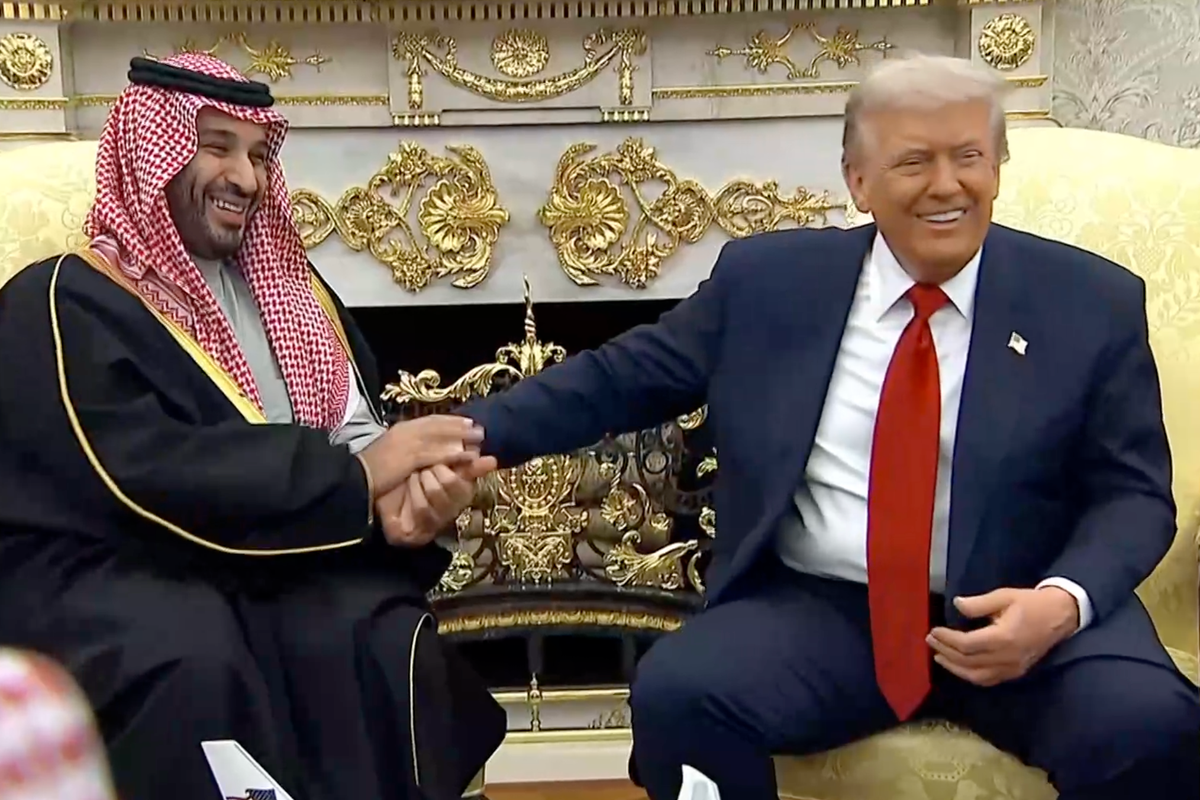
The White House just cleared a massive 30-year civil nuclear agreement with Saudi Arabia, and the fine print has experts across Washington and the Middle East sounding alarms.
President Donald Trump approved a Section 123 Agreement with Riyadh that grants the kingdom access to American nuclear technology. It opens the door for Saudi Arabia to eventually enrich uranium on its own soil after a two-year joint study.
What makes this deal wildly controversial isn't just the tech transfer. It's what was left out.
The deal drops crucial safeguards long considered essential to keep civil atomic programs from turning into weapons pipelines. Washington didn't require Saudi Arabia to sign the International Atomic Energy Agency's (IAEA) Additional Protocol. Nor did it demand the famous "Gold Standard" restriction that explicitly bans domestic uranium enrichment and spent fuel reprocessing.
If you're trying to figure out how we got here, why the administration did this, and what it means for nuclear proliferation, here is the full breakdown.
What is a 123 Agreement and Why Does It Matter
Under Section 123 of the U.S. Atomic Energy Act of 1954, American companies can't export significant nuclear technology, material, or reactors to foreign nations without a formal bilateral treaty. These treaties set the legal rules for nuclear commerce.
The U.S. has signed dozens of these agreements over the decades. Historically, Washington used its technical monopoly as leverage. If a country wanted reactors from Westinghouse or GE, it had to promise not to tinker with the nuclear fuel cycle in ways that produce weapons-grade uranium or plutonium.
The new Saudi pact turns that tradition on its head.
Instead of blocking domestic fuel production, the pact explicitly establishes a legal pathway for cooperation across the entire fuel cycle. U.S. Energy Secretary Chris Wright and Saudi Energy Minister Abdulaziz bin Salman agreed to conduct a joint two-year feasibility study on building an enrichment facility inside Saudi territory.
That distinction is massive.
Uranium enriched to low levels (3% to 5%) fuels power reactors. The exact same centrifuge technology can spin that uranium up to 90% purity, which creates weapon core material. Once a nation masters centrifuge enrichment, short-circuiting the path to a nuclear device becomes a matter of political choice rather than technological capability.
What Happened to the Nuclear Gold Standard
In 2009, the Obama administration negotiated a landmark nuclear agreement with the United Arab Emirates. The UAE agreed to a legally binding pledge: it would never enrich uranium or reprocess spent fuel on its territory. Instead, it would import all reactor fuel from international suppliers.
Nonproliferation policy experts called that commitment the "Gold Standard".
For over fifteen years, key U.S. lawmakers insisted that any future Middle East civilian nuclear package must copy the Emirates model. Riyadh repeatedly refused. Saudi Crown Prince Mohammed bin Salman insisted that because the kingdom possesses rich domestic uranium reserves, it has a sovereign right to mine, refine, and enrich its own fuel.
The new deal abandons the Gold Standard entirely.
Even worse for oversight advocates, the agreement bypasses the IAEA Additional Protocol. While Saudi Arabia adheres to a basic Comprehensive Safeguards Agreement, it hasn't granted the IAEA authority to perform voluntary snap inspections at unannounced sites or investigate undeclared facilities.
Administration officials argue that U.S. personnel will maintain tight, direct bilateral oversight over facilities built with American gear. Energy Secretary Wright stated publicly that the deal adheres to strict safety guidelines designed by American scientists. Yet, former State Department nonproliferation official Robert Einhorn warned that without legally binding limits on enrichment, the agreement creates real proliferation risks throughout the region.
Henry Sokolski, executive director of the Nonproliferation Policy Education Center, put it even more bluntly, noting that if Saudi Arabia gets a waiver on enrichment, regional neighbors like Turkey, Egypt, and the UAE will likely demand equal treatment down the line.
Dropping the Israel Normalization Condition
Under the previous administration, nuclear talks with Riyadh were tightly bound to a grand diplomatic bargain: Saudi Arabia would normalize diplomatic ties with Israel in exchange for a U.S. security guarantee and nuclear cooperation.
The Gaza conflict disrupted those broad regional alignment plans. Saudi officials made clear that full normalization couldn't move forward without concrete steps toward a Palestinian state, a condition Israel's government rejected.
Instead of waiting for diplomatic breakthroughs that might take years, the Trump administration severed the nuclear treaty from the normalization talks.
That move triggered sharp reactions in Jerusalem. Israeli officials across political lines expressed anxiety over an Arab neighbor acquiring enrichment capability. Former Israeli Prime Minister Ehud Barak labeled the uncoupling of normalization from the nuclear pact as a clear sign of shifting diplomatic dynamics between Washington and Jerusalem.
Israeli Energy Minister Eli Cohen indicated Israel would work diplomatically to block any development that could open the door to nuclear weapons capabilities in the region.
Commercial Realities and Civil Power Ambitions
Why would Washington sign a deal with fewer guardrails? The answer comes down to global commercial competition.
Saudi Arabia plans to spend tens of billions of dollars constructing power reactors to diversify its economy away from crude oil. If the U.S. walked away from the bargaining table over strict nonproliferation demands, Riyadh wasn't going to scrap its plans. It was going to sign contracts with Beijing or Moscow.
China National Nuclear Corporation and Russia's Rosatom were actively pitching Riyadh. Neither Moscow nor Beijing mandates Gold Standard conditions.
Administration strategists concluded that losing the contract meant losing all technical leverage over the Saudi nuclear sector for the next fifty years.
By securing a 30-year bilateral agreement, American giants like Westinghouse position themselves to anchor the construction, operation, and maintenance of Saudi reactors. Administration officials contend that having American engineers, managers, and proprietary tech embedded inside Saudi facilities provides far stronger real-world monitoring than third-party international observers ever could.
Money talks. U.S. nuclear supply chains haven't seen a domestic buildout of this scale in decades, and industry executives lobbied hard to secure the Saudi market before foreign competitors took over.
Can Congress Block the Saudi Nuclear Deal
Now that the agreement is formally signed, the clock starts ticking for Capitol Hill.
Under the Atomic Energy Act, a Section 123 Agreement must lie before Congress for 90 days of continuous session before taking effect. Lawmakers don't technically vote to approve it; the deal becomes law automatically unless Congress enacts a joint resolution of disapproval.
That distinction is critical.
Passing a joint resolution requires majorities in both the House and the Senate. If President Trump vetoes that resolution, Congress needs a two-thirds supermajority in both chambers to override his veto.
Because Republicans hold majorities in both houses, assembling a veto-proof two-thirds coalition is virtually impossible. Several key lawmakers who voiced skepticism during previous debates—including Secretary of State Marco Rubio during his time in the Senate—previously advocated for Gold Standard guardrails. However, party discipline and commercial arguments will likely keep enough Republicans in line to prevent a veto override.
Unless a sudden political revolt occurs in Congress, the treaty will go into effect before the year ends.
Key Things to Watch Next
The signing of the agreement is just the first step in a decades-long process. To track how this deal develops, monitor these three milestones:
- Congressional 90-Day Review: Watch for public committee hearings in the Senate Foreign Relations Committee. Key testimony from nuclear experts will reveal details about secret bilateral side agreements filed alongside the treaty text.
- The 2-Year Feasibility Study: Pay attention to progress reports on the joint U.S.-Saudi study regarding uranium enrichment viability. Whether Washington approves construction of a joint enrichment plant or encourages fuel imports will reveal the actual boundaries of the pact.
- Regional Reactions: Keep an eye on Tehran and Abu Dhabi. Iran's enrichment progress remains a core security trigger for Riyadh. If Saudi Arabia moves closer to domestic enrichment, watch whether the UAE demands to renegotiate its 2009 agreement to drop its own enrichment prohibition.