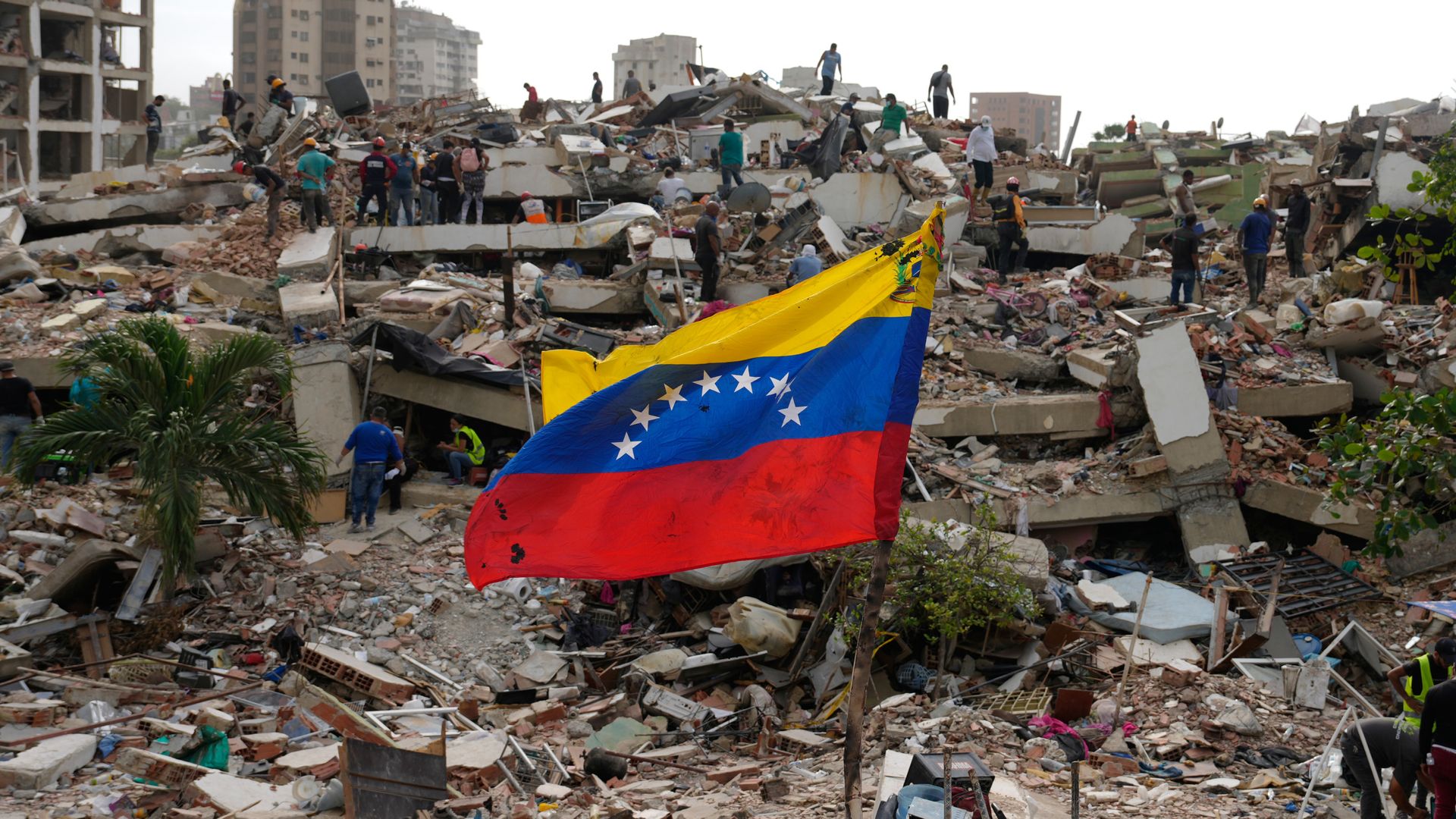
Venezuela is grieving, but its leadership is playing defense. Last week's devastating earthquake has left coastal towns in ruins, flattened apartment complexes, and triggered a full-scale political showdown in Caracas. Acting President Delcy Rodríguez just held a late-night press conference to slam her critics. She called reports of a slow emergency response "disgraceful misinformation" manufactured in "propaganda laboratories."
But the view from the ground looks completely different.
The official government body count stands at roughly 2,500 dead. Meanwhile, an opposition-run registry has logged more than 40,000 missing people. The United Nations is reportedly buying 10,000 body bags for the country. This isn't just a natural disaster anymore. It's a high-stakes test of survival for a fragile government struggling for legitimacy.
A Broken Coast and a Sluggish Start
The epicenter of the destruction lies along the coast, especially in the state of La Guaira and the port city of Catia La Mar. Satellite analysis indicates that nearly 59,000 buildings have been damaged or completely destroyed. For the first 48 hours after the tremors stopped, official aid was practically nonexistent.
Survivors didn't see heavy machinery or government rescue squads. Instead, they had to dig through heavy concrete slabs with their bare hands, listening for the screams of buried neighbors.
Rodríguez eventually acknowledged this reality during her foreign press briefing, but she spun it as a normal occurrence. She argued that neighbors and relatives are naturally always the first to arrive at any collapsed building site. She insisted that the full capacity of the Venezuelan state was mobilized within 24 hours. Local residents tell a different story. They describe a chaotic, disorganized effort where localized volunteer networks did the heavy lifting while state officials tightly controlled the distribution of incoming relief supplies.
The Scandal of Collapsing Social Housing
One of the biggest flashpoints of public anger centers on public housing infrastructure. The earthquake systematically targeted signature social housing projects built under former President Hugo Chávez.
In Playa Grande, satellite imagery captured the total failure of the Hugo Chávez housing developments. Out of 280 buildings in that single complex—each housing 16 two-bedroom apartments—dozens flattened or tilted violently onto their sides. A similar disaster occurred further east in Los Corales, where eight massive residential towers simply ceased to exist.
Structural experts call this specific type of failure "pancaking." It happens when the vertical columns supporting a building's weight fail completely, causing the upper floors to crash straight down onto the lower ones. It leaves almost no air pockets for survivors. It points directly to substandard construction practices, cut corners, and a lack of regulatory oversight.
When confronted with the collapse of these high-profile state projects, Rodríguez deflected. She claimed that roughly 80% of all collapsed structures were actually developed by private companies. She didn't offer a single piece of evidence to back that claim up.
The Battle of the Numbers
Trust is the first casualty in a crisis like this. The gap between what the government admits and what independent observers see is widening by the hour.
- The Official Toll: The state insists the death toll is rigorously verified and sits near the 2,500 mark.
- The Missing Registry: The opposition database has blown past 40,000 unique reports of missing individuals.
- The Pathologist Accounts: Forensic workers speaking anonymously due to fear of state retaliation tell international outlets that the official death toll represents less than a third of the actual casualties.
- The UN Procurement: The United Nations is quietly sourcing 10,000 body bags specifically for this crisis, which suggests their internal projections are grim.
The smell of decomposition now hangs heavy over the streets of Catia La Mar. Local officials are seen moving through rubble-strewn blocks stacking plain wooden coffins. Yet, the administration refuses to release any official estimate for the missing, preferring to keep public communication under total lockdown.
Miracles Amid the Ruin
Even in total devastation, moments of pure luck break through. Emergency workers recently pulled 43-year-old security guard Hernán Alberto Gil Flores from the ruins of a collapsed shopping mall.
He survived for nearly eight days under the concrete. That's a full five days past the critical 72-hour window where rescue chances drop to near zero. He managed to stay alive by accessing a small pocket of space where rescuers could slide food and water through narrow crevices before they could safely cut him loose.
National TV networks have broadcasted his rescue on a continuous loop. It's a brilliant piece of morale-boosting footage, but it's also a convenient distraction from the larger systemic failures defining the broader recovery operation.
The Ticking Clock for Delcy Rodríguez
The timing of this earthquake couldn't be worse for the current administration. Delcy Rodríguez took power as interim leader in January after the United States pushed out former President Nicolás Maduro. Her government has spent months desperate for international and domestic legitimacy.
This disaster has become the ultimate test of her ability to govern. To make matters worse, her 180-day mandate as acting leader expires today. Nobody knows what happens next to the executive branch, adding a layer of deep political instability to an ongoing humanitarian catastrophe.
Unlike Hugo Chávez, who famously rejected American aid during the catastrophic 1999 landslides, Rodríguez has been forced to swallow her pride. She has welcomed foreign aid workers and emergency teams from all over the world, including the United States and its regional allies.
Actionable Steps for Tracking and Support
If you have family in the affected regions or want to support the recovery efforts directly without your aid getting lost in state bureaucracy, focus on these verified channels.
First, utilize the independent missing persons database set up by the opposition coalitions rather than waiting for government updates. These platforms allow you to input names, last known locations, and photos, which are cross-referenced by volunteer teams on the ground in La Guaira.
Second, route your financial support through international organizations with established local distribution networks. Groups like the United Church of Christ and regional international secular relief funds are bypassing state-controlled warehouses to deliver water filtration kits, medical supplies, and temporary shelter materials directly to displaced families in Catia La Mar.
Avoid sending uncoordinated goods to the main Caracas airport, as strict government blockades and customs delays are currently stalling independent cargo shipments. Focus on cash donations to ground-level actors who can buy supplies within the region.