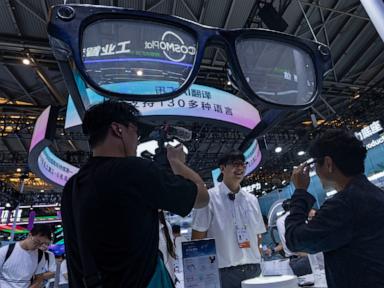
Walk into the World Artificial Intelligence Conference in Shanghai and you won't see abstract slide decks about theoretical software models. You'll see a two-legged robot fold your laundry, pour a cup of tea, and hand you smart glasses before executing a backflip.
July 2026 marked a turning point in the technology conflict between Washington and Beijing. Over 1,100 companies gathered at Shanghai's annual flagship event, displaying hardware that looks less like experimental science projects and more like mass-market retail goods. State statistics presented at the event revealed Chinese firms now produce over 400 distinct humanoid robot models. That's more than half of the global total built on Earth today.
While American tech executives spend billions training massive proprietary software models behind closed doors, Chinese firms are flooding the physical market with cheap, open-source hardware and accessible foundation models. That strategic divergence is changing how the global tech race plays out.
The Real Gap Lies in Mass Production
American innovation excels at raw computing breakthroughs and frontier research models. If you want the most capable closed software system, American labs still hold an edge in pure parameter count and reasoning benchmarks. But hardware is where research meets real life.
Building a software algorithm costs server hours. Building ten thousand bipedal machines requires motor factories, titanium casting, sensor supply lines, and rapid physical prototyping. China spent the last two decades building the ultimate physical supply ecosystem in places like Shenzhen and Suzhou.
When a robotics start-up in Silicon Valley needs custom actuators or specialized gears, they order samples and wait weeks for overseas shipments. A startup in Shanghai gets three modified prototypes delivered to their floor by afternoon courier. That friction gap compound over time.
While Western media focuses on GPU export bans, Chinese engineers focused on component iteration. They replaced costly imported servo motors with domestic alternatives that cost a fraction of the price. They shrank the bill of materials for a walking bipedal machine from hundreds of thousands of dollars down to under twenty thousand dollars.
That's how you go from lab experiments to four hundred commercial humanoid models in a few short years.
Open Source As a Geopolitical Lever
Hardware is only half the story. Software powers the metal, and China's approach to software has shifted dramatically over the past eighteen months.
Western AI giants built walled gardens. They sell access through expensive subscription plans and tight application interfaces. Chinese developers chose a completely different tactic by dumping open-weight models directly onto the global developer market.
When you offer high-performing open models for free, global developers build on top of your foundation. Researchers in South America, Southeast Asia, and Europe are now deploying Chinese open-source architectures because they're cheap, adaptable, and easy to run on local hardware.
This strategy mimics what happened with smartphone operating systems a decade ago. By providing the open platform, you set the default standards for how future software interacts with hardware.
Brain Interfaces and Spatial Computing Move Outside the Lab
The Shanghai conference floor wasn't restricted to walking machines. Neural tech and wearable systems took center stage alongside bipedal units.
Mindtrix showcased direct brain-computer interfaces designed for hands-free control, demonstrating non-invasive neural headbands that interpret user intent in real time. Nearby, visitors tried lightweight augmented reality glasses equipped with on-device vision models that identify objects and translate spoken conversation instantly.
These devices aren't just gadgets. They represent the inputs for embodied intelligence. A robot needs to understand physical space the same way a human wearer does. By developing consumer neural gear and vision glasses at scale, Chinese firms are building massive real-world datasets that feed directly back into their artificial intelligence training loops.
Why the Export Restrictions Missed the Mark
Washington thought blocking advanced graphics chips would halt China's automated progress. It certainly created immediate friction for huge language training runs, but it also forced Chinese engineers to innovate where it hurts the US market most.
Deprived of unlimited computing horsepower, Chinese research teams concentrated on efficiency. They built smaller, specialized models tailored to run on modest hardware embedded directly into machines.
Instead of building one giant brain in the cloud to control every machine on Earth, they put thousands of tiny, efficient brains directly into the physical joints of factory workers, home assistants, and delivery bots.
Here's what that look like in practice:
- Factories deploy machines that handle spot-welding and sorting without needing constant cloud connection.
- Agricultural bots navigate orchards and harvest delicate fruit using tiny local chips.
- Medical facilities use specialized assistant bots operating on isolated local networks for strict patient privacy.
This edge-computing focus turned out to be far more practical for real-world industrial deployment than relying on distant data centers.
What Most Western Analysts Get Wrong About the Rivalry
The common narrative frames the US-China rivalry as a sprint to artificial general intelligence. Commentators argue about which country will reach superintelligent software first.
That framing overlooks the practical economic impact. The nation that commercializes useful physical automation first will win the industrial productivity battle.
It doesn't matter if an American software system writes brilliant poetry or passes legal bar exams if factories in Asia are running fully automated assembly lines twenty-four hours a day at one-tenth the labor cost.
Robots folding laundry or assembling electronics aren't just parlor tricks for tech conferences. They represent the automated labor force of the next decade. When a nation faces steep demographic decline and shrinking working-age populations—as both China and Western nations do—deploying physical automation becomes an urgent matter of national economic survival.
China's rapid rollout of low-cost hardware proves they view automation as an immediate industrial necessity, not a long-term research experiment.
The Cost Equation That Changes Everything
Price dictates adoption. You can build the most sophisticated humanoid unit in the world, but if it costs two hundred thousand dollars, only wealthy research universities and government labs will buy it.
When the price drops to fifteen thousand dollars, small business owners take notice. Auto repair shops, commercial bakeries, regional logistics hubs, and eldercare facilities suddenly find the math irresistible.
Chinese manufacturers understand mass production better than anyone else. They accept thin margins on hardware because they know volume creates market control. Once thousands of their units operate across global facilities, they own the ecosystem for software updates, replacement parts, and operational data collection.
This pricing strategy creates a massive barrier for Western hardware startups trying to compete on cost.
How Businesses Should Navigate the New Reality
If you run an enterprise looking to deploy automated systems over the next three to five years, sitting on the sidelines waiting for clear winners is a mistake.
First, stop evaluating artificial intelligence purely through the lens of screen-based software. Look hard at embodied systems that interact with physical inventory, manufacturing floors, and facilities.
Second, re-evaluate your open-source software stack. The developer community has embraced open weights, making custom on-premise deployments faster and far cheaper than relying exclusively on proprietary cloud services.
Third, audit your hardware supply chains. Understand where your automation components originate. Diversifying your component sources now protects your business from potential trade tariffs and supply interruptions as tech nationalism increases.
Finally, test physical automation in small, bounded operational tests today. Buy a single commercial unit for repetitive tasks like warehouse sorting or basic cleaning. Learn how your existing staff interacts with physical machines before attempting full-scale facility deployment.
The Shanghai exhibits proved that automated hardware is no longer a future prediction. It's already rolling off assembly lines in volume.