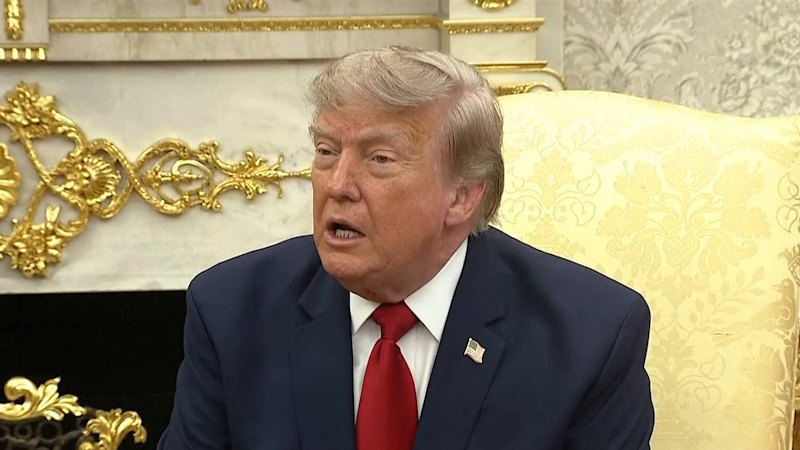
Donald Trump just pulled off one of the fastest policy pivots of his presidency, and almost nobody is looking at the real math behind it.
On Monday, the White House announced a stunning plan to charge a 20% toll on all commercial cargo passing through the Strait of Hormuz. Trump declared the US would act as the official "GUARDIAN OF THE HORMUZ STRAIT" and demand payback for protecting the world's most volatile choke point. Fast forward less than twenty-four hours, and the plan was dead.
The administration wants you to believe this was a graceful diplomatic masterstroke. Trump claims that after some highly productive phone calls with Middle Eastern emirs and kings, he decided to swap the shipping fee for "MASSIVE" Gulf state investments directly into the US economy.
But don't buy the clean PR narrative. The reality is that the 20% shipping toll was an administrative, economic, and legal nightmare that was completely dead on arrival.
The $34 Million Ticket Nobody Was Going to Pay
Let's look at how global shipping actually works to understand why this toll plan collapsed so fast.
Under the proposed plan, the US would levy a 20% fee based on the value of a vessel’s cargo. Think about the scale of that request. A standard Very Large Crude Carrier (VLCC) transiting the Strait of Hormuz regularly carries up to two million barrels of oil. With crude prices hovering around $79 a barrel, a single tanker is carrying roughly $150 million to $170 million worth of cargo.
Trump's fee meant asking a single commercial ship to write a check for $30 million to $34 million just to sail through an international waterway.
No shipping company was ever going to pay that. They would have simply anchored their fleets, rerouted around Africa, or halted operations entirely. We already saw immediate panic in the market. The moment the toll was proposed, vessel traffic through the strait plummeted. Kpler tracking data showed only 14 ships crossing the waterway on Sunday, down from 37 just a week prior.
The shipping industry operates on thin margins. A $34 million fee per transit would instantly destroy the economics of global energy transportation. It would have triggered a massive oil supply shock, sending gasoline prices at the pump screaming upward by an estimated 30 to 40 cents a gallon in the United States alone. Trump essentially threatened to tax his own domestic voters right before a major political cycle.
The Legal Trap of Tolling the High Seas
There is a reason the US government has spent the last seventy years arguing against maritime tolls.
International maritime law is built on a simple foundation: freedom of navigation. Under the United Nations Convention on the Law of the Sea (UNCLOS), straits used for international navigation must remain open for transit passage. No country has the right to charge transit fees on a natural waterway.
Historically, when Iran threatened to charge its own fees for using the strait, the US State Department rightly called it illegal. Even Trump’s own Treasury Secretary, Scott Bessent, had previously blasted Iran's tolling ideas on social media, urging the world to reject any effort to disrupt the free flow of commerce.
When Trump turned around and tried to implement the exact same fee structure, he shredded decades of American foreign policy. Suddenly, the US was adopting the legal arguments of its adversaries.
Maritime law experts and organizations like the International Maritime Organization (IMO) immediately flagged the proposal as a blatant violation of international norms. If the US could charge a 20% tariff on the Strait of Hormuz, what would stop China from charging a toll in the South China Sea? The precedent was dangerous, and the White House legal team surely realized they had zero legal ground to stand on.
A Ceasefire in Tatters and the Real Blockade
While the shipping fee has been quietly shelved, the military situation in the Gulf is spiraling out of control.
The fragile June ceasefire agreement—which was supposed to buy time for a permanent peace deal—has completely collapsed. We are now seeing intense direct hostilities between US forces and Iranian assets.
- US Air Strikes: US Central Command launched heavy strikes inside Iran, targeting missile installations, drone launch sites, and coastal defense systems.
- Iranian Retaliation: Iran struck back hard, targeting commercial tankers and launching missiles toward Jordan, Bahrain, and Kuwait.
- Tanker Casualties: The commercial tankers Mombasa and Al Bahiyah were hit and set ablaze, resulting in multiple crew casualties. A Dutch-owned vessel, the Stolt Magnesium, also suffered an engine room fire after an attack.
Trump has decided to replace the shipping toll with a highly aggressive naval blockade targeted strictly at Iran. The US military is actively blocking any ship entering or leaving Iranian ports, as well as any vessel carrying Iranian cargo.
[All Non-Iranian Shipping]  --->  Strait of Hormuz (Open & Toll-Free)
[Iranian Ports & Cargo]     --->  US Navy Blockade (Intercepted / Blocked)
This is a high-stakes gamble. By enforcing a physical blockade on Iranian cargo while keeping the strait open for everyone else, the US is attempting to choke off Tehran’s remaining economic lifelines without completely freezing global energy markets.
How the Gulf States Bought Their Way Out
So, how did we get from a 20% global shipping toll to "massive investment deals" in less than a day?
It came down to a series of frantic phone calls. Gulf Arab leaders, particularly from the UAE and Saudi Arabia, recognized that a 20% US transit fee would decimate their oil export revenues. They also knew that Trump values tangible economic wins—specifically, direct foreign investment into US manufacturing and infrastructure.
Instead of fighting a protracted diplomatic battle over maritime law, the Gulf states offered Trump an easy out. They promised billions of dollars in fresh US investments in exchange for dropping the toll.
It was a classic transaction. Trump got to drop an unworkable, highly dangerous policy while claiming he forced foreign nations to invest "billions and billions" in America. The Gulf states protected their shipping corridors from a devastating economic shock.
What Ship Operators and Investors Need to Do Next
The threat of a 20% toll is gone, but the Strait of Hormuz is more dangerous today than it was last week. If you are managing maritime supply chains or tracking energy markets, you need to adjust your strategy immediately.
First, do not rely on standard route transit times. Even though the waterway remains legally open to non-Iranian traffic, the active exchange of missile and drone strikes means transit delays will persist. Build a minimum of 5 to 7 days of transit buffer into your Gulf operations.
Second, prepare for soaring insurance premiums. With tankers like the Mombasa and Al Bahiyah taking direct hits, war-risk insurance premiums for transit through the Gulf of Oman and the Strait of Hormuz are going to skyrocket. Factor these rising costs into your operational budgets now rather than waiting for the quarterly adjustments.
Third, monitor airline routing. The European Union Aviation Safety Agency has already warned commercial airlines to avoid the airspace over Bahrain, Kuwait, Qatar, and the UAE due to the risk of stray missiles. Expect air freight rates in the region to climb as carriers reroute flights around the conflict zone.
The toll idea was a brief, chaotic distraction. The real story is the escalating naval blockade and the very real possibility of a broader regional conflict. Keep your eyes on the physical security of the vessels, because the diplomatic posturing is just noise.