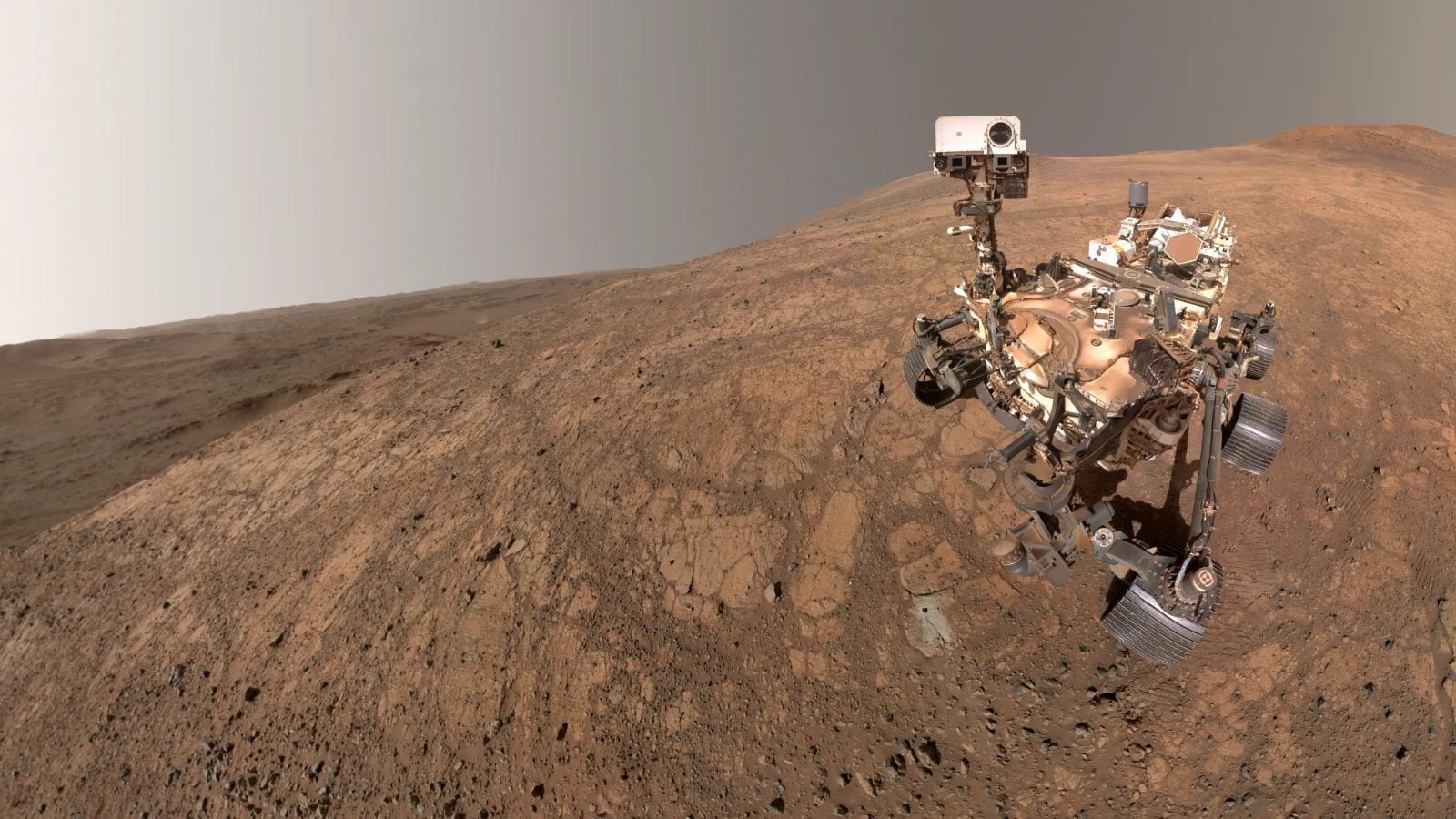
Mars is a freezing desert today, but its rocks hold a violent history that Earth completely erased.
NASA recently announced that the Perseverance rover stumbled upon a massive, 245-foot-thick stack of bedrock clinging to the rim of Jezero Crater. Scientists call this geological formation the Broom Point member. It is more than 3.9 billion years old. That makes it some of the oldest material a human machine has ever touched directly on another planet.
People look at Mars news and think we are only searching for tiny green microbes or dried-up lakebeds. That misses the bigger picture. This new discovery is not about ancient Martian life. It is a terrifying, beautiful record of how the inner solar system was literally hammered into existence by giant asteroids.
If you want to know what Earth looked like before life took over, you have to look at these shattered Martian rocks.
The violent story behind the Broom Point member
When Perseverance climbed out of the flat floor of Jezero Crater in late 2024, it entered a completely different geological era. The rover ground into the rock faces and used its spectrometers to scan the chemistry underneath the dust.
The science team found six completely distinct rock types stacked on top of one another.
This is not a simple pile of dirt. The formation contains alternating layers of two wildly different materials. First, there are breccias, which are messy rocks made of sharp, angular fragments cemented together. Right next to them are layers of incredibly fine, pulverized rock dust.
When you look closely at the fragments inside those breccias, you find tiny holes. These are gas-bubble cavities. They only form when rock gets heated so intensely that it melts into liquid magma and traps gas as it cools down.
This tells us the area was not shaped by a gentle river or a slow volcanic trickle. It was a warzone. The alternating layers show that massive impacts repeatedly blasted the area, vaporized solid stone, and dropped layers of ash and molten gravel back onto the surface over millions of years.
Why Mars has what Earth destroyed
You might wonder why we have to fly a multi-billion-dollar robot across space just to look at old rocks. Why not just dig a hole in Canada or Western Australia?
The answer comes down to plate tectonics.
Earth is a restless planet. Our crust is divided into massive plates that constantly slide around, crash into each other, subduct into the mantle, and melt away. It is a giant planetary recycling machine. Because of this endless churning, almost every single piece of Earth's crust from 4 billion years ago has been crushed, cooked, and completely erased. We have almost zero record of our planet's infancy.
Mars does not have plate tectonics. Its crust never recycled.
When an asteroid struck Mars 3.9 billion years ago, the debris settled, hardened, and just sat there for eternity. Nobody stepped on it. No tectonic plate dragged it down into the planetary furnace. The Broom Point member is a time capsule. It gives us a look at a geological era that literally does not exist on our own planet.
Understanding these layers helps us understand the early environment where life first tried to take root on Earth.
Glassy beads and the cosmic one two punch
The most telling clue hidden in the Broom Point member is the presence of countless tiny, dark, glassy beads scattered through the sediment.
Volcanoes can make glassy droplets, but they do not make them in quantities like this. These beads form when an asteroid impacts a planet with so much energy that it instantly melts the target rock, flings a plume of liquid glass high into the sky, and lets it rain back down across hundreds of miles.
Some of these beads are enormous. The science team noted that the largest ones rival the debris thrown out by the Chicxulub asteroid impact. That is the ten-mile-wide rock that wiped out the dinosaurs on Earth.
Imagine that level of destruction happening repeatedly in the same region. Alex Jones, a planetary geologist at Imperial College London, described this era perfectly. He noted that back then, it did not rain water or snow. It rained molten rock droplets and choked the air with pulverized stone dust.
Geologists believe a cosmic one-two punch created the jagged structures Perseverance sees today.
First, a truly gargantuan asteroid slammed into Mars, carving out the Isidis Basin, a massive scar roughly 1,200 miles wide. That unimaginable blast violently tilted the existing rock layers upward. Millions of years later, a separate, smaller asteroid hit the exact same neighborhood, punching out the 28-mile-wide Jezero Crater. This second blow fractured the already tilted rocks and pushed them straight up into the air, creating the cliffs the rover is currently exploring.
Inside the core samples Bell Island and Main River
Perseverance did not just snap high-resolution photos and move on. It deployed its robotic drill and captured two pristine core samples directly from this ancient impact sequence.
The science team named these specific samples Bell Island and Main River.
Right now, these rock cores are sealed inside airtight titanium tubes carried within the belly of the rover. They represent our best shot at putting actual numbers on the timeline of the early solar system.
We know these rocks are old, but we do not know exactly how many millions of years passed between each individual asteroid strike. Onboard rover instruments cannot do high-precision radiometric dating. For that, you need massive, building-sized mass spectrometers that only exist in clean rooms back on Earth.
If the Mars Sample Return mission successfully brings Bell Island and Main River back to Earth, scientists will read them like a cosmic calendar. We will finally find out if the asteroid bombardment was a sudden, intense spike or a long, agonizingly slow burn that delayed the emergence of habitable conditions on both Mars and Earth.
Your next steps to follow this discovery
Do not let this discovery fade into your news feed. If you want to track the ongoing exploration of Mars' oldest crust, take these concrete steps right now.
First, bookmark the official NASA Mars Perseverance Mission updates page. The engineering teams upload raw images daily. You can see the actual abraded rock patches and drill holes at Broom Point hours after they are beamed back through the Deep Space Network.
Second, track the progress of the Northern Rim Campaign. Perseverance is currently moving past the Arbot location and heading toward a region called Gardevarri. This next stop is loaded with olivine-rich rocks that scientists suspect might originate from deep within the Martian mantle. Monitoring this path will give you a front-row seat to the deepest planetary history ever uncovered.