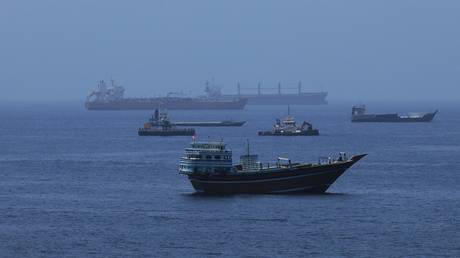
The latest flare-up in the Persian Gulf isn't just another round of empty geopolitical posturing. When the Iranian government warns that Middle Eastern oil and gas exports will be "either for everyone or for no one," the global energy market should listen. We aren't talking about a simple, temporary blockade of the Strait of Hormuz anymore. The threat of a full-scale regional energy shut down is now incredibly real.
If you think the current price of oil hovering around $85 a barrel is high, you're not looking at the bigger picture. If the situation escalates further, nine million barrels of oil a day could suddenly vanish from the global market.
The US reinstated a naval blockade on Iranian ports, stopping vessels from transiting to and from the country's coast. Tehran responded immediately with a terrifying ultimatum. The Islamic Revolutionary Guard Corps (IRGC) made it clear that if Iran can't sell its energy, nobody in the Gulf will. This is a massive shift in strategy. It goes way beyond the usual threats to block shipping lanes.
Understanding what's actually happening on the water requires moving past the standard media talking points. This is a highly dangerous conflict played with live ammunition, and the consequences will hit your wallet sooner than you think.
The Reality of the New Blockade
The short-lived diplomatic deal struck last month is officially dead. On Tuesday evening, the US military reimposed its naval blockade on Iranian ports, effectively trapping the country's remaining oil exports inside its borders. The US aims to force Tehran back to the negotiating table on Washington’s terms.
Iran didn't wait long to retaliate. Within hours of the US announcement, the IRGC issued a blunt warning. They declared that regional oil and gas exports are either for everyone or for no one.
This isn't just a threat. It is a promise of systematic sabotage.
Simultaneously, Iran’s state-run broadcaster reported that the country’s armed forces carried out targeted attacks against US military installations in Jordan, Kuwait, and Bahrain. While US allies claimed to have intercepted most of the incoming drones and missiles, the message was delivered loud and clear. Iran has the capability and the willingness to strike deep into neighboring territories. They aren't backing down. Not this time.
Why the Strait of Hormuz is Only Part of the Problem
For decades, energy analysts have obsessed over the Strait of Hormuz. It's easy to see why. Roughly one-fifth of the world’s oil supply passes through this narrow channel. If Iran closes it, global energy markets go into a tailspin.
But Tehran’s new strategy is far more ambitious and dangerous.
Iran is targeting the alternative export routes that its neighbors spent billions building specifically to bypass the Strait of Hormuz. These bypass pipelines are the economic lifelines for the United States' Gulf allies.
Take Saudi Arabia’s East-West Pipeline. It can transport up to seven million barrels of crude oil per day directly to the Red Sea, completely avoiding the Strait of Hormuz. Iran’s regional proxies already proved they can hit this infrastructure. During a previous round of hostilities, a drone strike temporarily knocked out a key pumping station on this exact pipeline.
Then there is the United Arab Emirates. The UAE operates a pipeline system running from the Arabian Gulf to the Gulf of Oman, handling up to 1.8 million barrels per day. The Emirati state oil firm, ADNOC, is working day and night to finish a parallel line to double that capacity.
If Iran successfully targets these overland pipelines with long-range missiles or drone strikes, those bypass options instantly evaporate. The world would lose close to ten percent of its entire daily oil supply in a matter of days. No amount of strategic reserves can fill a hole that big for long.
Trump and the War of Attrition
Washington's response has been aggressive, predictable, and highly risky.
US Central Command (CENTCOM) launched a massive wave of daylight air, drone, and naval strikes across southern Iran. The primary target was Greater Tunb Island, where the US military sought to degrade coastal defense systems and anti-ship cruise missile launch sites. They want to keep the shipping lanes physically open, regardless of what Iran says.
But military strikes don't solve the underlying political crisis.
President Donald Trump warned that the US will escalate its target list next week. He threatened to bomb Iranian bridges, power plants, and civilian infrastructure if Tehran doesn't capitulate. He openly admitted that he is saving energy targets for last, but will hit them if pushed.
This is a dangerous path. Deliberately targeting civilian power grids and transport networks is widely condemned by international bodies as a war crime. It also guarantees that Iran will retaliate in kind. Tehran is already preparing for a long-term war of attrition. They believe they can endure the economic pain longer than the West can tolerate soaring energy prices.
How the Oil Market is Reacting
Currently, the markets are underestimating the risk. Oil prices have crept up to around $85 a barrel, representing a one-month high, but they haven't experienced the vertical spike you might expect.
This calm is deceptive.
In the early stages of this conflict, prices briefly touched $120 a barrel before cooling off. The current stability relies on the assumption that the US can successfully protect Gulf shipping and that Iran’s threats to regional pipelines are mostly bluff.
That is a dangerous assumption.
If a single Iranian missile successfully compromises a major Saudi pumping station or if Yemen’s Houthi rebels begin actively targeting tankers in the Red Sea again, crude will easily shoot past $150 and head toward $200 a barrel. The International Energy Agency (IEA) recommended releasing 400 million barrels from global strategic reserves, but that is a temporary band-aid for a structural, long-term disruption.
Critical Next Steps for Businesses and Investors
You can't control geopolitical events, but you can protect your operations from the economic fallout. The threat of a major regional energy halt is real, and waiting for prices to spike before acting is a recipe for disaster.
- Audit Your Supply Chain Energy Exposure: If you run a business reliant on physical logistics, manufacturing, or transport, calculate your vulnerability to $150+ oil. Lock in fuel hedging contracts now while prices are still relatively stable in the $85 range.
- Diversify Shipping Routes: Relying on transit through the Red Sea or the Gulf of Oman is becoming highly speculative. Explore overland freight options or alternative maritime corridors, even if they come with higher baseline costs.
- Monitor Secondary Commodity Risks: A massive spike in oil and gas prices doesn't just affect fuel. It drives up the cost of plastics, fertilizers, and chemical feedstocks. Prepare your inventory strategies for sudden, sharp increases in raw material costs.
The standoff in the Persian Gulf is not a localized dispute. It is a direct threat to the global economy. As both Washington and Tehran double down on their respective blockades, the margin for error has shrunk to zero. Prepare your business for a volatile, high-cost energy environment before the next round of strikes forces your hand.