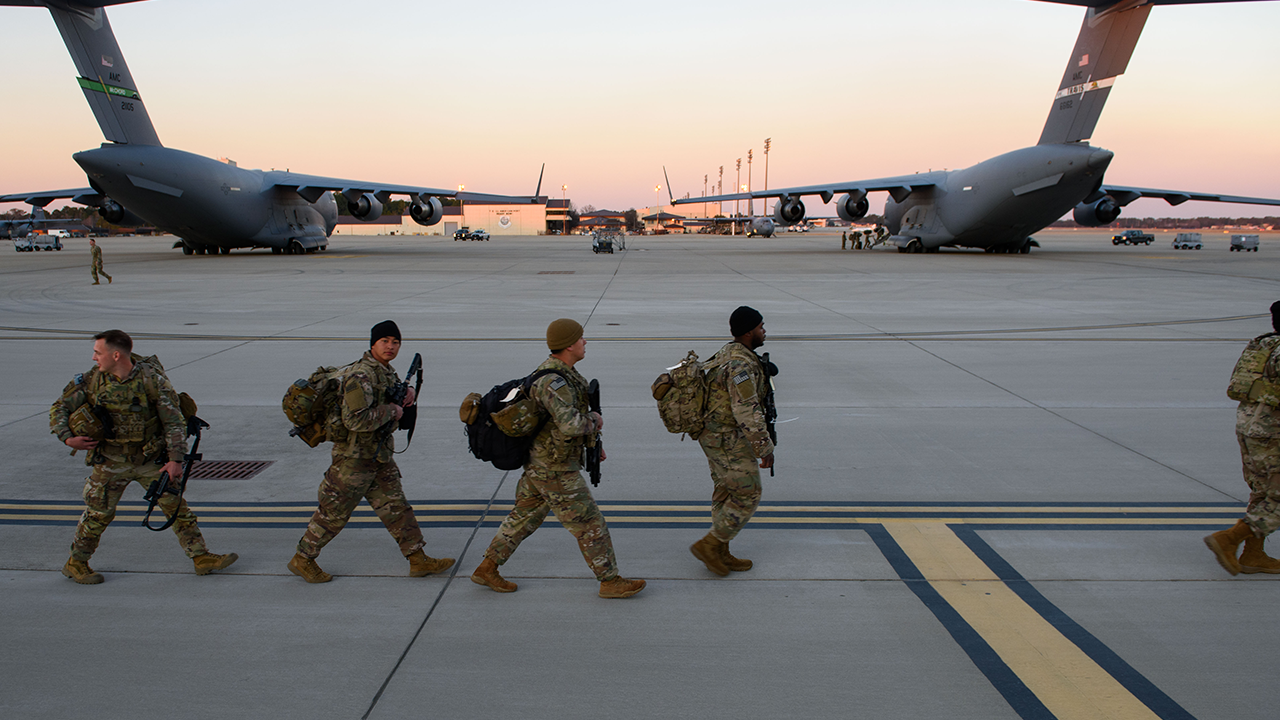
The United States and Iran are locked in an open military conflict that is rapidly spiraling beyond control. Over seven straight nights of continuous airstrikes, American bombers have hammered targets deep inside Iranian territory. We are no longer watching a shadow war of proxies and covert assassinations. This is direct, state-on-state warfare, and the latest round of strikes marks a terrifying evolution in how this conflict will play out.
Early on Saturday, US Central Command confirmed yet another wave of heavy airstrikes targeting Iranian infrastructure. But the target list has shifted dramatically. Military logistics networks and underground missile silos are still on the radar, but American forces are now actively taking out critical infrastructure like bridges, railway lines, and water treatment plants. Meanwhile, Iran is striking back hard, launching waves of anti-ship ballistic missiles and drone swarms against commercial vessels and naval assets in the Persian Gulf.
The old rules of engagement are officially dead. For decades, both Washington and Tehran maintained a unspoken threshold to avoid total war. That threshold has been completely obliterated.
The Real Strategy Behind Bombing Bridges and Water Plants
When military strategists start targeting civilian-use infrastructure, the nature of a war changes. The United States maintains that these strikes are designed to degrade the Iranian military's logistics and surveillance capabilities. If you drop a bridge or buckle a rail line, you stop the Islamic Revolutionary Guard Corps (IRGC) from moving ballistic missiles from inland storage facilities to coastal launch pads.
But hitting a water plant or a main transit bridge carries massive consequences for ordinary people. It signals a shift from targeted containment to total strategic degradation. The immediate goal is to cripple Iran's domestic mobility. If the IRGC cannot move its assets smoothly across the country, its ability to sustain a prolonged conflict drops significantly.
Iran claims these strikes are a direct assault on its civilian population. Tehran's state media has been broadcasting images of twisted metal and flooded roads, using the damage to stoke fierce nationalist sentiment. It's a classic wartime playbook. The regime is using the destruction to unify a population that, just weeks ago, was deeply fractured by economic hardship and political dissent.
Chaos in the Hormuz Strait and the Fight for Global Shipping
You cannot look at the strikes inside Iran without looking at what is happening on the water. The Persian Gulf and the Strait of Hormuz are turning into absolute no-go zones for international maritime trade. Iran has responded to the American bombing campaign by hitting back at the global economy's most vulnerable artery.
Drones and sea-skimming missiles are hitting commercial tankers with terrifying frequency. Shipowners are facing a worst-case scenario. Insurance premiums for vessels transiting the region have skyrocketed to the point where shipping through the Gulf is becoming financially unviable. Some global maritime firms are instructing their captains to bypass the region entirely, adding weeks to journey times and driving up costs for everything from crude oil to consumer electronics.
The US Navy and its international allies are stretched incredibly thin. Shooting down a $20,000 Iranian attack drone with a $2 million air-defense missile is a losing mathematical equation over the long haul. Iran knows this. They are using cheap, expendable technology to exhaust the defensive magazines of multi-billion-dollar Western warships.
What Most People Get Wrong About This Escalation
A common mistake in analyzing this conflict is assuming that one side will eventually back down due to economic pressure. That is a fundamental misunderstanding of both American domestic politics and the Iranian regime's core survival instincts.
Washington cannot afford to look weak, especially with domestic political pressure mounting ahead of major legislative transitions. The White House has taken a hardline stance, betting that overwhelming military force will compel Tehran to sue for peace. It is a high-stakes gamble that has not worked historically in the region.
Tehran views this conflict through an existential lens. The ruling elite believes that backing down under direct American bombardment would mean the immediate collapse of their political authority at home. When an authoritarian government feels cornered, its default response is to escalate, not deescalate. They will continue to launch retaliatory strikes against US bases in Iraq and Syria, and they will keep squeezing the choke points of global trade.
The Massive Regional Fallout Everyone Is Ignoring
This conflict is not staying contained within the borders of Iran and the waters of the Gulf. Neighboring countries find themselves caught in a geopolitical vise. Gulf states that host American military bases are watching the skies with mounting dread.
Iran has already warned its neighbors that any country allowing its airspace or bases to be used for American strikes will be treated as an active combatant. This puts nations like Qatar, the United Arab Emirates, and Bahrain in an impossible position. They rely on the US for security, but their infrastructure is fully exposed to Iranian retaliatory missile strikes.
We are already seeing reports of restricted airspace across the Middle East. Civil aviation routes are being redrawn in real time, causing massive delays and logistical nightmares for global travel. The regional security framework that stood for the last decade has been shattered, and nobody knows what will replace it.
The Long Road Ahead
Expect things to get much worse before they get any better. The United States has signaled that its air campaign is nowhere near finished, and Central Command is continuously mapping new targets inside Iran. At the same time, the IRGC is dispersing its missile batteries into rugged, mountainous terrain, ensuring they can keep fighting even after weeks of heavy bombardment.
This is a war of attrition that will affect your wallet, your energy bills, and global stability for months to come. The time for diplomatic off-ramps has passed, and both sides are now fully committed to a military resolution.
Keep a close eye on the daily shipping data coming out of the Red Sea and the Persian Gulf. Watch the crude oil futures markets. Those metrics will tell you the true story of how badly this war is hurting the global economy long before official government press releases admit the scale of the crisis. Prepare for an extended period of global economic volatility and a fundamentally altered Middle Eastern security map.